The Best Things About 2013
Posted: January 2, 2014 Filed under: Art & architecture, Movies, Music, Theater, TV, radio | Tags: Bruce Springsteen, Chicago Dramatists, Gapers Block, Interrobang Theatre Project 2 CommentsYes, there were some horrible things about 2013, mostly political, Congressional, in fact. But there were some great things about the year. Here’s are some of the things I want to remember about the last 12 months.

I’ve written about most of these things here, but I decided not to provide links because then the whole post would be links. If you want to follow up on a topic, check the Categories selections on the right. (Image courtesy PSD Graphics.)
Personally….
- Retirement means I’m finally able to be a writer. Writing about the things I love. I was a business writer for 35 years, but it was never this much fun.
- Being “hired” to write for Gapers Block has been terrific. Thank you, Andrew and LaShawn. In just seven months, I’ve posted 71 articles, mostly theater and art reviews. All Gapers Block writers work as volunteers, but I do get free theater tickets and personal previews of art exhibits.
- Nancy Bishop’s Journal has been in business for 18 months and this year I wrote 65 new posts, as my WordPress Annual Report announced yesterday.
Theater bests
- An Iliad at Court Theatre was absolutely the best play of my year.
- The Seafarer at Seanachai Theatre, performed at The Den Theatre, was a close second. It’s been extended, so you can still see it until February 1.
- Homeland 1972 at Chicago Dramatists. How could I not love a play based on a Bruce Springsteen song? (“Highway Patrolman” from the 1982 album Nebraska.)
- Terminus performed by Interrobang Theatre Project at the Athenaeum.
- The Half-Brothers Mendelssohn by Strange Tree Theatre at Signal Ensemble Theatre. The time machine was worth the ticket price but the whole show was smart and funny.
- Remy Bumppo seems to do no wrong, at least this year. Both Northanger Abbey and An Inspector Calls were outstanding productions.
- Hypocrites is another company that does great work. Their production of the Chicago story titled Ivywild was wondrous.
- Trap Door Theatre’s production of The Balcony was outstanding, and so is most of this group’s work.
- There were many more excellent shows, many that I reviewed for Gapers Block. But I’ll stop at nine.
Music
- Leonard Cohen at the Chicago Theatre. Leonard was his usual charming, sprightly self and left me cheering for a performer who knows how to present a great show. Both Leonard and I are approaching the age at which we might be called “super-agers” and I look forward to seeing how both of us do in our 80s.
- The farewell to Lou Reed, who died in October at 71, was a musical tribute played outside in a grove of trees near Lincoln Center. Watch this video to see friends and fans rocking out to his “Walk on the Wild Side.”
- The soundtrack from the film Inside Llewyn Davis, taking us back 50 years to relive the ‘60s in Greenwich Village, in the pre-Dylan era. The songs are all new arrangements of traditional folk songs, except for “Please Mr. Kennedy,” done in a hilarious performance by Oscar Isaac, Justin Timberlake and Adam Driver (providing the bass notes).
- “Dream Baby Dream,” the Springsteen song I couldn’t stop listening to
- Anticipation: A new Springsteen record, High Hopes, will be released January 14. We’re hoping that Bruce will finally come home to tour but so far the 2014 dates are only in South Africa and Australia.
Films (a few of my favorites, in random order)
- Inside Llewyn Davis, which I’ve seen twice and reviewed here last week.
- Russian Ark, a 2002 film by Aleksandr Sokurov, a technological and artistic masterpiece, despite being plotless. It’s a tour thru the Hermitage with a cast of thousands.
- Sound City, a documentary made by Dave Grohl about one of the last analog music production studios in Los Angeles.
- Anna Karenina, a gorgeous film innovatively staged—literally on a theater stage—with beautiful costumes, settings, cinematography and acting.
- Holy Motors, a bizarre masterwork directed by Leos Carax, starring Denis Lavant.
- Springsteen and I, in which his fans talk about how they came to be Springsteen fans and what his music means to them.
- 20 Feet from Stardom, a film about the background singers, mostly black and female, who make rock sound like the music we love.
- I didn’t see Spike Jonze’s Her until January 3, but it’s one of the top films of 2013. My review is coming up.
- The Story of Film: An Odyssey, written and produced by Mark Cousins, an Irish film critic. The fascinating 15-part series starts with the first barely moving pictures in the 19th century and ends with today’s filmmakers. TCM ran it on 15 consecutive Monday nights this fall and Netflix is streaming it.
- As always, a bow to the Gene Siskel Film Center and its dedication to excellent, rarely seen films
Television
- House of Cards, the Netflix political drama available for binge-watching
- Treme, a somewhat flawed HBO series, centered on the eponymous New Orleans neighborhood, with great music; it ended this week after four seasons.
- Breaking Bad on AMC; it’s all over for Walter White. Looking forward to the final season of Mad Men, also to be shown in two parts. Will Don Draper finally become Dick Whitman?
- Stand Up for Heroes, the annual benefit concert for wounded warriors, on which Mr. Springsteen did a 20-minute set and told bad jokes.
- Palladia, the 24/7 rock music channel. What would I do without it?
Art and art venues
- The Art of Fashion X 3. The most underrated of the three exhibits–Inspiring Beauty: 50 Years of the Ebony Fashion Fair—is at the Chicago History Museum until May 11. It’s a fabulous show; don’t miss it. The other two were Punk: Chaos to Couture at the Metropolitan Museum of Art in New York; and the Art Institute of Chicago’s Impressionism, Fashion and Modernity exhibit.
- Shutter to Think: The Rock & Roll Lens of Paul Natkin. This exhibit of the Chicago rock and roll photographer’s work for magazines, album covers and posters is excellent. It’s at the Chicago Cultural Center thru January 4, so you still have a minute to see it.
- Chicago’s Bauhaus Legacy, a superb exhibit at the Ukrainian Institute of Modern Art on West Grand Avenue. I wrote a feature about this excellent small museum for Gapers Block.
- The Work at Play exhibit of graphic design at the Chicago Design Museum in the Block 37 building, part of the Pop-Up Art Loop project. The exhibit honored the work of John Massey, a famous Chicago designer, and other important graphic designers
Books and book events
- I’ve written about short stories, my book group, ebooks on the CTA, and musical author book events: Richard Hell at the BookCellar and Peter Hook at the MCA
- Emile Zola, whose novels I binged on this year. Nana, The Ladies’ Paradise, The Joy of Life and Germinal are just the beginning.
- The 50th anniversary of the release of Betty Friedan’s The Feminine Mystique.
Miscellaneous but important
- The death of Roger Ebert left a huge gap in film criticism and the movie biz.
- Edward Snowden and the NSA. Snowden’s release of NSA files, whether legal or not, made us aware of how much the government is invading our privacy. My view is that Snowden is a patriot and should be given amnesty so he can come home. He should not be imprisoned and tortured as Bradley/Chelsea Manning was for similar acts. Today the New York Times published a powerful editorial agreeing with me.
- Oscar Libre. After 32 years, it’s time to release Oscar Lopez Rivera, the Puerto Rican independence activist. I wrote about him a few weeks ago.
- And now, it’s time for ….

Reliving the ‘60s: My review of Inside Llewyn Davis
Posted: December 28, 2013 Filed under: Movies, Music | Tags: @CFLX312, Bob Dylan, Bruce Springsteen, Dave Van Ronk, Gapers Block, Inside Llewyn Davis, Steve Prokopy 2 CommentsYes, I was there in the ‘60s, but not in Greenwich Village where Dave Van Ronk and Bob Dylan hung out and where the new film Inside Llewyn Davis is set. I spent the ‘60s in northwestern Wisconsin in River Falls, a small college town that I now think of as Brigadoon, a magical place. Well, at least a very good place to live and raise two small boys. We lived in a series of comfy old houses with big back yards on tree-lined streets with names like Cedar, Maple and Main.
We didn’t go to the Gaslight Café to hear up-and-coming musicians. But we did go to a local coffee house to listen to folk music and poetry by students, faculty and occasionally visiting talent. And there was always some kind of musical or theatrical event to attend on campus. Eugene McCarthy campaigned in River Falls in 1968 and we went to the parade on Main Street to cheer him on. What a lovely place to live.
You can’t help but think of life in the ‘60s as you watch Inside Llewyn Davis, the new Coen brothers film that you could only have missed hearing about if you have been in a cocoon for the last month. But for once, the hype is worth it. It’s a smart film, mostly historically accurate, and the music is worth the price of the ticket. Even though I generally prefer music that rocks, these are lyrical, traditional folk ballads (with one exception) arranged for today, with T Bone Burnett as the musical czar and Marcus Mumford (of the eponymous Mumford & Sons) as co-producer. Best of all, you hear full-length songs in the film, not 30-second samples.


The Llewyn Davis character is patterned after a folk singer of the time, Dave Van Ronk, whose memoir, The Mayor of MacDougal Street, was one of the Coen brothers’ historical sources. Van Ronk’s second album, Inside Dave Van Ronk, provided the cover art idea for the movie version of the Llewyn Davis album, Inside Llewyn Davis. And the poster for the new film is a dead ringer for the cover of Bob Dylan’s album, The Freewheelin’ Bob Dylan (with a cat instead of Suze Rotolo). The similarities are striking in both cases. My friend June Skinner Sawyers writes about the Freewheelin’ photo shoot in her book, Bob Dylan: New York (2011, Roaring Forties Press).
The film shows us the quest of Llewyn Davis (played by the very talented Oscar Isaac), a folksinger who wants to perform authentic folk music, in the era before the genre became commercial. He goes everywhere, with his beatup guitar case, a knapsack, and usually a cat over his arm. The cat, who acts like cats do, is also on a quest—to escape from Llewyn’s grasp and, maybe, to get home. The fact that the cat is named Ulysses, which we don’t find out until the end of the film, adds to its charm. We could analyze Llewyn’s quest as that of a modern-day Ulysses or Odysseus, but we don’t need to do that to enjoy his quest for someone to listen to his music and pay him for performing. He just wants to make his living as a musician.
His journey includes performing at the Gaslight, a “basket club” where performers’ remuneration is in the tip basket; trying to get his manager to sell his solo album; and taking a road trip to Chicago, which is a short film in itself. He finds his way to the Gate of Horn on Dearborn Street to audition for its owner, Bud Grossman (played by Murray Abraham), who is known to be an effective manager of musicians. In an empty club, in sunlight and shadow, Llewyn plays an old folk song, “The Death of Queen Jane” for Grossman. Unfortunately, it’s the wrong song. Grossman says “I don’t see much money in that,” when Llewyn finishes.
The Grossman character, like most of the characters in the film, is patterned after a real person. Albert Grossman, the man who ran the Gate of Horn, managed Bob Dylan, Janis Joplin, and created and managed the trio Peter, Paul and Mary. At the end of Llewyn’s audition, Grossman tells him he’s forming a trio of two guys and a girl singer. “If you trim that beard to a goatee and stay out of the sun, we could use you,” Grossman tells Llewyn. Llewyn declines the opportunity.
There are many parallels to the quest of other young musicians to gain an audience. Bruce Springsteen spent years playing in small bands and performing on his own before finally getting to audition for John Hammond, the legendary Columbia record producer and civil rights activist. Bruce’s manager, Mike Appel, pressured Hammond to audition Bruce in May 1972 and the result, after Bruce played for Hammond, was a 10-record contract with Columbia. Bruce was lucky; he had a manager who fought for him (even though he and Appel later split in a contentious contract dispute). If he hadn’t, he might have ended up like Llewyn Davis, wandering the streets of New York with his guitar and playing for tips.
In a 1998 interview with MOJO magazine, Springsteen remembered the session: “It was a big, big day for me… I was 22 and came up on the bus with an acoustic guitar with no case… I was embarrassed carrying it around the city. I walked into his office and had the audition, and I played a couple of songs and [Hammond] said, ‘You’ve got to be on Columbia Records.’ – See more here. The audition tracklist and the tapes themselves were part of the Bruce Springsteen exhibit at the Rock and Roll Hall of Fame and Museum that ran from April 2009 thru February 2011. (I visited three times.)
At the very end of the film, after Llewyn leaves the stage at the Gaslight, we see the next performer in shadowy profile—a young Bob Dylan; the song playing is Dylan’s unreleased version of “Farewell” aka “Fare Thee Well,” an 18th century English song that’s played several times in the film. Playing over the credits is Dave Van Ronk himself, singing “Green Green Rocky Road,” which Llewyn sings in the film.
The Coen brothers have created a film that immerses you in 1961 Greenwich Village with their obsessive attention to detail. It’s a good film to just enjoy; you’re sure to find some elements that apply to your life, even though you may disagree with others. There have been many reviews of this film and interviews with its star. Plus Showtime is running an excellent concert film (Another Day, Another Time: Celebrating the Music of “Inside llewyn Davis”) with music and performers from the film plus other related music and performers. My favorites in this splendid cast are the Punch Brothers, fronted by Chris Thile, the mandolinist and composer who won a MacArthur Fellowship (the Genius Grant) last year. I’ve had discussions, arguments even, with friends who want to overanalyze the Llewyn Davis character. Or the cat. Don’t do it. As Steve Prokopy says at the end of his Gapers Block review:
“The movie manages to be rough around the edges, yet poignantly elegant. Many audience members may not be familiar with Isaac’s work: he’s been around for a few years in supporting roles. But he rises to the importance of this role, in a way that Davis himself probably never could have. The parallels between the character and the person playing him are not lost, but one is rising to the occasion while the other is frequently buckling under pressure. Inside Llewyn Davis is easily one of the best films you’ll see this year, but it may be difficult to pinpoint why. So don’t try — just let the music, the humor, the look and feel of it all wash over you and take you to a place that feels like another world.
I couldn’t agree more.
December Diary: My reviews of theater, art, movies
Posted: December 18, 2013 Filed under: Movies, Music, Theater | Tags: @CFLX312, Den Theatre, Gapers Block, Inside Llewyn Davis, Irish writers, Remy Bumppo, theater vs. theatre, Theater Wit 1 CommentTwo theater recommendations
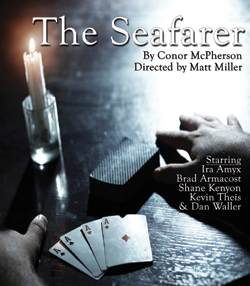 The Seafarer is a Christmas play by an Irish playwright. Given that, you know that there may not be a happy ending or a lot of tra-la-la. And there most likely will be consumption of alcohol. I hate stereotypes, but there you are. The Seafarer, by Conor McPherson, is a terrific production by Seanachai Theatre Company at The Den Theatre on Milwaukee Avenue. My Gapers Block review gives all the details. The play is running until January 5. I gave it a “highly recommended” for theatreinchicago.com, as did all the other reviewers.
That website, theatreinchicago.com, is a great resource for theatergoers. It compiles reviews of all current plays on Chicago, along with their ratings. Go to the website and click on Review Roundup in the left-hand column.
An Inspector Calls at Remy Bumppo Theatre seems at first like a smart drawing-room comedy. But J.B. Priestley’s play, written in 1945 for an English audience, soon turns into a tale about the 99 percent vs. the 1 percent. The 1 percent is the Birling family, wealthy through their manufacturing business. The 99 percent is represented by a young working woman who comes to a sad ending through actions, ultimately, taken by all the family members. (That’s a bit of a spoiler, so forget I said it.)
The Remy Bumppo cast is excellent and the production very gripping. Nick Sandys, as the mysterious inspector, plays the role very coolly. Calmly and without bluster, he terrorizes the Birlings in their dining room. Priestley was raised in a socialist family and was a writer of social conscience. As David Darlow says in his director’s note, Priestley “calls out to us to be accountable and responsible for our behavior and actions.” The play runs through January 12 in the upstairs mainstage at the Greenhouse Theater Center on Lincoln Ave.
Linguistic whine. Why can’t theater/theatre companies settle on one spelling, preferably the standard American spelling of theater, rather than the pretentious Anglified theatre. When I’m writing reviews for Gapers Block, it makes me crazy, going back and forth between the spellings, depending on whether I’m naming a theater company that persists in using that spelling (see above) or using the word generically as part of a sentence. Grrrrr.
Art with a message

Small Change by Richard Laurent; image courtesy of the curator.
The Art of Influence: Breaking Criminal Traditions. There’s a very interesting exhibit of art with a message at the IIT Chicago-Kent College of law, 565 W Adams St. I know, that’s an unusual place for an art exhibit, but it works. The exhibit is made up of 38 works in various media by 13 local and regional artists and represents metaphorically — in ways both beautiful and horrifying — the crimes perpetrated on women and girls in countries where those actions are considered part of the culture, rather than crimes. The purpose of the exhibit is to make an impact on those who may be influential in the future to help change the legal processes in those countries. My review for Gapers Block gives all the details and shows four images that illustrate the range of the work.
Films, live and DVDd
Blue Is the Warmest Color, directed by Abdellatif Kechiche. This controversial film about a young woman and her older woman lover in Lille, France, is beautifully filmed and to my mind, too long at 3 hours plus. The much-discussed sex scenes are quite beautiful and almost painterly in their composition. Most importantly, the film raises issues of male viewpoint, social class and life choice between the two lovers and their friends and families; those issues are fruitful discussion topics. The film is currently on view at local theaters.
A Constant Forge: The Life and Art of John Cassavetes (DVD). This very thorough documentary of Cassavetes’ work is well worth your time as an illustration of the auteur approach to independent filmmaking. It’s almost 3.5 hours long and no, this film wasn’t too long, although I did watch it in two sittings. It was made in 2000, about 11 years after his death at 59. The doc includes interviews with many of the actors he worked with: his wife Gena Rowland, Peter Falk, Ben Gazzara, Jon Voight and Seymour Cassel. The actors and others talked about his creativity, his honesty, and his lack of concern about making money. Many long film clips and film of scenes during the shooting process really bring Cassavetes’ approach to life.
My favorite Cassavetes quote: A reporter asks him if he’ll ever make a musical. He says he really wants to make only one musical, Dostoyevsky’s Crime and Punishment. My kind of guy.
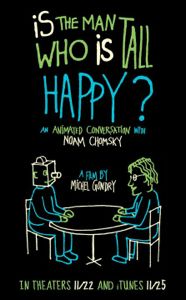 Is the Man Who Is Tall Happy? An Animated Conversation with Noam Chomsky. Yes, I said Noam Chomsky. But this is the avuncular linguistics professor, not the radical political activist (though just a hint of that Chomsky shows occasionally). French director Michel Gondry (Eternal Sunshine of the Spotless Mind) created this animated documentary from interviews with Chomsky. He animates and illustrates Chomsky’s ideas by scrawling clever cartoons and charts.
The film title is taken from a sentence that Chomsky diagrams near the end of the film to show how children learn to use language.
The film runs at the Gene Siskel Film Center through tomorrow. I’ll watch it again on DVD when it’s available. There are places where I wanted to say, “Wait, let me replay that last bit because I didn’t quite get it.”
My coming attractions for this week
Inside Llewyn Davis. This is the Coen brothers film about the early years of the folk movement in Greenwich Village in the 1950s. It opens here Friday and I’ll be there. In addition to the film, Showtime network has been running a concert with a setlist of some of the music from the film, performed by other musicians. There’s also a Showtime making-of film called Inside Inside Llewyn Davis. And there’s the soundtrack on CD or download. I’ll review this film here soon.
Blood on the Cat’s Neck by Rainer Werner Fassbinder at Trap Door Theatre on Cortland. The always provocative and entertaining Trap Door group has been getting mixed reviews for this play; it’s Jeff recommended, however.
Burning Bluebeard by Jay Torrence presented by The Ruffians at Theater Wit. The play is about the tragic 1903 Iroquois Theatre fire in Chicago. This is a theater company I have not seen before and I’m looking forward to it.
And finally, I’ve gone another whole week without writing about Bruce Springsteen. But he has a new album coming out in January. You can be sure I’ll make up for my apparent neglect.
A/C report: An Iliad, some Tiffany + goodbye Lou
Posted: November 22, 2013 Filed under: Art & architecture, Music, Theater | Tags: An Iliad, Court Theatre, Driehaus Museum, Lou Reed, Tiffany 1 CommentA/C. That’s art and culture in Chicago. Your intrepid blogger is here to report on two items that you should consider adding to your calendar. Plus: what a way to say goodbye! To Lou Reed, the legendary punk rock musician who died last month.
An Iliad at Court Theatre: The poet reports
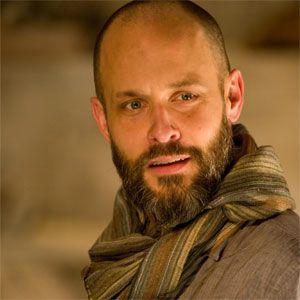
Photo courtesy Court Theatre
Court Theatre has remounted An Iliad two years after it was first produced. I was blown away the first time by the power of the story, the language and the acting. Timothy Peter Kane, a very talented Chicago actor, performs a tour de force one-man show as the poet or observer of this classic blood and glory story set at the end of the Trojan War.
The remounting, which runs until December 14, is perhaps even more powerful than the original. Is it because we all, including Kane, have seen two more years of the endless US war in the Middle East? He seems to be sadder, more traumatized and distraught by the many deaths around him. The single most gripping scene is his three-minute soliloquy of wars through history, beginning with the conquest of Sumer and ending, this year, with Libya and Syria. I was in tears at the end of it. Here’s a clip of that speech from the 2011 play.
The play, adapted from the Robert Fagles translation of Homer’s long poem, was written by Denis O’Hare, another masterful Chicago actor, and Lisa Peterson, a director at the New York Theatre Workshop.
An extravaganza of Tiffany at the Driehaus Museum

Photo by Nancy Bishop
Richard Driehaus, a successful investment banker, is an important supporter of the arts and historic preservation in Chicago. He purchased the Samuel Nickerson mansion (1883, Burling & Whitehouse, architects) at 40 E Erie St and restored it to its ornately decorated, Gilded Age form. In 2007, it was opened as the Richard H Driehaus Museum of Decorative Arts and it’s worth visiting on its own, but even more so now. Sixty pieces from Driehaus’ large collection of works by Louis Comfort Tiffany are on exhibit on the second floor of the museum until June 29, 2014. The museum is open Tuesday through Sunday until 5pm and you can take a docent-led tour or meander through on your own.
I went with three of my ex-CAF docent friends and, as always, we create our own tour. The four of us have a combined treasure of knowledge on architecture, art and design and we love doing these tours collaboratively.
The photo at left is one of the Tiffany windows, beautifully displayed, in the exhibit.
Goodbye Lou
What a great way to say farewell to an iconic musician like Lou Reed. Just his music, played 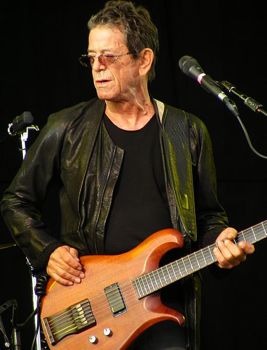 at the appropriate volume (that is, loud) in a grove of trees near Lincoln Center. It was one of those days I wish I lived in New York…or at least had the wherewithal to fly there on a whim for a landmark event.
Lou Reed, known as a solo musician, guitarist, songwriter and founder of the Velvet Underground, the preeminent punk rock group, died at 71 on October 27.
See Greg Mitchell’s site here for three videos from the event. My favorite is “Walk on the Wild Side.” It’s wonderful to see people communing over music, many singing along, others dancing, all paying tribute to Reed’s music.
The photo is Lou Reed performing at the Hop Farm Music Festival on Saturday, July 2, 2011, courtesy of Wikimedia Commons.
September, musical birthdays…and nostalgia
Posted: October 3, 2013 Filed under: Design, Music, People | Tags: Berwyn bungalows, Bruce Springsteen, John Coltrane, Leonard Cohen 7 Comments


September. It was a lovely month. Usually it means no more hot weather…for which I shout hurray. On a Sunday morning walk, I celebrated the charms of North Avenue beach by hanging out for a while at the Chess Pavilion. It’s a beautiful refuge from the sun and my favorite place to take a break on the lakefront. The Chess Pavilion was built in 1957, designed by architect Maurice Webster. Sculptor Boris Gilbertson carved the stone chess pieces and the incised chess figures.

The Man–at 64
Happy birthday, Bruce
September is also the month of Bruce Springsteen’s birthday (the 23rd), which gives me an excuse to post a photo of him looking great at whatever his age is. This year it’s 64. Here’s a photo of him on the beach in Rio de Janeiro, where he played his first South American concerts in many years.
Happy birthday, Leonard
And it’s the month of other important birthdays. Like Leonard Cohen (the 21st), who at 79 is still touring, looking fabulous and sounding like his usual charming, gravel-voiced self. He’s sort of a lounge lizard version of Tom Waits. Leonard is still touring on his latest album, Old Ideas. He’ll be in Australia and New Zealand in November. I reviewed his March concert at the Chicago Theater.
Remembering Trane
And it’s also the month to remember the late great John Coltrane, who shares Bruce’s birthday, September 23. If Trane were alive today, he would be 87. His death at the age of 40 was a tragedy and an immense loss to the music world. He was and is today enormously influential to young musicians. He was beginning to experiment with avant-garde jazz (as in his spiritual album A Love Supreme) as well as with eastern religions.
Trane’s biography and legacy are complex. He’s been treated as a religious figure by some African-American churches; there is at least one film about the St. John Coltrane African Orthodox Church in San Francisco; and a church in New Jersey includes him on a list of African-American saints. You’ll find some beautiful images and a great Coltrane quote on that church page. And they hold services every Sunday with the Coltrane liturgy.
Bungalow nostalgia

My house, a very fine house
Before going on a Berwyn bungalow tour last week, I was exploring far northwest side real estate to see how bungalows are currently valued. (They are real values, solidly built small houses in pleasant older neighborhoods.) I decided to search for the house where I grew up and was pleased to find a great photo of it from the time of its last sale in 2009. The house is on Rutherford Avenue in the Montclare neighborhood, near the intersection of Grand and Oak Park avenues. My parents bought the house in 1938 and lived there for about 30 years.
The standard bungalows in Berwyn all have similar layouts. Small front hall, living room, dining room, kitchen, half bath and sometimes a small bedroom on the first floor. The second floor typically has sloped ceilings in the two bedrooms plus one full bath. These are small houses, typically 1200-1500 square feet. My parents’ house, even though it didn’t have a bungalow façade, had exactly that inside layout. The developer on that block decided to spiff up the exteriors by applying “Tudor” façades. I could draw the floor plan from memory this minute.
“Super-bungalows,” are larger and have different space layouts, more bedrooms and baths. We saw a few of those in Berwyn Sunday. The tour is a self-guided walking tour to seven or eight houses, with docents stationed at each house to guide visitors through the interiors. It’s an annual event, so put it on your calendar for September 2014. I recommend it highly.
How I spent my week…theater, art, music
Posted: September 25, 2013 Filed under: Art & architecture, Music, Rock and roll, Theater | Tags: Athenaeum Theatre, Interrobang Theatre, Museum of Contemporary Art, Steve Earle, the Bauhaus, The Vic, Ukrainian Institute of Modern Art 1 CommentA great theater experience, plus some cartoon art and memories of the Bauhaus. The finishing touch was a Steve Earle concert. Am I lucky to live in Chicago or what?
Terminus at Interrobang Theatre Project
Mark O’Rowe is one of the new generation of Irish playwrights whose work was first seen in the 1990s. In Terminus, being presented by Interrobang Theatre Project, he displays his fascination with language and his passion for words. Terminus isn’t so much a play as a series of stories, intertwined in monologues by three characters, known only as A, B and C. Their stories, set in the streets of Dublin, begin separately and gradually become more connected, until they are finally merged in a glorious fantasy of blood, sweat, tears and sex. That’s how my review of Terminus begins. It’s a terrific play with thrilling language. Truly a treat to listen to. I recommend it highly.
Modern Cartoonist: Daniel Clowes exhibit at MCA

Daniel Clowes is a well-known graphic novelist, who has published nearly 50 books and magazines. Modern Cartoonist: The Art of Daniel Clowes is his current exhibit at the Museum of Contemporary Art, which runs until October 13. The show is beautifully designed and curated and has many lovely little graphic surprises.
It was very interesting to see the progression and process of Clowes’ work, sometimes from sketch through inking and printing. For some publications, a series of pen and ink on tissue pages was shown. Since so much art today is created on the computer, it’s fascinating to see so many of Clowes’ pages drawn by hand on paper.
Image: Collection of Daniel Clowes. Courtesy of the artist and Oakland Museum of California
Chicago’s Bauhaus Legacy at the Ukrainian Institute of Modern Art
 It’s been years since I visited this little gem of a museum on Chicago Avenue in Ukrainian Village. Do not think it’s only about Ukrainian art; it’s really a center for modern and contemporary art. The Bauhaus exhibit is fabulous and it’s open through this Sunday, September 29. If you are interested in modernism, you don’t want to miss it.
The legacy starts with Lazslo Moholy-Nagy moving to Chicago to establish the US version of the famous German citadel of design. The Bauhaus’ existence was threatened in the 1930s by Hitler’s aversion to modern art. Moholy-Nagy was followed by other artists and designers who moved to Chicago (including Mies van der Rohe). The New Bauhaus went through many name changes and locations and in 1949 became part of the IIT Institute of Design.
The exhibit includes about 150 pieces by 90 artists and designers. Work includes painting, sculpture, photography, architecture plans, furniture and design pieces. A lovely example of the latter is a bar of Dove soap, designed by three students in 1952 as part of a special project funded by Lever Brothers. Dove still uses the same shape for its soap bars. (The original carved wooden prototype is on show at the Chicago History Museum.)
In addition to the main exhibit in the west gallery, the east gallery includes Bauhaus work from the institute’s permanent collection. There’s also a very interesting wall that shows the birth and development of the Ukrainian institute.
I’m going to write a feature on the institute for Gapers Block and I’ll provide a link to it here when I do.
Steve Earle at the Vic 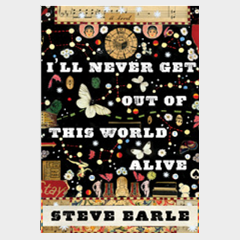
Steve Earle and the Dukes played a great concert at the Vic Saturday. The setlist included many of his fine old songs as well as tracks from his new album, The Low Highway. His band is made up of four musicians: a drummer, upright bass player, lead guitarist and fiddler/mandolin player. Earle plays a number of stringed instruments himself (guitar, mandolin, banjo) and sings lead vocals. Many of his songs (and his occasional patter between songs) involve social commentary. Here are a few lines from the song “The Low Highway.”
Heard an old man grumble and a young girl cry
A brick wall crumble and the white dove fly
A cry for justice and a cry for peace
The voice of reason and the roar of the beast
And every mile was a prayer I prayed
As I rolled down the low highway.
His novel–I’ll Never Get Out of This World Alive–is on my reading list and coming up soon.
Theater update: Three you can see
Posted: September 16, 2013 Filed under: Movies, Music, Theater | Tags: American Blues Theater, Hank Williams, Shattered Globe Theatre, Sideshow Theatre, Theater Wit 3 CommentsIt’s theater season again and I have three new reviews that you’ll be interested in. Plus a special tip on what to see in the future.
Theater picks
9 Circles at Sideshow Theatre

From @HistoryinPix
9 Circles takes us through the depths of Dante’s Inferno by telling the story of an Iraq war veteran who is accused of a terrible crime. The play presents a series of two-person scenes between the ex-soldier and a series of helpful or surreal professionals. The story moves from accusation to trial to execution. The play is gripping, intense and discussion-provoking. It’s a terrific performance by Andrew Goetten, who plays the ex-soldier, and by the other actors in multiple roles. You can read my Gapers Block review here.
The photo at left is the one I reference in the first paragraph of the review. The photo is from the @historyinpix Twitter page and titled “Soldier in Vietnam, 1965.” Click to enlarge it and read what the soldier has written on his helmet.
Hank Williams: Lost Highway at American Blues Theater
This is a lively musical biography but of course the underlying story is tragic. Hank Williams was a brilliant country-blues singer/songwriter in the 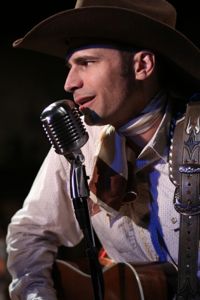 1940s and early 1950s. He influenced many performers who followed him and the play suggests how he was a link to the African-American blues musicians of the period. His life was cut short at the age of 29 because of his addictions to alcohol and prescription drugs. The ABT play does a good job of telling both the tragic story and making you happy to hear a healthy setlist of Williams’ songs. The band (Williams’ Drifting Cowboys) is made up of some excellent Chicago musicians and Matthew Brumlow as Hank comes close to channeling his image, his voice and musical style. Read my Gapers Block review here.
Photo by Johnny Knight; courtesy of American Blues Theater.
Other People’s Money at Shattered Globe Theatre
This is a witty and fast-moving play about corporate raiders in the late 1980s. You remember them, don’t you? Michael Milken, Victor Posner, Carl Icahn? The financial crisis of five years ago this month has brought other corporate names to the forefront. Jamie Dimon, Richard Fuld and Hank Paulson; companies like Lehmann Brothers, Bear Stearns and AIG. So the raiders and their takeovers seem a bit dated now. Nevertheless, this is an interesting and entertaining play and I recommend it. Ben Werling is terrific as Larry the Liquidator. Think of it, as I said in my Gapers Block review, as a drawing room comedy of the 1980s.
NT Live in HD
The Audience, a National Theater Live encore presentation
 The National Theatre of London broadcasts live performances of some of its productions to theaters around the world, similar to the Metropolitan Opera Live in HD broadcasts. NT Live broadcasts a live performance and several encores at the two Northwestern University theaters in Evanston, at the Music Box in Chicago and Renaissance Place in Highland Park.
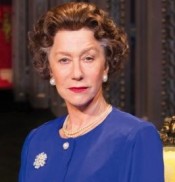
Last week we saw the final broadcast of the commercial, West End production of The Audience by Peter Morgan. Helen Mirren stars as Elizabeth II of England and some talented actors as her various prime ministers over the years. The play is a series of scenes, in random, not chronological, order, in which Mirren ages or reverses her age with very quick changes of wig and costume. It’s brilliantly acted and riveting as it takes the viewers through historical events of Elizabeth’s long career. Her first audience was with Winston Churchill in 1952 and the latest with David Cameron in 2012.
Future NT Live productions this season are three Shakespearean tragedies: Othello, Hamlet and Coriolanus.
Mirren as Queen Elizabeth; photo copyright National Theatre Live.
Remembering Chile’s 9/11
Posted: September 13, 2013 Filed under: Movies, Music, Politics, Theater | Tags: Ariel Dorfman, Bruce Springsteen, Victor Jara, Victory Gardens Theatre 8 CommentsRemembering 9/11/73, the day that changed everything–in Chile
We observed the 12th anniversary of the 9/11 attacks on the World Trade Center this week. News channels had at least one story on the memorial observances. MSNBC relived the entire experience, replaying the NBC news footage from that fateful morning, minute by minute.
 In Santiago, Chile, they remembered their own 9/11, which had an even more profound impact on Chilean society. The Christian Science Monitor reported that “President Sebastian Pinera marked the 40th anniversary of the military coup that overthrew Salvador Allende on Wednesday by urging Chileans to heal from—but never forget—the events of Sept. 11, 1973, that launched a bloody 17-year dictatorship.” Allende was a democratically elected socialist who launched the “Chilean path to socialism.” He nationalized the copper industry (mostly owned by US companies) and used the money to improve education and health care for his people. The US–meaning the CIA–found a way to sow chaos and provoke the military coup. Chile’s national history museum opened an exhibit this week to mark the anniversary.
Chilean writer Ariel Dorfman had a poignant article in the September 8 New York Times, titled “9/11: The Day Everything Changed, in Chile.” He and his friend Claudio Jimeno were among four advisers to President Allende when the government was under threat of a military takeover by the forces of General Augusto Pinochet. The advisers rotated nights at La Moneda, the presidential palace, to keep watch and alert the leader to any emergency. Dorfman was to keep watch on Monday night, September 10, but changed nights with his friend because of a family obligation. The rest is history, of course. Jimeno was taken prisoner in the coup, tortured and became one of the desaparecidos.
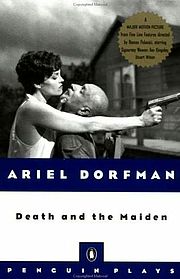
Dorfman is author of the novel and play Death of the Maiden, which has been dramatized on screen as well as stage. Victory Gardens Theatre will mount a production of the play in June 2014. The 1994 film starred Sigourney Weaver as the activist who believed she had been raped and tortured by a doctor who befriends her husband. The events could have happened in most any country under siege today, but it was Chile. Chile after 9/11.
Bruce Springsteen honors Victor Jara, Chilean hero

image courtesy backstreets.com
Bruce and the E Street Band performed in Santiago, Chile, on September 11, their first show in South America since the Amnesty International Human Rights Now! tour in 1988. Bruce took the opportunity to honor Victor Jara, Chilean poet, activist and Allende supporter, by performing his song “Manifiesto” during the encore set. Jara was tortured and killed after the 1973 coup.
Film odysseys, digital and analog
Posted: September 8, 2013 Filed under: Digital life, Movies, Music | Tags: Dave Grohl, Sound City 1 CommentHere are my strong recommendations on three films that illustrate the history of film and music and how technology has affected both art forms. All three films are fascinating and deserve our attention if we care about the popular culture that affects our lives.
The Story of Film: An Odyssey
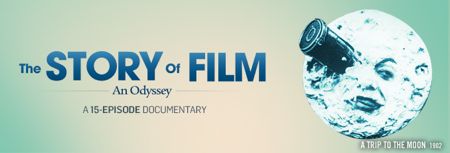 A new series on the history of film (no yawns, please) just started running on cable channel TCM. It’s based on a 15-part, 900-minute documentary series titled The Story of Film: An Odyssey, created by Mark Cousins, a film critic from Northern Island and author of a 2004 book of the same title. The first chapter ran last Monday night (September 2) on TCM and will continue for the next 14 Mondays, at 9pm CT. TCM creates a whole evening around the theme of that week’s episode, showing some of the films referenced before and after The Story of Film episode. You can see the list of films referenced in each episode here. The image in the film poster above is from the 1902 George Méliès film, A Trip to the Moon. (You may remember Méliès as the owner of the toy shop in the recent film Hugo.)
The first episode covering 1895 to 1918 starts with early moving pictures made by Thomas Edison in New Jersey and the Lumière brothers in Lyon, France. Cousins pays attention to changes in film editing and the evolution of movie theaters from nickelodeons to grand movie palaces of Egyptian, art deco and other exotic decor.
As AO Scott wrote when the series was released last year: “It is global in scope, attentive to the political implications of film, generally director-centric and closely attuned to matters of form. There are interviews with academics and filmmakers, visits to cinematic landmarks and a wealth of wonderful clips.”
Watch the trailer.
Side by Side
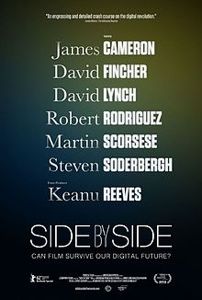 Are you a movie junkie like me who loves the technical side as well as the creative? Then you will appreciate the 2012 documentary, Side by Side, which looks at changes in film technology and focuses on the switch from photochemical film to digital projection. That technology revolution is highly controversial in the movie business, although most theaters have switched to digital completely. (The Gene Siskel Film Center still shows both formats and usually indicates format in its listings.)
Side by Side shows the history and workflow of both kinds of filmmaking and illustrates what is gained and lost in both processes. Keanu Reeves is host and interviews directors and cinematographers about how the technology affects their filmmaking.
The film points out that digital production democratizes the filmmaking process because a filmmaker can go out alone with a single piece of equipment. A digital camera does not require the elaborate equipment and crew that celluloid film does. And it makes every film ever made available for instant viewing. That’s how I can watch old foreign and indie films now on DVD or streaming.
But many directors are saddened or angry by the change and insist the color and image richness of celluloid is lost in digital technology.
Sound City: Live sound, slain by technology
 The 2013 documentary Sound City tells much the same story about the music business. The 108-minute film, directed by musician Dave Grohl (Nirvana, Foo Fighters), tells the story of the legendary Los Angeles recording studio where bands like Tom Petty and the Heartbreakers, Nirvana, Neil Young, Johnny Cash, John Fogerty, Nine Inch Nails, Rage Against the Machine, Fleetwood Mac and Rick Springfield made great music.
Sound City never really joined the digital revolution and continued its tape-based recording in a venue where every room had its own sound quality. But once the digital revolution began, its demise was in sight. Many musicians still prefer the richer sound of tape-based, analog recording. But Sound City and the other great recording studios have disappeared. Grohl bought the original Neve soundboard from Sound City and has it installed in his own Studio 606.
This is a fine documentary, telling the story of a landmark musical institution, its impact on rock and roll, and its demise, slain by technology. Drummer/guitarist Grohl proves himself to be a filmmaker too.
The film will be shown again a few times this week on Palladia or VH1 Classic. And you can buy it from iTunes or on DVD.
This weekend: Chicago
Posted: August 23, 2013 Filed under: Art & architecture, Chicago, Food, Movies, Music | Tags: Bayard Rustin, Bruce Springsteen 1 CommentSummer in Chicago is drawing to an end, but there are great outdoor and indoor activities in my city this weekend.
Festa Italiana
 Summer is the time for street and neighborhood festivals. This is one of my favorites. It’s in little Italy, the old Italian neighborhood near the UIC campus. Festa Italiana runs through Sunday on Taylor Street between Racine and Ashland. There’s food from all the great Taylor Street restaurants and entertainment ranging from Italian-surnamed crooners to new bands such as This Must Be the Band, Acoustic Generation and my favorite band name, Inbound Kennedy.
The highlight of the festival, for some, will be the meatball-eating contest. Personally, I’m grossed out by food-gorging displays. The winner will be the person who eats eight meatball-slider sandwiches in two minutes. (That is disgusting.)
Lill Street Art Festival
The Lill Street Art Center (which started out on Lill Street) is celebrating its 10th year in its Ravenswood location, at the corner of Ravenswood and Montrose. The opening reception tonight will celebrate Best Served Hot: Ceramics for the Coffee Ritual, cosponsored by Intelligentsia Coffee. Saturday will include an open house and block party. Lill Street Art Center offers classes, a gallery and studio space for artists in ceramics, metalsmithing and jewelry, painting and drawing, printmaking, textiles, glass, digital arts and photography. I treasure a few pieces of ceramic jewelry from Lill Street.
Movies
 In honor of the 50th anniversary of the 1963 March on Washington and Martin Luther King’s “I have a dream” speech, you should watch the documentary about Bayard Rustin, the strategist and activist who organized the march. He was a key adviser to MLK until he was asked to leave (or was pushed out) because of his political past (socialist) and sexual orientation (gay). The film is Brother Outsider (available on DVD and streaming). It’s an excellent view of Rustin’s background, leadership and his activist life after 1963. President Obama will award a Presidential Medal of Freedom to Rustin posthumously. It’s bloody well time.
The Huffington Post has a good article on Rustin by Peter Dreier, E.P. Clapp Distinguished Professor of Politics at Occidental College.
Anna Karenina, the gorgeous Joe Wright version of Tolstoy’s tragic novel with a script by Tom Stoppard, is showing occasionally on HBO right now. If you haven’t seen it, do. It’s creatively staged–and staged is the right word because much of it is set in an old theater. The railroad scenes, as ice-encased trains arrive in Moscow or St. Petersburg, are not to be missed.
Eats
Have you been to Big & Little’s? It’s a fine place to stop for a fish taco, a fried oyster or shrimp po’ boy (my favorite) and many varieties of burger and sandwich choices. Also foie gras & fries or truffle fries. Yum. Delish. Not fancy. Big & Little’s is at 860 N Orleans, just north of Chicago Avenue. There’s a tiny parking lot and you can sit inside or outside (as I did today) or carry out. Cash only. It’s been featured on the Food Network’s Triple-D (Diners, Drive-Ins and Dives) and on Chicago’s Best on WGN and on Check Please on WTTW.
Wish I was at the Jersey Shore
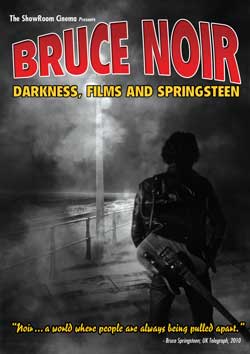 I often wish that and I occasionally go to that neighborhood we call Springsteenville: Freehold, Asbury Park and West Long Branch, New Jersey. This is one of those weekends. There’s a Bruce Noir Film Festival in Asbury Park. The five films being shown are those he’s mentioned in interviews or in songs.
Since I can’t be there, I’ll find another way to watch them. The films are:
- — Gun Crazy (1950; on which Springsteen based his song “Highway 29” from the Nebraska album)
— Badlands (1973; based on the Charles Starkweather murder spree story, which Springsteen tells in the song “Nebraska”)
— Out of the Past (1947; a Robert Mitchum film about a private eye)
— Atlantic City (1980; a Louis Malle film with script by playwright John Guare, starring Burt Lancaster and Susan Sarandon)
— Thunder Road (1958; Robert Mitchum plays a bootlegger trying to save the family moonshine business from big-city gangsters; lots of great road footage as Mitchum drives a “tanker,” a car modified to carry alcohol in the fuel tank)
 nancy bishop's journal