A tale of three cities: Mostly Manhattan
Posted: July 31, 2013 Filed under: Art & architecture, Punk rock, Theater | Tags: Irish Repertory Theatre, Movies, theater 3 CommentsNew York was fascinating as always, despite being beastly hot. My favorite thing about New York is always tramping uptown and downtown, east side and west side. Unfortunately, since temps were in the high 90s, my tramping was focused on finding cool buildings for respite or walk-thrus. In my next tale, I visited friends in Connecticut and I finished up with a family wedding in Brooklyn in the neighborhood known as DUMBO (Down Under the Manhattan Bridge Overpass).
Manhattan
First we’ll take Manhattan, as Leonard Cohen sang (or sort of sang). The highlight was my visit to the Metropolitan Museum of Art and its special exhibit on Punk: Chaos to Couture, which runs until August 14. I also saw two very good plays – one at Irish Repertory in Chelsea, my regular favorite New York theater, and the other a Richard Greenberg drama on Broadway.
 Punk: Chaos to Couture was the Met’s 2013 Costume Institute exhibition and it celebrates both the look that punk musicians adopted in the 1970s in the UK and the US and the impact it had on couture (meaning clothes-not-going-to-be-worn-by-the-average-woman). Original punk clothing was shown, especially that worn by some performers and some designed by Vivienne Westwood for her London punk boutique. Couture by name designers of that period and later decades is also shown. The exhibit was visually and aurally appropriate with period music and videos.
The DIY (do-it-yourself) nature of the punk scene was celebrated in the organization of the exhibit. The section DIY Hardware displayed the use of safety pins and metal ball chains in both punk and couture looks. DIY Bricolage used trash materials in costuming. Here we had the use of bottle tops, plate shards, plastic shopping bags and Tyvek envelopes to create wearable garments. Best of all, black trash bags were shredded or chopped to make glamorous gowns. Really. They were couture and I would wear one of them.
Most of the couture seemed fakey to me, especially that from the last two decades. The use of safety pins or other metal and shredded and torn fabric doesn’t make sense outside of its musical context.
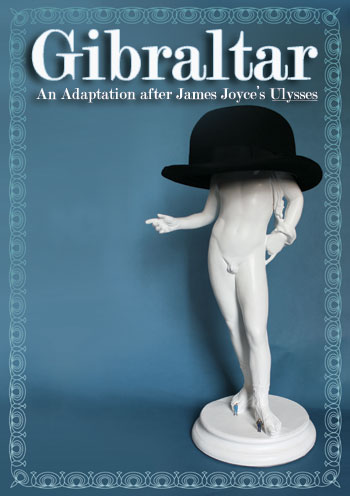 Gibraltar. At Irish Rep, the two-character play Gibraltar, “an adaptation after James Joyce’s Ulysses,” was being presented in its tiny basement studio. I felt like I was at home in a Chicago storefront venue. The play was written and performed by Patrick Fitzgerald, along with Cara Seymour as Molly Bloom, and directed by Terry Kinney, one of the Steppenwolf founders. It’s beautifully done, retaining Joyce’s language, and leading us through many of Leopold Bloom’s errands and encounters on Bloomsday. (I was a month or so late for Bloomsday.) It ends with Molly’s monologue, usually called the Eight Beatitudes. Beautiful lighting and sound design make this scene magical.
The Assembled Parties by Richard Greenberg is a family affair set in a large old Central Park West apartment in two acts on two Christmas Days, 1980 and 2000. Judith Light and Jessica Hecht give fine performances as sisters-in-law in a family in decline. The dialogue is charming, funny and vivid and we glory in their lives in act one and grieve for them in act two. It’s a terrific play. (Greenberg also wrote Take Me Out, The Violet Hour and Three Days of Rain.) The revolving set displays five rooms of the apartment, designed as only Santo LoQuasto can furnish a room.
Stamford
Stamford was a short visit, punctuated by shopping (I learned that Stew Leonard’s is a destination, not a supermarket), eating, visiting, exploring Stamford and Greenwich, and going to a movie. We saw The Way Way Back with Steve Carell and Toni Collette. Carell is Collette’s obnoxious boyfriend, a character you love to hate. The movie is funny and sweet, one of those coming-of-age stories about the Collette character’s 14-year-old son. Sam Rockwell (remember him in Seven Psychopaths?), a very talented actor, manages to give it an edge and keep it from lapsing over into sentimentality. His performance is the treat of the movie.
Brooklyn
 Short story. Family wedding at a lovely old temple with a lively reception in DUMBO. The bride and groom were darling and it was nice to see friends and relatives. Just before we reached the reception, we passed an intersection that offered a fabulous view of the bridges (Brooklyn and Manhattan) and we walked back to take lots of photos. I took this one with the Empire State Building playing a cameo in the distance.
Storefront theaters shine in Chicago
Posted: July 24, 2013 Filed under: Chicago, Punk rock, Theater | Tags: Bailiwick Chicago, Broken Nose Theatre, CBGB, Jackalope Theatre, Nelson Algren 1 CommentI’ve been seeing a lot of theater lately and I wanted to post my last three reviews for Gapers Block. Two of these shows close in the next week, so hurry up and see them. We have an unbelievable wealth of theater talent in Chicago. These plays are worth your time – and these small theaters will appreciate your support.
My next post will get out of Chicago and report on my visit to New York, featuring one off- and one on-Broadway show.
Mahal at Bailiwick Chicago: It’s a Family Affair
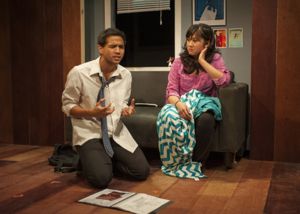
Mahal by Danny Bernardo is a story about a Chicago Filipino family, the first play with that ethnic focus, to my knowledge. Bailiwick Chicago is presenting it at Stage 773 at 1225 W Belmont, formerly the Theater Building. The Stage 773 owners have upgraded the space, especially the entrance and lobby area, to be very attractive and contemporary—a great improvement.
 My review begins:
“Mahal is a family story. A Filipino family with strong roots in the Philippines adjusts to life, love and loss in its new country. The family members – father, two sons and a daughter – are each recovering in their own way from the recent death of their mother. (Some family members call the mother’s phone number to hear her voicemail greeting – and leave messages for her until the mailbox fills up.)”
Bailiwick Chicago presents Mahal until August 2 at Stage 773, 1225 W Belmont Ave. Read the review here. Photo of Kevin Keyes and Jillian Jocson by Michael Brosilow.
The Casuals at Jackalope Theatre: Exploring Life in the Atomic Era
The Casuals is set in 1955 Nevada and involves personal as well as political issues. It’s a new play by Jackalope Theatre Company with script by Chance Bone and Andrew Burden Swanson, and direction by Jonathan Berry. Here’s how my review starts:
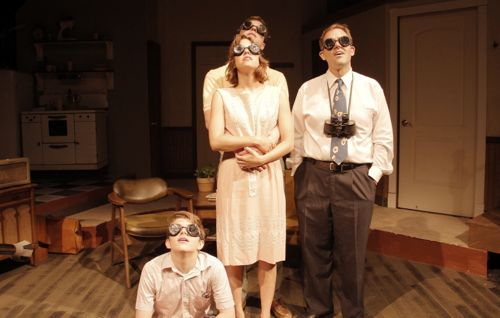 “Some things about The Casuals might make you uncomfortable–nuclear testing, for instance. Government agencies that hide the truth (and insist you don’t ask questions). Stories that may be lies or truth. A mother who tells her son how his father died a hero. An uncle who tells his nephew’s wife how his brother really died.”
The Casuals runs until July 28 at DCASE Storefront Theater, 66 E Randolph St. Tickets are cheap: $10-$15.
Read the review here. Photo by Alex Hand: Watching an atomic test.
Rooms: A Rock Romance at Broken Nose Theatre
I hardly ever get to indulge my love for rock and roll at the theater. So I was very excited to get to review this show, which includes a scene set at CBGB, the famous New York rock club. Rooms features a talented live band and some straight-up rock as well as a little punk. My review starts this way:
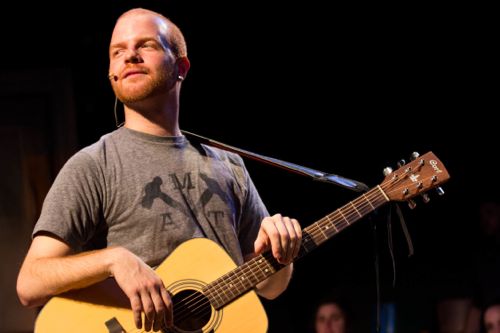 “The sign outside the theater says, “This is a rock musical. It will be loud.” And it starts loud with a four-piece rock band playing preshow music including the classic ‘Seven Nights to Rock.’
“Rooms: A Rock Romance is a fairly traditional musical, punctuated by some great rock and punk rock songs performed on stage with a band. It is, at its heart, a love story about two people with different visions of life. Monica (Hillary Marren) wants to be a rock star, to travel and perform all over the world and Ian (Matt Deitchman) is a musician who prefers to stay at home in his own room with his guitar.”
Broken Nose Theatre will present Rooms until August 11 at the Collaboraction Pentagon space in the Flat Iron Arts Building, 1579 N. Milwaukee Ave.
Read my review here. Photo of Matt Deitchman by Taryn Goodge.
Broken Nose Theatre, by the way, takes its name from the way Nelson Algren describes my favorite city in his book, Chicago: City on the Make.
“Yet once you’ve come to be part of this particular patch, you’ll never love another. Like loving a woman with a broken nose, you may well find lovelier lovelies. But never a lovely so real.”
Happy anniversary to me
Posted: July 18, 2013 Filed under: Rock and roll | Tags: Bruce Springsteen 8 CommentsToday is the one-year anniversary of Nancy Bishop’s Journal. When I started this a year ago, I had no idea I would write so prolifically or find it so invigorating to do so. I’ve written 65 posts, most of them op-ed column length of 700-800 words. Topics have been divided fairly evenly among theater, movies and music, although I’ve been posting more theater reviews lately, since I’m also contributing to Gapers Block, the Chicago website.
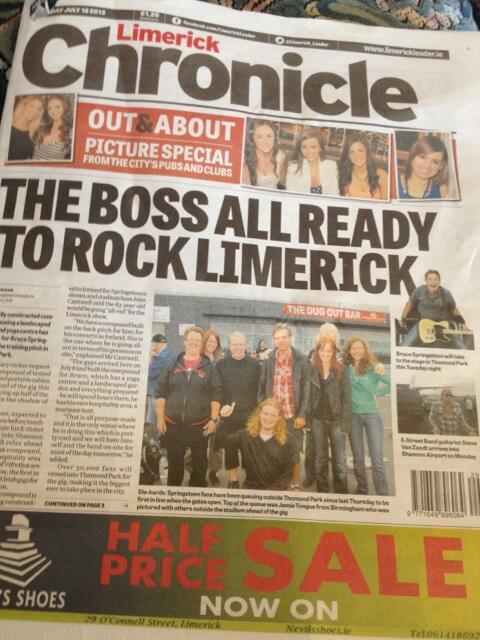 Speaking of music, I haven’t written about Bruce Springsteen lately. (How can that be?) So I have a special anniversary treat for you. Bruce and the E Street Band are nearing the end of their European tour. His fans follow setlists on Twitter every night in lieu of being there to hear him live. Last night they played in Limerick and the Limerick Chronicle celebrated that as front-page news. Bruce’s heritage is Irish and Italian, so he has always been very popular in those countries. (Thanks to kbutler333 Kathleen Butler for the Twitter pic.)
When he played in Rome last Thursday night, his fans got a special treat and I’m sharing it with you to celebrate my anniversary. The song is “New York City Serenade,” a Bruce rarity that thrills his hard-core fans. This really isn’t just for Springsteen fans. It’s a beautiful ballad that starts with a great piano intro by Roy Bittan, the long-time E Street Band keyboard player and Bruce collaborator.
http://www.youtube.com/watch?v=fAe0IPLqgjE
The song is buried as the last track on Bruce’s second album, The Wild, The Innocent and the E Street Shuffle, released in 1973. It’s never been played very much and rarely played in concert. He played it the other night with the Roma Sinfonietta on stage.
Thanks to my nephew Brad for sending the link.
Molière to Levon on stage & screen
Posted: July 14, 2013 Filed under: Movies, Music, Theater | Tags: Court Theatre, Levon Helm, The Artistic Home, The Band, The Last Waltz 3 CommentsMore theater suggestions, one from a Gapers Block review, plus two music films. My rock and roll and film commentary is coming back. I’m working on something now about rock lyrics — and an essay on art and fashion is on the horizon.
Molière in Hyde Park
Not only is the Court Theatre’s new play showing in Hyde Park, Court’s home territory. Director Charles Newell has set this new production of Molière’s marvelous Tartuffe in modern dress in Hyde Park/Kenwood. (His name was really Jean-Baptiste Poquelin; Molière was his stage name.) The delicious touch is that Newell has cast the same ensemble of actors, mostly African-American, to play Tartuffe as performed The Misanthrope, the first play in the Court Molière Festival. Tartuffe is the religious fanatic hypocrite who almost takes over Orgon’s family and wealth.
The acting is superb and the cast does a splendid job with Moliere’s witty dialogue. The mansion setting and contemporary costuming are beautiful … with the possible exception of Mariane’s and Valère’s outfits. Mariane, Orgon’s daughter, wears some silly-looking pink frocks (to emphasize her youth?) while Valère, her love interest, wears shorts he would never wear on the streets of Hyde Park and a White Sox cap that doesn’t know where to go.
The two-hour-plus-intermission play is immensely entertaining. The translation by poet Richard Wilbur is the gold standard and isn’t hurt by some modern interpolations. The Tartuffe run ends this weekend.
Beaten at The Artistic Home
Beaten is a new play by Scott Woldman at The Artistic Home, a storefront on Grand Avenue. It’s a family drama about three generations of women living in the same home and provides meaty roles for Kathy Scambiatterra, Kristin Collins and Kathryn Acosta as grandmother, mother and daughter.
 My review begins:
“Put three generations of women in a house together and you’re sure to have an eruption of personalities; eventually, long-kept secrets slip out and lies are undone. Beaten, a world premiere drama by Scott Woldman, gives the Artistic Home actors a searing and emotionally charged script, and they all come through with fine performances.”
I also noted that the play “was inspired by a 2009 workshop at Chicago Dramatists where female actors expressed their dissatisfaction with the lack of challenging parts for women; when asked to name their dream roles, all named parts written for men. Playwright Woldman listened.” (Photo courtesy of The Artistic Home; Scambiatterra and Acosta.)
The play runs at The Artistic Home, 1376 W Grand Ave, until August 11.
Read the complete review here.
Two new music documentary films
20 Feet From Stardom is about the mostly anonymous female backup singers behind some of the greatest bands of the 20th century. The 90-minute film directed by Morgan Neville features singers such as Darlene Love, Merry Clayton and Claudia Lennear, plus interviews with some of the musicians they performed with. It’s at the Landmark Century Centre Cinema now but it’s probably one of those films that will disappear from theaters after a short run.
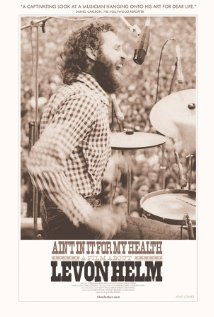 Ain’t In It for My Health is a film about Levon Helm, the late great drummer and singer with The Band. You’ve heard him on songs like “The Weight” and “The Night They Drove Old Dixie Down.” Levon died last year of throat cancer and was a musician until the end although he lost his voice in 1998. His Midnight Rambles at his home and studio in Woodstock, NY, were famous. The Levon film had three showings at the Music Box last month and I missed all of them so now I have to find it elsewhere or wait for the DVD to be released.
You can find Levon’s music on levonhelm.com and if you want to see him in top form, watch the 1978 documentary The Last Waltz, directed by Martin Scorcese.
On stage: Memories, heads, apocalypse prep
Posted: July 6, 2013 Filed under: Chicago, Theater | Tags: Lookingglass Theatre, Mary Arrchie Theatre, Sideshow Theatre, theater, Theater Wit 2 CommentsComments on a few plays I’ve seen recently, including one full review.
The Burden of Not Having a Tail: Apocalypse When?
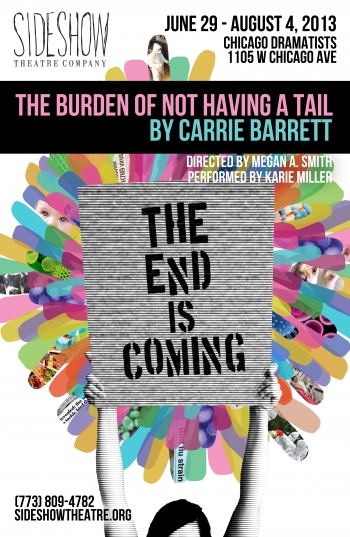 Sideshow Theatre is presenting this one-woman show at Chicago Dramatists. It’s an entertaining 70 minutes about the prospects of an apocalypse. Woman, the lone character, is a “prepper” and the audience (that would be us) is there to learn from her experience to prepare ourselves. There’s a sad thread to it (besides the grim one) about the death of her baby daughter.
All in all, the play fails to hold together as a play but I have to give the actor (Karie Miller), playwright (Carrie Barrett) and director (Megan Smith) props for a good try. It’s not easy to tell a dramatic story and hold a one-character play together. The successful ones I have seen are about the lives of riveting characters such as Clarence Darrow (by David Rintels from the Irving Stone biography) or Charlotte van Mahlsdorf (her story, I Am My Own Wife, was produced at Goodman Theatre in 2005). Or brilliantly written one-man plays, like Krapp’s Last Tape by Samuel Beckett.
Read my review of The Burden of Not Having a Tail on Gapers Block. You can see it until August 4.
Big Lake, Big City: Chicago noir
If you think “comic noir” is not an oxymoron, then you’ll love the new play by Keith Huff at Lookingglass Theatre. Huff wrote the gripping two-character cop play, A Steady Rain, which was a hit here at Chicago Dramatists and then went to New York where Daniel Craig and Hugh Jackman starred in it. That earned Huff his writing cred and he’s been writing for great TV dramas such as Mad Men and House of Cards, the recent Netflix streaming series that I wrote about in February.
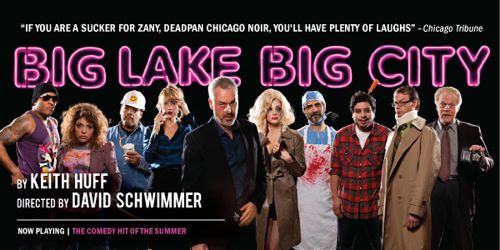
David Schwimmer directs this play about Chicago crime, with two hard-bitten police detectives (Philip R Smith and Danny Goldring), a guy who wants to go to Disneyland with a screwdriver embedded in his head (that’s right, he doesn’t make it through the metal detectors at O’Hare), and two morgue doctors who play golf with severed heads. Actually, heads get a lot of attention in this play and you can decide whether that’s symbolic or not. I left out the two corpses burned to a crisp while in flagrante delicto in a Lincoln Avenue motel and a dozen other delicious incidents.
The play has a lot of characters, a lot of plot threads and is probably more suited to TV, as a couple of critics have observed. Smith and Goldring are terrific as the two cops, and the acting and timing is very good. I suppose it’s not wholly successful as a theatrical exercise. However it’s really entertaining and stuffed with great Chicago jokes and references. My favorite scenic device is the Navy Pier Ferris wheel cab that I kept watching above me; it finally descended in one of the last scenes.
I recommend Big Lake Big City, although maybe not for out-of-town visitors. It runs until August 11 at Lookingglass Theatre at the Water Tower Water Works.
The Glass Menagerie: Memories in shards of glass
Mary Arrchie Theatre is presenting its distinctive version of the Tennessee Williams memory play in an extension at Theater Wit. It’s beautifully done and the acting makes you really appreciate Williams’ poetic language.
Tom, the poet, is played as a homeless man by Hans Fleischmann, who also directs. Tom wanders barefoot through a setting covered in glass shards. He’s the brother of delicate Laura and the son of Amanda (the southern belle who can’t believe the poverty of her current existence). There was something odd that I can’t quite put my finger on about Tom being played as a homeless man. The glass shards, of course, are reminiscent of Laura’s life with her glass menagerie and symbolic of their shattered lives. Basically, no one in the play accepts the reality of their own existence.
The play has a beautiful original score by Daniel Knox, which really enhanced the atmosphere.
I have seen The Glass Menagerie many times. My favorite still is the Court Theatre’s 2006 version, performed on an elevated set, mostly on the fire escape outside the Wingfield family flat in St. Louis. It captured the mood of Williams’ memory play beautifully, with fine acting in a minimalist setting. Jay Whittaker, an excellent Chicago actor who has left for other pastures, was a poetic Tom, longing for escape.
The Glass Menagerie runs until July 28 at Theater Wit, 1229 W Belmont.
Chicago as Brigadoon & other stories
Posted: July 1, 2013 Filed under: Chicago, People | Tags: Bill Savage, Chicagoist, John Hodgman, Newberry Library, Paul Durica, Pocket Guide to Hell Leave a commentI’m a student of Chicago history and have been ever since I started reading Mike Royko’s columns in the Chicago Daily News (RIP) and discovered Ben Hecht and Charles MacArthur’s play Front Page. I learned more in a Chicago history course at Steinmetz High School and a lot more in docent training from the Chicago Architecture Foundation. I’ve been collecting books and anecdotes about my favorite city ever since. When John Hodgman said that Chicago is a fictional city like Brigadoon, I knew this had to be added to my library. Bill Savage and Paul Durica obliged with another Chicago yarn.
John Hodgman discovers Chicago
 John Hodgman, the Daily Show resident expert and occasional “deranged millionaire,” was in Chicago recently for the Just for Laughs Festival. The Chicagoist interviewed him and he made an astounding statement, which we Chicago lovers must not forget.
“As you know, I, John Hodgman, have always maintained Chicago is a fable, a fictional city like Brigadoon.”
Hodgman had predicted the end of civilization and possibly the end of the world on December 21, 2012, in accord with the Mayan prediction. So he swallowed and walked that back a bit. Here are some snippets from the Chicagoist interview by Samantha Abernethy.
C: Are you concerned that the world could end before you appear in Chicago next week?
JOHN HODGMAN: No, but what I’m saying is that another one of my prophecies that came true is that Chicago became, Chicago emerged from the swamp next to the lake and became real. Because as you know I, John Hodgman, have always maintained Chicago is a fable, a fictional city like Brigadoon.
C: And why is that?
JOHN HODGMAN: Well you know, for those of us in New York, we would meet these travelers who had come to New York, and they would tell these stories about this amazing utopia called Chicago where rents were still reasonable and newspapers still thrived, and old-time bars still served boilermakers and the rivers were green with beer. I was like, “I’m sorry but you’re insane. There is no such place. If there were, why did you leave it?” And that’s how I came to believe that there was a mythical city called Chicago, a legend of folklore. There was this great city of wide shoulders in the middle of the country, but of course it’s patently false. Or it was, anyway.
I would come and visit quote-unquote Chicago for meetings and public appearances and lectures and comedy and so forth, and it was really amazing the lengths to which the so-called Chicagoans would go to maintain this fantasy. They’d build a great papier-mache city, a great white city* just to fool me and themselves that it was Chicago. I’m pretty sure as soon as I left the rain would wash it all away back into the lake. And now there is a real city called Chicago. It happened. It materialized, like magically. I’m looking forward to coming back to it.
C: And when did that happen?
JOHN HODGMAN: I would have to go back through my notes. Sometime in the fall of 2012…. In all seriousness, I love Chicago whether or not it was ever real. I’m glad now that for sure that it exists, because I love it so much.
You can read the whole interview here.
Chicago by Day and Night – or a Pocket Guide to Hell**
Paul Durica and Bill Savage, two Chicago writers, have published a new edition of Chicago by Day and Night: The Pleasure Seeker’s Guide to the Paris of America. They recently did a joint reading of excerpts from the book at the Newberry Library.
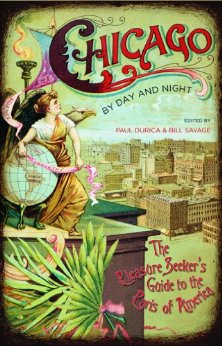 Savage teaches Chicago literature, history and culture at Northwestern University and the Newberry. Durica is a writer and the founder of Pocket Guide to Hell Tours and Reenactments.
The book was originally published in 1892 for visitors attending the World’s Columbian Exposition of 1893. It advises such “wayfarers” where to find dining, amenities and proper entertainment while avoiding “the free and easy shows, gambling hells, barrel-house saloons, massage parlors and other dens of iniquity that beset our great city.” In so doing, of course, it makes the dens of iniquity seem very alluring.
The two writers wrote a new introduction and extensive notes for this edition. They tried to “strike a balance between recreating the book as it originally appeared and making it modern.” The entire book was reset in type, but the authors retained elements of the design, including the cover and most of the illustrations. The original book was meant to be vest pocket size. It’s 7×4.5 inches. Without the introduction and 65 pages of notes, it might still fit in a vest pocket.
The book was just published by Northwestern University Press; cover price is $16.95. While perhaps not a good reference for today’s tourist, it’s funny and engaging with many delectable quotes for a lover of Chicago history and trivia.
————————————-
* “… a great papier-mache city, a great white city”: This might be a reference to the World’s Columbian Exposition of 1893, built on Chicago’s south lakefront and known as the White City. All but two of the buildings were meant to be temporary and were demolished after the fair. The Beaux Arts structures were built of “a mixture of plaster, cement and jute fiber called staff.” Erik Larson’s book, Devil in the White City, gives many details of the fair’s construction.
** “Chicago is a pocket edition of hell.” “Hell is a pocket edition of Chicago.” According to legend (located in a footnote in Jack London’s 1907 novel The Iron Heel), a famous English labor leader named John Burns visited Chicago. When asked his opinion of the city, he said, “Chicago is a pocket edition of hell.” Later, as he departed for England, he was asked if he had changed his opinion of Chicago. “Yes, I have. My present opinion is that hell is a pocket edition of Chicago.” Thanks to Chicago Weekly; see more here.
 nancy bishop's journal