Listening to the blues in Corky’s chamber
Posted: May 31, 2013 Filed under: Music | Tags: Chamber Blues, Corky Siegel, Mayne Stage Leave a commentA hipster string quartet, a madman drummer* – and the inimitable Corky Siegel, collapsing on his back in an ecstasy of harmonica playing. That was the culmination of an evening with Corky Siegel’s Chamber Blues last weekend at the Mayne Stage.
Siegel is a well-known Chicago blues musician — harmonica and piano player – who has been playing in various Chicago venues since 1964. You might have seen him years ago at Pepper’s Lounge on 43rd Street, where blues masters such as Muddy Waters, Howlin’ Wolf, Otis Rush, Junior Wells, Magic Sam and Buddy Guy played. Corky connected with guitarist Jim Schwall in the ‘60s and they played regular gigs there and toured and recorded as the Siegel-Schwall band into the 1970s; they still play today and have current dates on the concert schedule.
 For the last 25 years, Siegel has been working on a hybrid kind of blues – combined with classical chamber music. Corky Siegel’s Chamber Blues plays several concerts in this area every year and travels the country and the world with this vibrant blues genre.
Last weekend I saw him at the Mayne Stage on Morse Avenue in Rogers Park. That’s a great venue with excellent acoustics and sight lines. If you pay a little more for “reserved” tickets, you’ll sit at a small café table on the main floor.
The concert opened with Siegel introducing the string quartet – two violins, viola and cello – to play two numbers, one of them from the Turtle Island Quartet. About that time, Frank Donaldson, the madman drummer, arrived to kneel at his tablas, bongos and other percussion instruments. Siegel came out soon after and the band began to rock in a series of jazzy blues numbers with some vocals by Siegel. The setlist is mostly original compositions by Siegel, many with names like Opus 14, 16, 17.2, 8 and 4 (half of 8).
The band played for about 90 minutes, then came back for a short encore, during which Siegel played a rousing piano solo, eventually joined by all the other musicians chiming in at the keyboard.
The musicians are all excellent and charming performers, who seem to be having as much fun as the audience. Violinist Chihsuan Yang gets some amazing percussive sounds by fingerpicking her strings. Her fellow violinist Aurelien Fort-Pederzoli played a marvelous solo with Siegel. Violist Dave Moss and cellist Jocelyn Butler add great depth to the classical/blues sound. And drummer Donaldson adds percussion in amazing ways, including a mystifying hand-slapping chorus. (Mystifying because I couldn’t figure out how he did it.) Plus he has a never-ending series of percussive instruments that add great fun to the music. (I’m a sucker for drummers. If I ever run away from home, it will be with a drummer.)
–***–
What does chamber blues sound like? You can hear some samples and learn about the Chamber Blues band here, including solo samples on the musicians’ bio pages.
The next local date right now for the Chamber Blues experience is Saturday, September 28, at the Beverly Arts Center. I’ve alerted you. Don’t miss it.
–***–
*Springsteen fans will recognize that phrase from Bruce’s early era of cramming as many syllables as possible into a lyric line.
Madman drummers bummers and Indians in the summer with a teenage diplomat
In the dumps with the mumps as the adolescent pumps his way into his hat
With a boulder on my shoulder, feelin’ kinda older I tripped the merry-go-round
With this very unpleasing sneezing and wheezing the calliope crashed to the ground
Some all-hot half-shot was headin’ for a hot spot snappin’ his fingers clappin’ his hands
And some fleshpot mascot was tied into a lover’s knot with a whatnot in her hand
And now young Scott with a slingshot finally found a tender spot and throws his lover in the sand
And some bloodshot forget-me-not whispers, “Daddy’s within earshot, save the buckshot, turn up the band”
“Blinded by the Light” from Springsteen’s first album, Greetings from Asbury Park, NJ
Orange Flower Water + Speech & Debate
Posted: May 22, 2013 Filed under: Theater | Tags: American Theatre Company, Interrobang Theatre Project Leave a commentNancy, the theater junkie, has been checking out local offerings lately. See my reviews of two new plays on Chicago stages at gapersblock.com. I recommend both. They’re interesting and enjoyable theater evenings.
Orange Flower Water: Breaking apart two families … at Interrobang Theatre Project
Orange Flower Water is a wrenching marital drama where the bed is the heart of the matter, both literally and metaphorically. The bed is the centerpiece of each scene, with quick changes of covering signaling changes of venue. The four characters are two couples who live in the same neighborhood and whose children play soccer together. One of the partners in each couple wants to end their marriages. James Yost, in his first Chicago directorial outing, directs this smartly written play by Craig Wright, author of television scripts written for “Six Feet Under,” “Lost,” “Brothers & Sisters,” and “Dirty Sexy Money.”
Please continue reading this review and see ticket info at the end. Orange Flower Water runs through June 9 at the Raven Theatre Complex, 6157 N. Clark St.
Speech & Debate speaks to a wide audience … at American Theatre Company
Group interpretation, original oratory, extemporaneous commentary. These are some of the graphic titles projected to introduce new scenes throughout Speech & Debate at American Theatre Company (ATC). That may sound like a yawnfest for speech majors but in the hands of four talented performers, they signal funny but searing explorations of teenagers trying to sort out their identities. This is doubly tough in an era where online activities further complicate the growing-up process.
Please continue reading this review and see ticket info at the end. Speech & Debate runs through June 23 at American Theatre Company, 1909 W Byron at Lincoln Ave.
Dumpster dive to floral design
Posted: May 21, 2013 Filed under: Design | Tags: adaptive reuse, mid-century design 1 Comment My grandson James presented me with a very creative Mothers Day gift. He took adaptive reuse to an extreme, creating a contemporary flower arrangement that fits perfectly with my decor. Which is pretty mid-century modern with lots of glass and chrome and a color palette of black, gray, white and a few bright colors.
His raw material? Pieces of heavy gauge copper and aluminum wire that he and his dad found in a dumpster at a construction site. (His father–my son Steve–is a home renovation contractor.)
James stripped off the black insulating shield covering the metal cables. He used a pliers to grab individual metal strands and twist them to make petals. Cables of three different lengths make an interesting arrangement, shown at the left. It’s a very cool addition to my living room.
I thought at first the material was coaxial cable, which is most often used by cable and telephone companies to carry signals from antenna or central locations to customers’ homes or offices. But no, it’s just plain old heavy duty wire, which is used for a variety of building purposes.
You might also be interested in art that other people have created with similar materials, especially the bull sculpture by a homeless man in New York. Several youtube videos here.
On stage: Chicago history, Middle East ambiguity
Posted: May 15, 2013 Filed under: Theater | Tags: A Red Orchid Theatre, architecture, Bathhouse John Coughlin, Chicago history, Mike Hinky Dink Kenna, The Hypocrites 2 CommentsTwo intriguing plays at two of my favorite small theaters: Ivywild: The True Tall Tales of Bathhouse John at The Hypocrites and In a Garden at A Red Orchid Theatre. Both are still running; details below.
Ivywild: Part Carnival, Part History Lesson
Ivywild: The True Tall Tales of Bathhouse John, the new play by the ever-audacious The Hypocrites http://www.the-hypocrites.com, is part carnival, part Chicago history lesson, and it is a delightful 90 minutes of fact mixed with fantasy. The play is written by Jay Torrence and directed by The Hypocrites’ artistic director, Halena Kays.
 When you walk into the lower-level performance space at Chopin Theatre, you know you are in for some fun. The set is a carousel with swings, made of faux antique materials, and light bulbs are festooned everywhere. Platform pieces move around and provide performance space. Before the performance begins, two audience members are asked to don white pinafore dresses so they can participate in simulated rides in the amusement park. The audience, seated close to the action as usual in this space, feels like part of the show. (Photo courtesy of The Hypocrites. Clockwise from bottom left: Ryan Walters as Kenna, Anthony Courser as Princess, Jay Torrence as Bathhouse John, Tien Doman as The Amusement and Kurt Chiang as little Walt.)
Torrence plays “Bathhouse John” Coughlin, the First Ward Alderman of Chicago during the 1890s, when the 20-square block area around Cermak and Michigan was the levee district, populated by saloons, brothels, gambling houses and plenty of corruption to fund it. Michael “Hinky Dink” Kenna, the precinct captain and later the second First Ward Alderman, is played by Ryan Walters. (Until redistricting in 1923, each Chicago ward had two aldermen.) The two amass great wealth through the levee district businesses, political corruption and general debauchery.
Ivywild is the amusement park and zoo that Bathhouse John actually built on a tract of land near Colorado Springs, where he has bought a second home. Coughlin meets young Walt Colburn (Kurt Chiang) there and makes him his personal assistant. Colorado, at that time, was home to hundreds of tuberculosis sanatoriums, where patients from all over the country would go to seek relief. Those are the factual threads that are woven throughout the play.
The other characters are Anthony Courser as Princess, an alcoholic elephant in a pink tutu with a deformed trunk, and a fantastical symbolic character named “The Amusement,” a lovely tubercular mime on a respirator, played by Tien Doman. (All the cast members also perform with the NEo-Futurists http://neofuturists.org, where Kays formerly directed. This connection suggests we might see some interesting future possibilities for these two innovative companies.)
The playbill includes a timeline of the Ivywild/First Ward Chicago story. Even if you know that period of Chicago history or read the timeline before the play starts, you may find it hard to follow the non-linear thread of the story. But no matter. Just enjoy the flow. Accept the fact that Princess may address the audience and tell the story of how she lost her trunk. (“The elevator door chopped off my nose.”)
Torrence’s Bathhouse John as a song and dance man—a pol who sees himself as a poet and songwriter, as well as the creator of a grand amusement park. His sartorial flamboyance was legendary. Hinky Dink Kenna was more conservative in dress and demeanor, and tries to push his partner to return to Chicago and pay attention to First Ward business. This Chicago duo suggests how Chicago won its reputation as a center for crime and corruption, even before the arrival of Al Capone.
Ivywild runs through June 16, so please be sure to see it. The Hypocrites perform at the Chopin Theatre, 1543 W Division St. Shows are at 7:30 pm Monday, Friday and Saturday and at 3pm Sunday.
A Gazebo Among the Lemon Trees
A Red Orchid Theatre http://www.aredorchidtheatre.org is presenting In a Garden by Howard Korder, a fast-moving and smartly written play in nine scenes spanning 15 years from 1989 to 2004. The play portrays the frustration of an ambitious American architect (played by Larry Grimm) proposing a design for a fictitious Middle Eastern country named Aquaat, which might be Iraq.
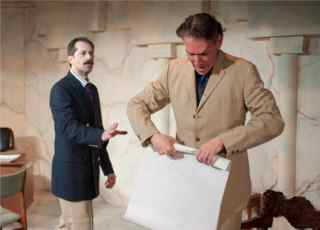 Director Lou Contey keeps the action moving well, with quick scene changes made by a stage assistant, veiled and silent — the only woman who appears. Broadcast news snippets between scenes set the time line. The tiny Red Orchid space is the office of the minister of culture (a strong performance by Rom Borkhardor), a man enamored of American pop culture and American architects. The architect and the minister develop an uneasy friendship over the years–but the play, which starts out like a satire with many clever lines about truth and beauty, becomes darker as the scenes progress. (Photo courtesy of A Red Orchid Theatre. Left, Borkhardor as the minister, and Larry Grimm as the architect.)
The architect has not had a successful career; he has several proposed and unbuilt projects in different countries and the minister refers to him as a second-tier architect. He is desperate to see one of his designs built, which may explain why he suffers through years of ambiguity and misdirection from his client (or patron, as the minister prefers). It’s never clear who is making the decisions or if in fact a decision will ever be made to build the gazebo in a peaceful garden of lemon trees so desired by the minister.
In the final scene in 2004, everything has changed: the space, the architect’s professional goals and the minister’s status. The gazebo was finally built, but now is gone. The lemon trees remain – to be enjoyed by the office’s new occupant: an American army officer.
In a Garden runs through Sunday, May 19, so you still have a chance to see it. Shows are at 8pm Thursday, Friday and Saturday and 3pm Sunday. A Red Orchid Theatre performs at 1531 N. Wells St.
—————————————
Slightly different versions of these reviews appear at gapersblock.com, a Chicago website, on the A/C or Arts page.
Mr. Selfridge: The Chicago connection
Posted: May 9, 2013 Filed under: TV, radio | Tags: Daniel Burnham, Marshall Field's, Montgomery Ward, PBS Masterpiece Classics, retail stores, Sears Roebuck, Selfridge's, Sewell Avery Leave a commentPBS’ current “Masterpiece Classic” series is set a century ago in London but has a strong Chicago connection. “Mr. Selfridge” is an eight-part series about the founder and founding of Selfridge & Co. in London. The program can be seen at 8pm Sundays on Channel 11, Chicago. PBS streams the series too, so you can catch up with most of the past episodes.
 Harry Gordon Selfridge, played by Chicago actor Jeremy Piven, was born and raised in Wisconsin. He came to Chicago in 1879 and worked for Field, Leiter & Co., became a director of Marshall Field and later manager of the State Street store. He sold his interest in Field’s in early 1904, bought the firm Schlesinger & Mayer (including the famous store building at State and Madison designed by Louis Sullivan) and renamed it H.G. Selfridge & Co. Selfridge sold that business to Carson, Pirie, Scott by the end of that year.
Selfridge’s wife, Rose Buckingham, was part of a wealthy Chicago family. Her cousin, Kate Buckingham, funded the Buckingham Fountain on Chicago’s lakefront as a memorial to her brother Clarence.
 Selfridge apparently had the wanderlust because he looked toward London as a place to establish what he envisioned as a new kind of department store. He moved his family to London and opened Selfridge’s in 1909. He brought fashionable selling ideas from the US to what he considered a dreary London retail environment. Selfridge’s was a large and beautiful store where women were encouraged to shop for pleasure, not just necessity. They could view and even touch the merchandise, and lunch in elegant restaurants at modest prices. Selfridge also incorporated celebrities of the day, such as suffragettes, ballerinas and aviators, as part of exhibits and events in the store. These themes about Selfridge’s retail vision are historically accurate, as are the portrayals of some of the characters. Chicago and Marshall Field’s are mentioned occasionally in the programs.
There’s another Chicago connection to this retail story. Selfridge chose legendary Chicago architect Daniel H. Burnham to design his new London store. Burnham’s firm had also designed the original part of Marshall Field’s State Street store (the section at Wabash and Washington), now Macy’s, as well as Wanamaker’s in Philadelphia and Filene’s in Boston. Burnham was the impresario of the 1893 World’s Columbian Exposition in Chicago and an urban planner and builder who won commissions and built important buildings all over the country.
Chicago played an important role in merchandising history; its central location as a railroad hub was a key factor. The two major catalog companies — Montgomery Ward & Co. (my alma mater) and Sears Roebuck and Company — were both formed here. Montgomery Ward was founded in 1872 by Aaron Montgomery Ward, who had the idea for a mail order business after his years as a traveling salesman. His travel in rural areas convinced him that rural residents wanted to buy goods but had no access to stores. Sears was founded as a mail order company in 1893 by Richard Warren Sears and Alvah Curtis Roebuck. Both later expanded to become chains of brick-and-mortar retail stores but Sears was more aggressive in its retail expansion and by the mid-20th century was much larger than Montgomery Ward.
In the early 1980s, I worked in the public relations department at Montgomery Ward headquarters on Chicago Avenue near the river. The 26-story building completed in 1972 was designed by Minoru Yamasaki, the architect who designed the World Trade Center in New York. The Montgomery Ward complex at Chicago Avenue and the river also includes the original two-million-square-foot catalog house (1908) and a high-rise merchandise building. All three buildings are now repurposed as condominiums, restaurants and offices.
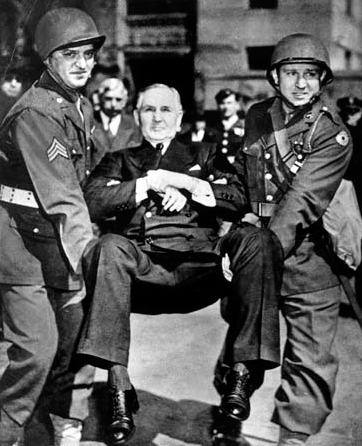 Because of the long history of the company and its Chicago Avenue location, we were very conscious of the company’s place in Chicago history. The PR department storage closet was filled with old papers, publications, photographs and other memorabilia, in addition to the even larger trove in the corporate library. One day a colleague and I were looking for something from the past and found a large, unsealed envelope on a shelf. We opened it and found a copy of a 1944 letter from President Franklin Roosevelt to chairman Sewell Avery, ordering him to allow union representation for employees and ensure the delivery of essential goods. Avery refused to sign the contract and two National Guard men removed him from his office, as shown in this famous AP photo of the time.
Note: A shorter version of this article appeared on gapersblock.com.
Richard Hell revisits his life in punk rock
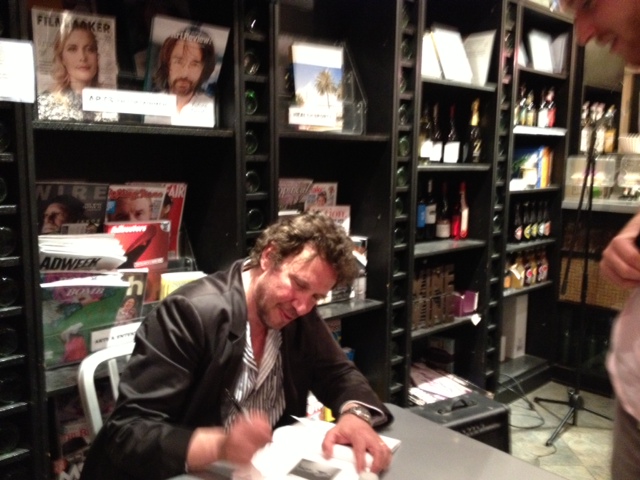
Posted: May 7, 2013 Filed under: Music, Punk rock | Tags: BookCellar, Richard Hell 4 CommentsRichard Hell, the punk rock pioneer and author, read from his new autobiography Thursday night at the Book Cellar in Lincoln Square. The cozy bookstore was packed when I arrived about 20 minutes before start time and I felt lucky to find a seat. I thought (as I did at the packed Peter Hook event at the MCA in February. “Yes, punk lives on!” http://bit.ly/Yt6t8W)
Hell was born Richard Meyers in Lexington, Kentucky, in 1949. The book, I Dreamed I Was a Very Clean Tramp (HarperCollins, 2013), starts with his childhood and moves to New York and his work as a poet and musician with bands like the Neon Boys, Television, the Heartbreakers and the Voidoids.
 Hell read several moving passages, such as this one on the thrill of making a band’s first sounds: “The power and beauty of it was unimaginable until then. It can’t be overstated, that initial rush of realizing, of experiencing, what’s possible as you’re standing there in the rehearsal room with your guitars and the mikes turned on and when you make a move this physical information comes pouring out and you can do or say anything with it. It was like having magic powers.” Later he continues “All through this book I’ve had to search for different ways to say “thrill,” “exhilaration,” “ecstatic” to communicate particular experiences. Maybe the most extreme example of this class of moment is what I’m trying to describe here. What it felt like to first be creating electrically amplified songs. It was like being born….”
Hell also read other passages about playing at the legendary rock club CBGB and working with musicians like the late Peter Laughner, Robert Quine and critic Lester Bangs.
After the readings, he answered questions about his music, his influences and other musicians he knew and worked with. Hell created the punk look of spiky hair, safety pins and shredded shirts, which will be represented in the exhibit of punk garments and punk-influenced couture at the Metropolitan Museum of Art in New York, opening May 9. The exhibit includes a re-creation of the famous toilet at CBGB. http://www.metmuseum.org/exhibitions/listings/2013/punk About the punk look, Hell said, “We just wanted to be noticed” and “I tried to figure out how I could make myself look the way I felt.” He wrote the preface for the exhibition catalog.
Check out the two articles about the Met exhibit in the April 27 New York Times. “Haute Punk” http://nyti.ms/10xfPuE and “Anarchy in the Met” http://nyti.ms/15adYEp
Hell was also the creator of the famous t-shirt displaying a target and the words “Please Kill Me” stenciled on the front. The shirt may have been worn only once by another member of the band Television. Replicas of that shirt can now be found on several internet sites.
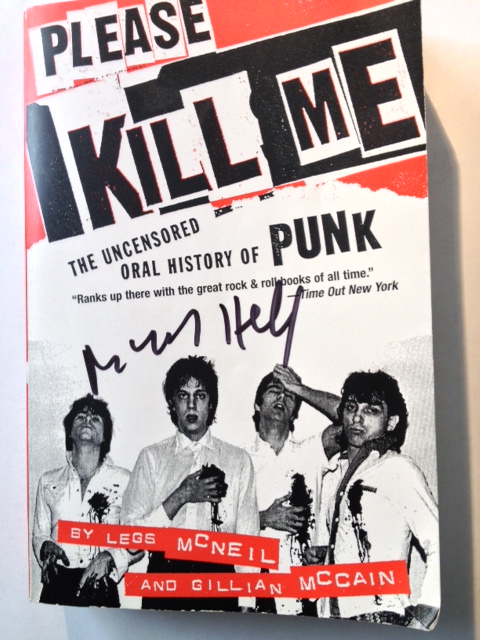 Hell signed copies of books and he also signed my own copy of Please Kill Me: The Uncensored Oral History of Punk (Grove Press, 1996). Hell is pictured on the front cover, second from left. And for the person ahead of me, he signed the jacket of a pristine vinyl copy of the Voidoids’ 1977 album Blank Generation, which features a photo of Hell, shirtless, with the words “You make me _______” written across his chest.
Please Kill Me by Legs McNeil and Gillian McCain is a very good overview of the people, bands, trends and events in US and UK punk rock, starting with the Velvet Underground in 1965 and Detroit bands like the MC5 and Iggy and the Stooges. Hell commented, in answer to a question, that there are a lot of errors in the book. Personally, I think it’s more the Rashomon effect: the book is made up of quotations and perceptions from dozens of musicians, producers, roadies and hangers-on – each from his or her own point of view. If you were there, you would surely find some of those perceptions to be factually incorrect.
Punk has been defined as “making up life for yourself.” (That’s usually credited to Legs McNeil.) It’s a sort of all-American attitude that allows for reinvention of the self. A teenaged Richard Meyers moved from Lexington, Kentucky, to Manhattan, wrote poetry, turned himself into Richard Hell, became a punk rock and fashion icon, wrote successful songs such as “Blank Generation,” then dropped out of music, left the drug culture, and became a successful writer.
A slightly different version of this article was previously published on Gapers Block, a Chicago website. http://bit.ly/16eOXIe
Kids’ theater: Build the next audience
Posted: May 2, 2013 Filed under: Theater | Tags: children's theater, Click Clack Moo, House Theatre, Lifeline Theatre, Our Town, The Hypocrites 3 CommentsI love live theater. I go to many plays, sometimes two or three a week, but rarely fewer than one. Theater isn’t just entertainment. Real theater — straight plays as they’re sometimes called — gives you new insights on people, issues and life past and present and may even give you a new understanding of contemporary issues. (When I say real theater, I’m excluding fluffy musicals and silly comedies.)
Sometimes I look around at a theater audience and worry because we’re all too old. Theater audiences skew old, unfortunately. So I consider it my responsibility to get kids used to going to the theater when they’re young.
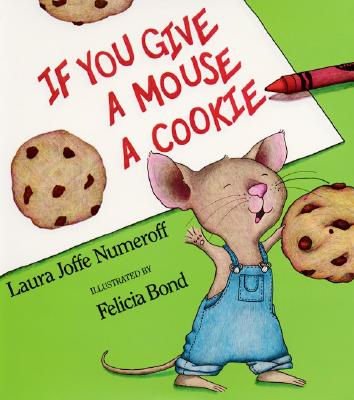 Last weekend, I was in Greensboro, North Carolina, visiting my son and his family. One day we took the 5-year-old, who has gone to the theater since he was a toddler, to the Children’s Theatre of Winston-Salem. http://www.childrenstheatrews.org We saw If You Give a Mouse a Cookie, which is made up of six short playlets, each based on a children’s book.
That’s a clever form for children’s theater. Each playlet is short – no more than 10 or 12 minutes – so the young audience’s attention is maintained. And they build familiarity with new books, which the children may read later at the library or at home. My grandson Meyer was enthralled with all the plays; this usually squirmy kid was totally still. We both especially liked Imogene’s Antlers and Borreguita and the Coyote.
The Winston-Salem theater has an eight-play season; most of its productions are performed by visiting companies. TheatreWorks USA performed this play. http://www.theatreworksusa.org The acting, music and production values were smooth and well done without being silly or slick.
 My oldest grandson, James, lives in the Chicago area, so I get together with him more often. We’ve been going to the theater since James was 3 or 4. He’s now a teenager, so we’ve been through all the permutations of pre-K, grade school, tween and silly sci-fi theater. One of the first plays we saw portrayed one of our favorite books: Click, Clack, Moo: Cows that Type by Doreen Cronin. We saw that and many other plays at Lifeline Theatre in Rogers Park, which does a great job with children’s plays. http://bit.ly/10WqZR5
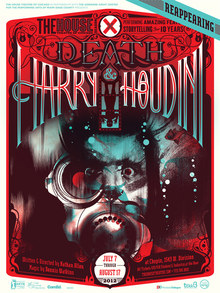 More recently we’ve seen Lion King, Animal Crackers at Goodman Theatre, Our Town at The Hypocrites, and Death and Harry Houdini at House Theatre. Oh and Bruce Springsteen at Wrigley Field.
I also go to the theater whenever possible with my grandnieces, who are now 7 and 11. Recently we enjoyed a fine production of The Wizard of Oz at the Arts Center of Oak Park. http://www.spotlight.org/oakpark
James is 15 now and this year we’re going to see Book of Mormon. (We both love sophomoric humor and I figure he’s heard all those naughty words anyway.)
James loves theater and he participated in summer theater camps for many years until he aged out. He probably won’t major in theater in college and he may not join a community theater when he’s older. But I think he’ll go to the theater as often as he can and see that his own children go too. Unfortunately, parents don’t always have the time or money to take their children to the theater.
That’s why I say it’s Grandma’s responsibility. Grandparents can ensure that the next generation learns the joys of live theater and makes it part of their lives.
Reading, short and spicy
Posted: April 17, 2013 Filed under: Uncategorized | Tags: George Saunders, Jennifer Egan, Junot Diaz, Stuart Dybek, TC Boyle 2 CommentsShort stories have always been the stepchildren of the fiction family. Why is that? To me, the short story is the perfect form of reading for today’s digital, short-attention-span culture. So it should get more respect.
But that’s not the best reason to appreciate short stories. A good short story is gripping and insightful about a character, a place or a moment in time. A short story collection is perfect for commuter reading, before-you-go-to-sleep reading, or lazy Sunday afternoon reading.
Now the digital age may be changing the short story’s relationship to the fiction family. A recent issue of The New York Times Book Review (March 24, 2013) was devoted to “Fresh Voices.” Of the eight fiction works discussed, four were short-story collections. And a February article in the Times pointed out that short fiction is a “good fit for today’s little screens.” http://nyti.ms/YR01ac
My book group gave up on Henry James’ The Ambassadors (400 pages on my Kindle). We revolted en masse about finishing it. But most of us finished and enjoyed Hilary Mantel’s Wolf Hall (~650 pages). So I don’t think that means we are 21st century Philistines. The Mantel book is fascinating, if dense, historical fiction; with a lot of events transpiring and a lot of people named Thomas. The Ambassadors, on the other hand, is a drawing room drama that languishes.
However, among the last few books we’ve read and liked are several in the short fiction genre. I’m going to talk about those and a few of my other favorite short story writers. None of these authors are really traditional fiction writers. But I recommend any or all of them if you want to dip into contemporary short fiction.
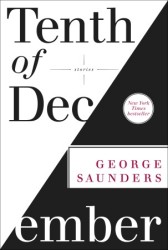 George Saunders’ Tenth of December (2013). Saunders has been getting movie-star publicity lately. The release of this book earlier this year was treated like the arrival of the latest Batman movie. His stories are rooted in pop culture, technology and current affairs and written in various styles. One story is in the form of a corporate memo involving personal confession; another is a series of shorthand diary entries by a man who tries to bring his family’s life up to the level of affluent neighbors. In fact, most of the stories are about downwardly mobile people trying to survive. Class and status distinctions abound. Most of the stories are sad, some are jarringly violent; and most have ambiguous endings. Here’s a link to a half-hour Saunders interview, where Saunders talks about his writing. I liked his description of how he edits until he gets “jangly sentences.” http://www.charlierose.com/view/interview/12757
Junot Diaz’ This Is How You Lose Her (2012). Diaz also has celebrity status as a writer; he’s a 2012 MacArthur Fellow and his 2008 novel The Brief Wondrous Life of Oscar Wao won the Pulitzer Prize for Fiction. His new book is a series of loosely linked stories about love and trying to make it work, involving the immigrant experiences of Dominican-Americans. His writing is a blend of Spanglish and streetwise slang and becomes more formal in the stories about his older characters. The stories have a strong autobiographical feel, although Diaz does not describe them that way. My favorite is “Invierno,” the story of a Dominican family’s arrival in their new New Jersey home in the middle of a snowstorm. The two brothers Rafa and Yunior yearn to be outside and play with the gringo kids, but their father does his best to keep them inside.
 Jennifer Egan’s A Visit From the Goon Squad (2010). This book of short fiction is a series of interlocking stories that stand alone or read novelistically. The leading characters are Bennie, a former punk rocker turned record executive, and Sasha, the young woman he employs, who goes through several incarnations and ends up living with husband and two children in the California desert. One story, by the way, is a PowerPoint presentation on “Great Rock and Roll Pauses” by Sasha’s daughter. The stories play out over a period of 50 years or more, with characters evolving and linking back and forth. The last story ends in a mass musical event on the site known as the Footprint, where the World Trade Centers once stood. This is a really creative work of short fiction.
Stuart Dybek’s The Coast of Chicago (1990), I Sailed With Magellan (2003), and Childhood and Other Neighborhoods (1980). Dybek is my favorite short story writer and one of my favorite writers. The Coast of Chicago was the 2004 selection for One Book, One Chicago. His writing, his characters, his geography are so quintessentially Chicago that his books would make me homesick if I didn’t live here. He also has two wonderful books of Chicago poems: Streets in Their Own Ink (2004) and Brass Knuckles (1979). I’m going to devote a whole essay to Dybek in the near future, so I will save my commentary for that.
 T. Coraghessan Boyle’s Greasy Lake & Other Stories (1985), and Wild Child and Other Stories (2010). T.C. Boyle is a witty and imaginative writer. His stories are rarely realistic but always fascinating. I guess I should confess that I picked up Greasy Lake in a bookstore because of the title — it’s the name of a fictional place in a Bruce Springsteen song, “Spirit in the Night,” from his first album Greetings from Asbury Park (1972). Boyle’s characters include an Elvis impersonator, a presidential staffer who facilitates Ike’s steamy affair with Nina Khrushchev (I said this was fiction, didn’t I?), and a blues musician who may be Robert Johnson. And that’s just in Greasy Lake & Other Stories. Wild Child includes many stories published in literary magazines and “Best of” compilations. His writing is colorful and often poetic. Boyle’s stories are so delicious that looking them over for this post made me want to read them all over again.
Here’s a random sample of Boyle’s prose: “Robert’s dream is thick with the thighs of women, the liquid image of songs sung and songs to come, bright wire wheels and sloping fenders, swamps, trees, power lines, and the road, the road spinning out like string from a spool, like veins, blood and heart, distance without end, without horizon.”
The Best in Rock Fiction (2005), edited by June Skinner Sawyers, introduction by Anthony DeCurtis. This is a book of short stories and excerpts from longer works by writers who have a rock and roll sensibility, as Sawyers says in her preface. “I want to capture the way rock sounds on the page, its unpredictability, the possibility that anything could happen,” she says. Some of the writers whose work is included are Nick Hornby, Don DeLillo, T.C. Boyle, Stephen King and Jonathan Lethem. Some of my favorites from this book are “White Noise” by DeLillo, an excerpt from “Eddie and the Cruisers” by P.F. Kluge, and an excerpt from Hornby’s book High Fidelity. “The Girl Who Sang With the Beatles” by Robert Hemenway is a wistful 1960s story about Cynthia, who is mesmerized by the Beatles’ music, and her husband, Larry, who prefers foreign movies and chamber music. For a while, they each listen to their own music on separate stereo headphones but at the end, Larry enters into her Beatles world.
I should acknowledge that June is a Chicago writer and a personal friend. See more about her work here http://www.illinoisauthors.org/authors/June_Sawyers.
Finally, here are some comments about short stories by an English journalist in Metro, a London version of Chicago’s Red Eye. The news peg is that the Costa Awards decided to add the short story to its traditional literary prize genres. http://nyti.ms/YR01ac
“The commercial reality is that short stories simply don’t shift as well as novels. People can argue – as many do – that the espresso-style adrenalin shot the genre offers is perfectly suited to today’s on-the-move culture and that new digital technology can support the form in the way traditional magazines used to. But the evidence remains that you are more likely to buy the new, unevenly reviewed JK Rowling for a friend for Christmas than Junot Díaz’s new, excellently received collection of short stories.”
Do you agree? Join me in becoming a short story fan.
Yes for “No” + Holy Motors + Goodbye Solo
Posted: April 9, 2013 Filed under: Movies, Politics | Tags: Chile, Gael Garcia Bernal, Goodbye Solo, Holy Motors, No, the film 1 CommentIn my continuing quest to tell you about pop culture that the mainstream media generally ignores, here are three terrific films. One is still in theaters and the other two are available on DVD.
No. 2012. Directed by Pablo Larraín. Spanish with subtitles. Nominee for best foreign film Oscar. Run time 1 hour, 45 minutes. This film will certainly be on a lot of best-of-2013 lists and it’s still in theaters.
September 11 was a day of infamy for Chile long before it was for the US. On that date in 1973, the democratically elected socialist government of Salvador Allende was overthrown in a military coup led by General Augusto Pinochet, who led Chile’s government for the next 15 years. (Allende was either assassinated or committed suicide, depending on whose side you believe.) This historical background is introduced briefly at the beginning of the film, which is fact-based.*
 In 1988, Pinochet agrees to international pressure for Chile to have a plebiscite on whether he should govern for another eight years and a Yes/No election is planned. Both sides are to have 15 minutes of national television time each night. (What a brilliant way to solve the campaign finance problem.) The leftists on the No side want to make TV commercials showing the torture, murder and disappearances of the Pinochet regime. But René Saavedra, a clever advertising executive, played by Gael Garcia Bernal, reluctantly agrees to help the left with its No campaign. People either don’t remember or don’t want to remember those days, he tells them. They want to believe they will be happy in the future. So the No campaign mounts a “Happiness Is No” campaign, complete with rainbow logos, theme songs, banners, parades and t-shirts. (Photo by Tomás Dittburn/Sony Pictures Classics)
You could argue this is a putdown of commercial advertising invading political discourse. Or you could just sit back and enjoy this clever satire on politics. The No side wins the plebiscite and the film ends in celebration. In fact, Pinochet had a behind-the-scenes role for years afterward.
The film is shot in smudgy color that feels like you’re watching an old videotape. There are other well-known Latin American actors besides the oh-so-darling Garcia Bernal, whose character is a mix of naïve and radical. You’ve seen him in Y Tu Mamá También, The Motorcycle Diaries, Bad Education, The Crime of Padre Amaro, and many other Pedro Almodovar films.
* The film has generated some controversy in Chile, of course. Described here. http://nyti.ms/12G358m
Holy Motors. 2012. Fantasy drama film written and directed by Leos Carax, starring Denis Lavant. French with subtitles. Get the DVD. Run time just under 2 hours. (July update: Holy Motors is now available streaming on Netflix.)
I hardly know where to start describing this. Lavant is M. Oscar, who lives 10 or 12 parallel lives or stories throughout the day and night of this film. He rides from gig to gig throughout Paris in a white stretch limo, which serves as dressing room, wardrobe and prop closet. His chauffeur Celine, a lovely woman with silver hair, apprises him of his appointments and keeps him on schedule.
He emerges from the limousine once as an old beggar woman, and again as a madman (M. Merde) who eats flowers stolen from a street market, then runs through the famous Paris cemetery, Pere Lachaise, where instead of names of famous people on tombstones, you see “visit my website at xxxxxx.com.” Other incarnations involve murder, simulated lovemaking in spandex, and a father-daughter interlude. You see why I said there’s no way to describe this film. Suffice to say, it’s a mesmerizing and beautiful film and you’ll be rewarded if you have patience. And … the title Holy Motors will make sense at the end. Kinda.
Roger Ebert gave it 3.5 stars in November and ended his review this way. “Here is a film that is exasperating, frustrating, anarchic and in a constant state of renewal. It’s not tame. Some audience members are going to grow very restless. My notion is, few will be bored.”
Goodbye Solo. 2008. Written and directed by Ramin Bahrani. On DVD. 90 minutes.
I’ve spent a lot of time in the Piedmont-Triad area of central North Carolina. So I was interested in this film set in Winston-Salem and Blowing Rock, a beautiful state park where I’ve hiked with my son. Solo is a Senegalese immigrant taxi driver who befriends William, a depressed old man, who hires Solo for a one-way trip to Blowing Rock.
Solo arranges to drive William whenever he calls the taxi company and tries to involve him in life in Winston, including meeting his pregnant wife and her daughter Alex. Solo worries about William’s plan for the trip to Blowing Rock, where it’s so windy “that if you throw a stick, it will fly back to you.” But he and Alex drive William to the park, and the last half hour involves the beautiful drive on the Blue Ridge Parkway and the visit to the park.
This is a small film, a sweet film (despite the ending). In a way, it represents how the area is changing with new immigrants like Solo making a home and a life. It’s not set in a taxi; you get acquainted with a lot of Winston-Salem and the region. This is Bahrani’s third film and I will be interested in seeing his other work.
Oh, Roger. The balcony is closed
Posted: April 5, 2013 Filed under: Digital life, Movies | Tags: Movies, Roger Ebert 2 CommentsI’m a cancer survivor. Twice. 16 years and counting. So I had particular empathy for Roger Ebert’s decade-plus battle with cancer. Despite his pain, many surgeries, and finally his inability to eat, drink or speak, he never flagged in his writing, film reviewing and outrage at political insanity. In 2012, he reviewed 306 films, his record. When he died yesterday, his tweet count was over 31,000.
He didn’t invent it, but he thrived on the internet, tweeting and blogging madly. He was one of the first people I followed on Twitter (just after Bruce Springsteen, who actually doesn’t tweet) and found him endlessly provocative. He didn’t just review and write about films. He also commented upon and provided links to items on important social issues and political controversies. He was an unreconstructed liberal and I valued his comments.
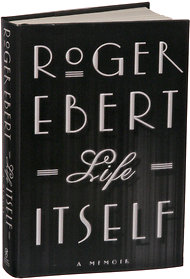 Something Roger said in his memoir helped get me started on this blog. I quote this on my What I Believe page. He said his blog taught him how to organize the accumulation of a lifetime. ”It pushed me into first person confession, it insisted on the personal, it seemed to organize itself into manageable fragments.” For Ebert, his blog was the beginning of writing his memoir, Life Itself (2011, Grand Central Publishing).
I did meet Roger and his wife Chaz once years ago at LAX. I was waiting to get home from a business trip and I knew they had been doing something much more glamorous in Hollywood. I had the opportunity to speak to him and I said something silly about a review he had written about a film I liked. I wished we could have had a longer conversation.
I regret not taking any of his film classes but reading his reviews ultimately was like listening to a film scholar. He was a humanistic reviewer. He wrote thoughtfully about the characters in the films he reviewed and often expressed insights that made a film and its people more meaningful. Recently I wrote here about This Must Be the Place, which is admittedly a rather weird film (just my type). A lot of reviews were negative or neutral at best. But Roger made an effort to help us understand Cheyenne, the aging glam rock star, and his sadness, a part totally inhabited by Sean Penn. https://nancybishopsjournal.com/2013/03/21/whats-showing-not-for-the-faint-of-heart/
Roger introduced me to many types of films, and showed me how to appreciate the skills of directors as well as cinematographers and other production staff. He wrote about the work of Andrew Sarris, whose concept of the director as “auteur,” or the true author of the film, is important in contemporary film viewing and in encouraging us to follow the work of certain directors.
I always loved movies, from the time I was old enough to walk to the Montclare Theater on Grand and Harlem with my friends Carol and Dolores. When we were in high school, we went to the Mercury Theater on North Avenue and Harlem, where we could smoke in the bathroom and flirt with boys from other high schools. Movies were more than entertainment.
After I subscribed to Netflix and had access to its large film archive, I was able to visit or revisit many classic, foreign and indie films that I had either seen in decades past or missed entirely. I started catching up on the great directors I had missed, reading Roger’s reviews as I went along. It was fun to read his early reviews of great directors like Altman, Antonioni, Bergman, Bunuel, Fellini, Kieslowski, Lang, Scorcese and Welles and later reviews of some of my favorite contemporary madmen like Pedro Almodovar, Guy Maddin, Christopher Guest, Jim Jarmusch, Kevin Smith and Quentin Tarantino. (What would I do without imdb.com, the wayback machine for movie junkies?)
Of all the obits and encomiums about him, one of my favorites is the editorial on the back of the special Roger Ebert wraparound section in today’s Chicago Sun-Times. It’s titled “Do you love what you do?” and describes how Roger did. And we all should.
There are many fine film reviewers today, like Tony Scott. Peter Travers, David Edelstein, Dana Stevens and Mick LaSalle. But none of them will replace Roger. Because the balcony is closed.
———————————–
If you’d like behind-the-scenes insights about the Siskel and Ebert TV era, I recommend an ebook titled Enemies, A Love Story: The Oral History of Siskel and Ebert by Josh Schollmeyer. It’s a series of interview quotes about every aspect of their TV history from many of the people they worked with. The ebook is published by Now and Then Reader, which publishes original short-form nonfiction in digital formats. See their site at nowandthenreader.com.
 nancy bishop's journal