On stage: Memories, heads, apocalypse prep
Posted: July 6, 2013 Filed under: Chicago, Theater | Tags: Lookingglass Theatre, Mary Arrchie Theatre, Sideshow Theatre, theater, Theater Wit 2 CommentsComments on a few plays I’ve seen recently, including one full review.
The Burden of Not Having a Tail: Apocalypse When?
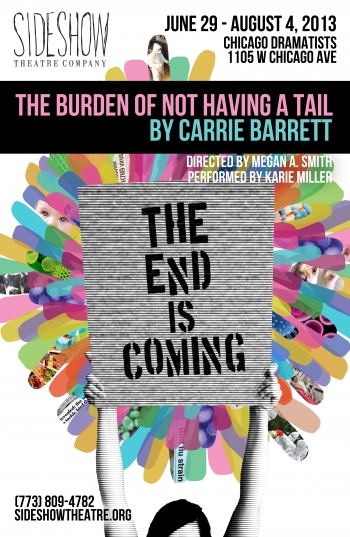 Sideshow Theatre is presenting this one-woman show at Chicago Dramatists. It’s an entertaining 70 minutes about the prospects of an apocalypse. Woman, the lone character, is a “prepper” and the audience (that would be us) is there to learn from her experience to prepare ourselves. There’s a sad thread to it (besides the grim one) about the death of her baby daughter.
All in all, the play fails to hold together as a play but I have to give the actor (Karie Miller), playwright (Carrie Barrett) and director (Megan Smith) props for a good try. It’s not easy to tell a dramatic story and hold a one-character play together. The successful ones I have seen are about the lives of riveting characters such as Clarence Darrow (by David Rintels from the Irving Stone biography) or Charlotte van Mahlsdorf (her story, I Am My Own Wife, was produced at Goodman Theatre in 2005). Or brilliantly written one-man plays, like Krapp’s Last Tape by Samuel Beckett.
Read my review of The Burden of Not Having a Tail on Gapers Block. You can see it until August 4.
Big Lake, Big City: Chicago noir
If you think “comic noir” is not an oxymoron, then you’ll love the new play by Keith Huff at Lookingglass Theatre. Huff wrote the gripping two-character cop play, A Steady Rain, which was a hit here at Chicago Dramatists and then went to New York where Daniel Craig and Hugh Jackman starred in it. That earned Huff his writing cred and he’s been writing for great TV dramas such as Mad Men and House of Cards, the recent Netflix streaming series that I wrote about in February.
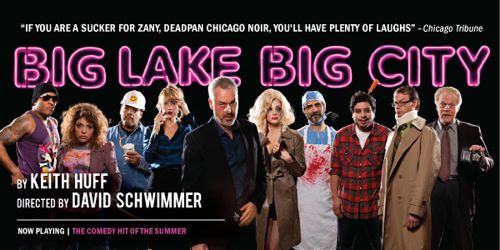
David Schwimmer directs this play about Chicago crime, with two hard-bitten police detectives (Philip R Smith and Danny Goldring), a guy who wants to go to Disneyland with a screwdriver embedded in his head (that’s right, he doesn’t make it through the metal detectors at O’Hare), and two morgue doctors who play golf with severed heads. Actually, heads get a lot of attention in this play and you can decide whether that’s symbolic or not. I left out the two corpses burned to a crisp while in flagrante delicto in a Lincoln Avenue motel and a dozen other delicious incidents.
The play has a lot of characters, a lot of plot threads and is probably more suited to TV, as a couple of critics have observed. Smith and Goldring are terrific as the two cops, and the acting and timing is very good. I suppose it’s not wholly successful as a theatrical exercise. However it’s really entertaining and stuffed with great Chicago jokes and references. My favorite scenic device is the Navy Pier Ferris wheel cab that I kept watching above me; it finally descended in one of the last scenes.
I recommend Big Lake Big City, although maybe not for out-of-town visitors. It runs until August 11 at Lookingglass Theatre at the Water Tower Water Works.
The Glass Menagerie: Memories in shards of glass
Mary Arrchie Theatre is presenting its distinctive version of the Tennessee Williams memory play in an extension at Theater Wit. It’s beautifully done and the acting makes you really appreciate Williams’ poetic language.
Tom, the poet, is played as a homeless man by Hans Fleischmann, who also directs. Tom wanders barefoot through a setting covered in glass shards. He’s the brother of delicate Laura and the son of Amanda (the southern belle who can’t believe the poverty of her current existence). There was something odd that I can’t quite put my finger on about Tom being played as a homeless man. The glass shards, of course, are reminiscent of Laura’s life with her glass menagerie and symbolic of their shattered lives. Basically, no one in the play accepts the reality of their own existence.
The play has a beautiful original score by Daniel Knox, which really enhanced the atmosphere.
I have seen The Glass Menagerie many times. My favorite still is the Court Theatre’s 2006 version, performed on an elevated set, mostly on the fire escape outside the Wingfield family flat in St. Louis. It captured the mood of Williams’ memory play beautifully, with fine acting in a minimalist setting. Jay Whittaker, an excellent Chicago actor who has left for other pastures, was a poetic Tom, longing for escape.
The Glass Menagerie runs until July 28 at Theater Wit, 1229 W Belmont.
Chicago as Brigadoon & other stories
Posted: July 1, 2013 Filed under: Chicago, People | Tags: Bill Savage, Chicagoist, John Hodgman, Newberry Library, Paul Durica, Pocket Guide to Hell Leave a commentI’m a student of Chicago history and have been ever since I started reading Mike Royko’s columns in the Chicago Daily News (RIP) and discovered Ben Hecht and Charles MacArthur’s play Front Page. I learned more in a Chicago history course at Steinmetz High School and a lot more in docent training from the Chicago Architecture Foundation. I’ve been collecting books and anecdotes about my favorite city ever since. When John Hodgman said that Chicago is a fictional city like Brigadoon, I knew this had to be added to my library. Bill Savage and Paul Durica obliged with another Chicago yarn.
John Hodgman discovers Chicago
 John Hodgman, the Daily Show resident expert and occasional “deranged millionaire,” was in Chicago recently for the Just for Laughs Festival. The Chicagoist interviewed him and he made an astounding statement, which we Chicago lovers must not forget.
“As you know, I, John Hodgman, have always maintained Chicago is a fable, a fictional city like Brigadoon.”
Hodgman had predicted the end of civilization and possibly the end of the world on December 21, 2012, in accord with the Mayan prediction. So he swallowed and walked that back a bit. Here are some snippets from the Chicagoist interview by Samantha Abernethy.
C: Are you concerned that the world could end before you appear in Chicago next week?
JOHN HODGMAN: No, but what I’m saying is that another one of my prophecies that came true is that Chicago became, Chicago emerged from the swamp next to the lake and became real. Because as you know I, John Hodgman, have always maintained Chicago is a fable, a fictional city like Brigadoon.
C: And why is that?
JOHN HODGMAN: Well you know, for those of us in New York, we would meet these travelers who had come to New York, and they would tell these stories about this amazing utopia called Chicago where rents were still reasonable and newspapers still thrived, and old-time bars still served boilermakers and the rivers were green with beer. I was like, “I’m sorry but you’re insane. There is no such place. If there were, why did you leave it?” And that’s how I came to believe that there was a mythical city called Chicago, a legend of folklore. There was this great city of wide shoulders in the middle of the country, but of course it’s patently false. Or it was, anyway.
I would come and visit quote-unquote Chicago for meetings and public appearances and lectures and comedy and so forth, and it was really amazing the lengths to which the so-called Chicagoans would go to maintain this fantasy. They’d build a great papier-mache city, a great white city* just to fool me and themselves that it was Chicago. I’m pretty sure as soon as I left the rain would wash it all away back into the lake. And now there is a real city called Chicago. It happened. It materialized, like magically. I’m looking forward to coming back to it.
C: And when did that happen?
JOHN HODGMAN: I would have to go back through my notes. Sometime in the fall of 2012…. In all seriousness, I love Chicago whether or not it was ever real. I’m glad now that for sure that it exists, because I love it so much.
You can read the whole interview here.
Chicago by Day and Night – or a Pocket Guide to Hell**
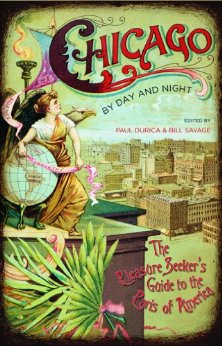
Paul Durica and Bill Savage, two Chicago writers, have published a new edition of Chicago by Day and Night: The Pleasure Seeker’s Guide to the Paris of America. They recently did a joint reading of excerpts from the book at the Newberry Library.
 Savage teaches Chicago literature, history and culture at Northwestern University and the Newberry. Durica is a writer and the founder of Pocket Guide to Hell Tours and Reenactments.
The book was originally published in 1892 for visitors attending the World’s Columbian Exposition of 1893. It advises such “wayfarers” where to find dining, amenities and proper entertainment while avoiding “the free and easy shows, gambling hells, barrel-house saloons, massage parlors and other dens of iniquity that beset our great city.” In so doing, of course, it makes the dens of iniquity seem very alluring.
The two writers wrote a new introduction and extensive notes for this edition. They tried to “strike a balance between recreating the book as it originally appeared and making it modern.” The entire book was reset in type, but the authors retained elements of the design, including the cover and most of the illustrations. The original book was meant to be vest pocket size. It’s 7×4.5 inches. Without the introduction and 65 pages of notes, it might still fit in a vest pocket.
The book was just published by Northwestern University Press; cover price is $16.95. While perhaps not a good reference for today’s tourist, it’s funny and engaging with many delectable quotes for a lover of Chicago history and trivia.
————————————-
* “… a great papier-mache city, a great white city”: This might be a reference to the World’s Columbian Exposition of 1893, built on Chicago’s south lakefront and known as the White City. All but two of the buildings were meant to be temporary and were demolished after the fair. The Beaux Arts structures were built of “a mixture of plaster, cement and jute fiber called staff.” Erik Larson’s book, Devil in the White City, gives many details of the fair’s construction.
** “Chicago is a pocket edition of hell.” “Hell is a pocket edition of Chicago.” According to legend (located in a footnote in Jack London’s 1907 novel The Iron Heel), a famous English labor leader named John Burns visited Chicago. When asked his opinion of the city, he said, “Chicago is a pocket edition of hell.” Later, as he departed for England, he was asked if he had changed his opinion of Chicago. “Yes, I have. My present opinion is that hell is a pocket edition of Chicago.” Thanks to Chicago Weekly; see more here.
Gapers Block: Best local blog of 2013
Posted: June 27, 2013 Filed under: Theater Leave a commentHere’s a recap of what I’ve been writing for the A/C page at Gapers Block lately. Cruise on over and see what’s going on there. This 10-year-old Chicago website was just named Best Local Blog on the Chicago Reader’s Best of Chicago 2013 list. It’s chock full of news about our favorite city: politics, music, books, sports, architecture, and arts and culture of all types.
You’ll notice that all the section titles have a driving/traffic theme. Merge. Transmission, Tailgate. Drive-Thru. Slowdown. Don’t know what a gaper’s block is? Check the About page over there.
The Half-Brothers Mendelssohn at Strange Tree Group
My headline says “Strange Tree Creates Head-Spinning Trips in the Time Machine.” Here’s how my review starts.
“What year is it? The opening in 1929 is the only time you’ll be sure.
“The Half-Brothers Mendelssohn begins with a dignified scene. It’s a funeral. The corpse (Joseph Stearns) is at rest in a raised coffin. The mourners are dressed in black. The funeral program informs us that The Rev. Christopher Herbert (Cory Aiello) will give the eulogy and his daughter Margaret (Audrey Flegel) will play selections from Felix Mendelssohn on a piano that someone forgot to have tuned. There also will be “Words From Family Members.”
“Yes, there will be words. Dueling speeches from two widows, in fact (Kate Nawrocki and Jenifer Henry Starewich). And there, 10 minutes into the play, sanity ends.”
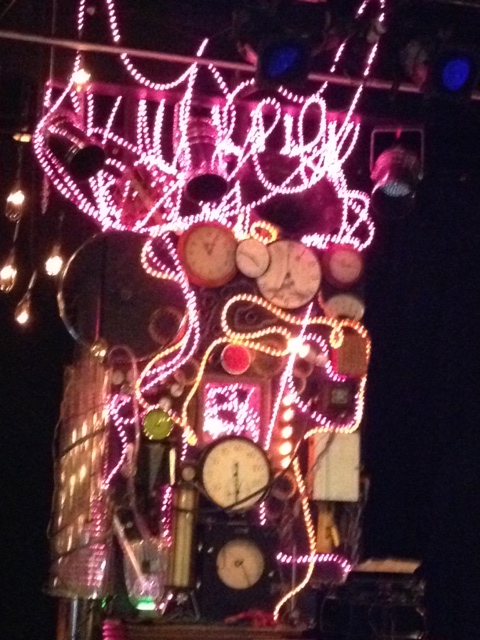 The Half-Brothers Mendelssohn is a funny, smart play that’s sort of about time travel but it’s really about love, families and surprising outcomes. I loved it and strongly recommend you check it out. The time-machine itself is a character in the play. My photo shows it in its glory.
Strange Tree is presenting this through July 20 at Signal Ensemble Theatre at 1802 W Berenice. It’s a nice venue in the West Lakeview/Ravenswood area and you might even find unmetered street parking.
Read my full review at gapersblock.com.
The Pride at About Face Theatre
My headline: “Time Shifts Emphasize Change in The Pride at About Face Theatre.” Here’s an excerpt from my review.
“The Pride is set in two eras, 50 years and eons of attitudes apart. The title reflects how societal and political changes have affected gay people and their straight friends over the years.
“The Pride takes place in London in 1958 and 2008; the players are two sets of characters who each have the same names in both time periods: Oliver (Patrick Andrews), Philip (John Francisco) and Sylvia (Jessie Fisher). The seeming emphasis on the names heightens our awareness of the societal changes that enable the modern Oliver, for instance, to live his life in a different way than the other Oliver could have.”
The Pride is being presented in the Richard Christiansen Theatre upstairs at Victory Gardens/Biograph at 2433 N Lincoln. It runs until July 13. Thought-provoking and very well acted and directed.
Read my review of The Pride on gapersblock.com.
See a real live playwright at work: The Storefront Playwrights are back
 Nearly 40 emerging and established playwrights will demonstrate how their craft works Tuesdays through Saturdays in July. Each playwright will work for a half day in the storefront window at 72 E. Randolph. Viewers will be able to read the work in progress on a large screen. The League of Chicago Theatres initiated this project in December 2012. But July weather should be more conducive to lingering to read while the playwright writes.
See my preview at gapersblock.com.
June Jam: MDQ + MC Othello
Posted: June 21, 2013 Filed under: Music, Theater | Tags: kids' theater, rock and roll Leave a commentDid you think there was a midsummer night’s slowdown? Nope. Lots of stuff going on in my world. You might be interested in these. They’re suitable for family entertainment or music and theater regulars.
My grandson and I had a theater bash weekend, his belated 15th birthday treat. We saw Million Dollar Quartet at the Apollo Theatre Friday night and Othello: The Remix at Chicago Shakespeare the next day. Both shows gave us great music as well as compelling theater. We loved both and the next day couldn’t decide which was better.
MDQ is in an open run at the Apollo Theatre on Lincoln Avenue. Othello: The Remix by GQ and JQ runs thru July 27 at Chicago Shakespeare on Navy Pier.
A million-dollar quartet in 1956–that’s $8.5 million today
I saw MDQ when it first opened here in 2009 — and although I say I hate musicals–you gotta love two hours of rockabilly music. It’s a great show–a jukebox musical, certainly–but with elements of character insight and plot points that make it fascinating (especially if you’re a music geek). From the first chords of “Blue Suede Shoes” to the last notes of “Whole Lotta Shakin’ Goin’ On,” the music is infectious and unbeatable.
 I assume you know the basic story. On a certain day in December 1956, four rock stars and almost-rock stars arrived at Sun Studios in Memphis. Each had his own issue to pitch or discuss with studio head Sam Phillips. The music that results is amazing. From Carl Perkins’ hot guitar licks on his Les Paul Gold Top and Jerry Lee Lewis acting up at the keyboard, to Elvis Presley and Johnny Cash singing and playing guitar in their inimitable styles. The great thing about this show is that the four performers are all musicians first as well as credible actors–so it ain’t faux piano playing when Lance Lipinsky hits the keys as Jerry Lee Lewis.
Near the end of the show, Sam Phillips wants to take a photo of his four artists. They pose around the piano and recreate the above photo of 57 years ago, which then appears on a giant screen.
James and I came home and watched YouTube videos of Jerry Lee Lewis.
Note for foodies: The Etno Village Grill
We wanted burgers before the show, so we went to a great little place just up the street from the Apollo. The Etno Village Grill, at 2580 N Lincoln, serves grass-fed burgers, and homemade soups and salads in addition to European-inspired street food such as Cevap sausages. Everything is made fresh and grilled to order. Sandwiches can be customized with 20 or so condiment options — most of them homemade — such as Etno Spread (feta cheese/sour cream/chilli pepper), great tsatziki, roasted garlic and chive spread (sour cream, roasted garlic, chive) and homemade dill or sweet pickles.. Highly recommended for excellent food quality. It’s a rather rustic, casual environment with counter service.
Othello: The Remix at Chicago Shakespeare
The next afternoon, we watched Shakespeare’s Othello in a hiphop setting. And you know what? It works. MC Othello is a musician who escapes the ghetto and rises to the top of the music industry. He’s in love with and marries a beautiful singer named Desdemona (whose voice we hear but never see). Iago, Cassio and Roderigo play roles something like Shakespeare wrote, transmogrified into the hiphop world. The four talented actors play all the parts, wearing coveralls and grabbing wigs, hats and props when they change characters. And they change characters frequently, with very convincing change of voice and physical demeanor.
The musical highlight of the show was surely “It’s a Man’s World” with topical humor merged into Shakespeare’s lyrical verse. The four actors perform it in glamour-gal style wearing gold lame “gowns” and nightclub-singer wigs and jewelry.
The plot twists and turns about jealousy and a fabricated affair are played in hiphop couplets with music. The play ends tragically, as the Bard wrote. It’s sharp and inventive and another star performance by the team that created and starred in Bomb-itty of Errors and Funk It Up About Nothin’.
Two theater reviews, one inspired by Bruce Springsteen
Posted: June 19, 2013 Filed under: Music, Theater | Tags: Bruce Springsteen, Gapers Block, theater 1 CommentTwo new theater reviews for your consideration. Both are excellent examples of why Chicago is such a great theater town. Homecoming 1972 only runs through this weekend but you can see Mine until August 11.
Homecoming 1972 at Chicago Dramatists
Chicago Dramatists is a fine, playwright-oriented theater company with a comfy small space at 1105 W Chicago Ave. Homecoming 1972 is a riveting play about the after-effects of the Vietnam war and its impact on those who served and those who stayed at home. As I note in my Gapers Block review, about halfway into the play I realized that it was based on the Bruce Springsteen song, “Highway Patrolman,” from the acoustic 1982 album, Nebraska. Frank, Joe and Maria? Those are the characters in the story Springsteen tells in that amazing song. Here are the lyrics, a summary of the play.
You’re probably thinking, “She’s obsessing again. Nancy thinks everything in life links back to Bruce Springsteen.” Well, I do think that. But in fact, the playwright Robert Koon is known to be a Springsteen fan too. I talked to some cast and crew members after the show and they confirmed that.
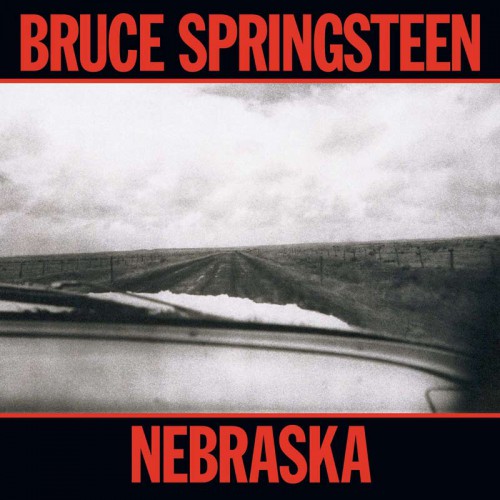 The Nebraska album is a mournful record of life in the late 1970s. Except for a few songs like “Atlantic City” and “Open All Night,” the album is basically a series of stories about downtrodden, lonely characters. Springsteen recorded it in his bedroom on a tape recorder, intending it to be a demo to be released with a full E Street Band treatment. But his manager convinced him to release it as his first acoustic album. Its initial reception was lukewarm but in the years since, it has been acknowledged as one of his finest albums.
Chicago’s Tympanic Theatre Company produced Deliver Us From Nowhere last year, a series of 10 short plays based on the 10 songs on Nebraska. It was an interesting attempt but less than successful theatrically.
You can read my review of Homecoming 1972 here. I strongly recommend it.
Mine at The Gift Theatre
The Gift Theatre performs in a tiny storefront on the northwest side. It’s a theater that I’ve been meaning to go to, since its work always gets outstanding reviews. I finally did that this week and reviewed a play called Mine that combines contemporary fears about parenting with reversion to medieval folklore. It’s a very intense and haunting play, made more intense by the small performance space. I often think when i see a play like this in a tiny space how much different it would seem if performed on a proscenium stage with a great deal of distance between players and viewers.
Read my review and try to see Mine — you have about six weeks to get there.
Czech Dream + Pussy Riot: Political reviews
Posted: June 15, 2013 Filed under: Movies, Politics, Punk rock 3 CommentsCzech Dream – a hoax reviewed
The Czechs got punked in this smart and funny documentary set in 2003 Prague. It was created by two film students, who get government support to create the documentary. Documentary filmmaker Morgan Spurlock (Supersize Me) introduces the film. He says admiringly, “I wish I’d thought of it.”
 The two filmmakers (Vit Klusak and Filip Remunda) go through the elaborate process of launching a new hypermarket for the shopping-crazed Czechs (who still remember waiting in long lines for basic necessities in the Communist era). Vit and Filip, as the store managers, get personal makeovers, pose for corporate portraits, and work with the local office of a well-known global advertising agency (BBDO). The agency (they’re in on the hoax) creates logos, signage, clever anti-consumerist advertising, giant billboards, flyers, even fake product labels for house-branded products. The campaign teases about the nature and location of the hypermarket, named Czech Dream (Cesky Sen) as a result of a focus group process.
The film ties in with the 2003 Czech Republic referendum on the question of joining the EU. The referendum passed with 77 percent of the votes and the country joined the EU in 2004. The political overtones of the film are probably more apparent to Czechs than they may be to viewers today.
On opening day, May 31, 2003, thousands of people gather hours before the store opening. Fencing keeps them a long hike from the colorful and massive storefront, which they can view in the distance. Finally, after long opening ceremonies and a bungled ribbon-cutting, the crowd is allowed to enter. The crowd trudges across the field toward the store, including families with baby carriages, and elderly people using canes and walkers.
When they get there, they find it is a Potemkin village. A storefront with nothing behind it.
The reactions of the prospective customers are most interesting. Some are really angry. Some blame the government. Some get the joke and enjoy it.
Both filmmakers have continued to make films in the Czech Republic since then. They must have learned a lot about audiences from this process – and so will you.
Pussy Riot, A Punk Prayer – an activist’s review
We’ll stay in eastern Europe for this 2013 film: a profile of the feminist performance-art collective known as Pussy Riot, which premiered on HBO this week. Because of their February 2012 performance on the altar of a Moscow church, a protest against Putin’s reelection, they were arrested, tried, found guilty and sentenced to two years in a penal colony.
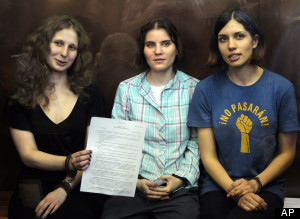
L to R, Masha, Katia, Nadia (Maria Alekhina, Yekaterina Samutsevich, Nadezhda Tolokonnikova)
Nadia and Masha are still serving prison terms; Katia’s sentence was suspended and she was released. They have become poster children for free speech all over the world. They are activists who use art to communicate and bring about political action. They were defiant to the end. “Come and taste freedom with us,” was Nadia’s closing remark at the trial.
In the film, religious people tell the filmmakers how much they were offended, even insulted, by Pussy Riot’s protest on the altar. Russia supposedly is a secular state with a secular constitution, according to one of the defense lawyers. But they were charged with blasphemy. Katia’s sentence was suspended because she had not actually done anything on the altar; she was taken away by police before being able to perform. She continues the Pussy Riot activities while Nadia and Masha serve their terms.
Pussy Riot has many more members who demonstrated in Moscow wearing neon-colored balaclavas and tunics. One of their early protests was “kiss a cop.” The documentary shows video of members attacking Moscow police with kisses. The day of the sentencing, many protestors wearing trademark balaclavas protested around the trial site. Their protests involved climbing on to the court building, shouting and singing their political messages and punk lyrics.
I wrote about Pussy Riot last fall and showed this photo of the three defendants; Nadia is wearing her No Pasaran shirt. @free pussy riot is on Twitter and has a multilingual website http://www.freepussyriot.org To my great joy, #nopasaran is a trending hashtag on Twitter, almost 70 years after the Spanish Civil War.
Design at Work and Play
Posted: June 12, 2013 Filed under: Design 1 CommentThe Chicago Design Museum has a varied exhibition on graphic design titled Work at Play, part of the Pop-Up Art Loop project. The exhibit includes work by four major designers and a collective of 12 contemporary designers. You can see it until June 30 in a raw temporary display space on the third floor of the Block 37 building, 108 N State St.

Wall of John Massey posters. Photo by Nancy Bishop.
My review at gapersblock.com notes that the exhibit honors the work of John Massey, a famous Chicago designer best known as the director of design and communications at the late great Container Corporation of America and the founder of the CCA Center for Advanced Research in Design.
Read my review at gapersblock.com.
Newest hot spot? Median on State Street
Posted: June 8, 2013 Filed under: Art & architecture, Design | Tags: Chicago Loop, State Street 1 CommentThe city of Chicago opened a new temporary park called Gateway to the Loop right in the middle of State Street yesterday — on the median between Wacker Drive and Lake Street. It’s a great place to savor your Starbucks, meet a friend for a brown bag lunch, or just kill time being an urban person. It’s really quite charming.
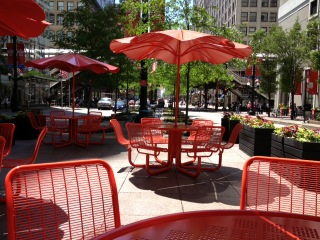

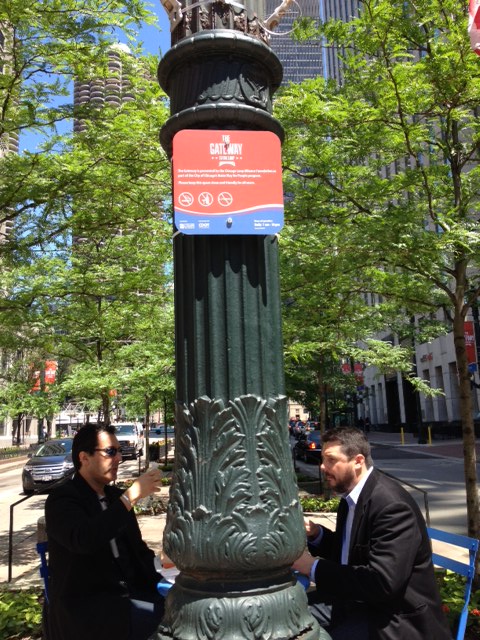
Photo credit: Nancy Bishop
Moving north: A theater director’s odyssey
Posted: June 6, 2013 Filed under: Theater | Tags: Gapers Block, Interrobang Theatre Project, North Carolina Leave a commentMy newest article on gapersblock.com is about a theater director who moved to Chicago from Charlotte, NC, to find a more challenging and dynamic theater scene. As you may know, I have a strong North Carolina connection. I’ve been there many times to spend time with my son, his beautiful lawyer wife and their two darling cherubs. I’ve spent time mostly in Greensboro but also in Winston-Salem, Durham, Raleigh and Charlotte. I know a little about the arts scene in Charlotte from my time with the giant law firm that has an office there. And I’ve been to a whole bunch of Bruce Springsteen concerts in North Carolina since 2002. (Greensboro is one of my favorite places to see Bruce; the audiences there are great!)
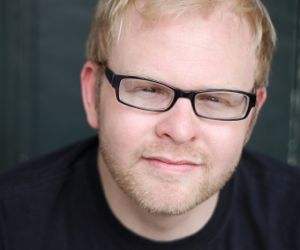 I met Jim Yost, the director, when I attended his current production, Orange Flower Water, at the Raven Theatre a few weeks ago. (The play is a co-production of Jim’s company, Barebones Theatre Group, with his new Chicago company, Interrobang Theatre Project.) You can see a link to my review on the right. I thought his move to Chicago from Charlotte might make an interesting feature for Gapers Block, the website about everything Chicago. So Jim and I had a good conversation recently in my office away from my home office, a Panera Cafe, and the story, in interview form, went up today.
It’s been years since I recorded an interview, transcribed it and turned it into a story. (I did that a lot earlier in my career.) It’s not a quick process, as any writer will tell you. But it’s a rewarding one — and getting the subject’s voice and style just right in the interview is important.
So here’s the story of Jim Yost and his move north to Chicago. His closing remark, which I didn’t put in the story? “I really love Chicago, except for the winter.” I told him he would get used to it. That’s why stores sell mittens, earmuffs, scarves and big puffy jackets.
(Photo courtesy of Interrobang Theatre Project.)
Smudge, a parent’s bad dream
Posted: June 2, 2013 Filed under: Theater | Tags: Athenaeum Theatre, Gapers Block, Ka-Tet Theatre Leave a commentKa-Tet Theatre is presenting a very interesting, dark and challenging play at the Athenaeum. Smudge by Rachel Axler is a 90-minute odyssey from ultrasound to reality. Here’s the beginning of my review at gapersblock.com.
It’s a prospective parent’s worst nightmare: Will our baby be perfect? A missing finger or toe and many congenital diseases can be adapted to or treated, but in Smudge, Ka-Tet Theatre asks us to think about how we would deal with an even more dramatic birth–an infant that may not be quite human.
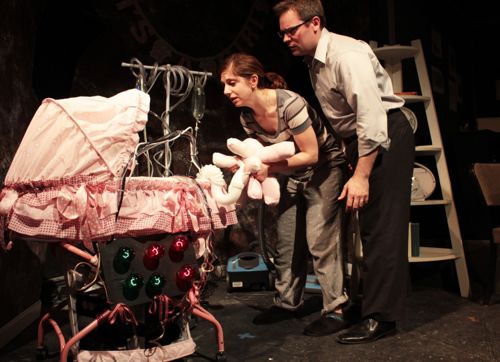 “This thing doesn’t need a mother,” Colby (Stevie Chadwick Lambert) says midway through this one-act, 90-minute play. “It’s got tubes.”
— *** —
Please read the review here. And check out this play for a rewarding evening of theater from one of our interesting small theater companies.
Stevie Chadwick Lambert (with Mr Limbs) and Scott Allen Luke. Photo by Andrew Cioffi
 nancy bishop's journal