Nancy’s Journal: 2013 in review
Posted: December 31, 2013 Filed under: Digital life Leave a commentThe WordPress.com stats helper monkeys prepared a 2013 annual report for this blog. I’ll be posting my personal 2013 favorite things soon.

Here’s an excerpt:
A San Francisco cable car holds 60 people. This blog was viewed about 3,500 times in 2013. If it were a cable car, it would take about 58 trips to carry that many people.
Click here to see the complete report.
Reliving the ‘60s: My review of Inside Llewyn Davis
Posted: December 28, 2013 Filed under: Movies, Music | Tags: @CFLX312, Bob Dylan, Bruce Springsteen, Dave Van Ronk, Gapers Block, Inside Llewyn Davis, Steve Prokopy 2 CommentsYes, I was there in the ‘60s, but not in Greenwich Village where Dave Van Ronk and Bob Dylan hung out and where the new film Inside Llewyn Davis is set. I spent the ‘60s in northwestern Wisconsin in River Falls, a small college town that I now think of as Brigadoon, a magical place. Well, at least a very good place to live and raise two small boys. We lived in a series of comfy old houses with big back yards on tree-lined streets with names like Cedar, Maple and Main.
We didn’t go to the Gaslight Café to hear up-and-coming musicians. But we did go to a local coffee house to listen to folk music and poetry by students, faculty and occasionally visiting talent. And there was always some kind of musical or theatrical event to attend on campus. Eugene McCarthy campaigned in River Falls in 1968 and we went to the parade on Main Street to cheer him on. What a lovely place to live.
You can’t help but think of life in the ‘60s as you watch Inside Llewyn Davis, the new Coen brothers film that you could only have missed hearing about if you have been in a cocoon for the last month. But for once, the hype is worth it. It’s a smart film, mostly historically accurate, and the music is worth the price of the ticket. Even though I generally prefer music that rocks, these are lyrical, traditional folk ballads (with one exception) arranged for today, with T Bone Burnett as the musical czar and Marcus Mumford (of the eponymous Mumford & Sons) as co-producer. Best of all, you hear full-length songs in the film, not 30-second samples.


The Llewyn Davis character is patterned after a folk singer of the time, Dave Van Ronk, whose memoir, The Mayor of MacDougal Street, was one of the Coen brothers’ historical sources. Van Ronk’s second album, Inside Dave Van Ronk, provided the cover art idea for the movie version of the Llewyn Davis album, Inside Llewyn Davis. And the poster for the new film is a dead ringer for the cover of Bob Dylan’s album, The Freewheelin’ Bob Dylan (with a cat instead of Suze Rotolo). The similarities are striking in both cases. My friend June Skinner Sawyers writes about the Freewheelin’ photo shoot in her book, Bob Dylan: New York (2011, Roaring Forties Press).
The film shows us the quest of Llewyn Davis (played by the very talented Oscar Isaac), a folksinger who wants to perform authentic folk music, in the era before the genre became commercial. He goes everywhere, with his beatup guitar case, a knapsack, and usually a cat over his arm. The cat, who acts like cats do, is also on a quest—to escape from Llewyn’s grasp and, maybe, to get home. The fact that the cat is named Ulysses, which we don’t find out until the end of the film, adds to its charm. We could analyze Llewyn’s quest as that of a modern-day Ulysses or Odysseus, but we don’t need to do that to enjoy his quest for someone to listen to his music and pay him for performing. He just wants to make his living as a musician.
His journey includes performing at the Gaslight, a “basket club” where performers’ remuneration is in the tip basket; trying to get his manager to sell his solo album; and taking a road trip to Chicago, which is a short film in itself. He finds his way to the Gate of Horn on Dearborn Street to audition for its owner, Bud Grossman (played by Murray Abraham), who is known to be an effective manager of musicians. In an empty club, in sunlight and shadow, Llewyn plays an old folk song, “The Death of Queen Jane” for Grossman. Unfortunately, it’s the wrong song. Grossman says “I don’t see much money in that,” when Llewyn finishes.
The Grossman character, like most of the characters in the film, is patterned after a real person. Albert Grossman, the man who ran the Gate of Horn, managed Bob Dylan, Janis Joplin, and created and managed the trio Peter, Paul and Mary. At the end of Llewyn’s audition, Grossman tells him he’s forming a trio of two guys and a girl singer. “If you trim that beard to a goatee and stay out of the sun, we could use you,” Grossman tells Llewyn. Llewyn declines the opportunity.
There are many parallels to the quest of other young musicians to gain an audience. Bruce Springsteen spent years playing in small bands and performing on his own before finally getting to audition for John Hammond, the legendary Columbia record producer and civil rights activist. Bruce’s manager, Mike Appel, pressured Hammond to audition Bruce in May 1972 and the result, after Bruce played for Hammond, was a 10-record contract with Columbia. Bruce was lucky; he had a manager who fought for him (even though he and Appel later split in a contentious contract dispute). If he hadn’t, he might have ended up like Llewyn Davis, wandering the streets of New York with his guitar and playing for tips.
In a 1998 interview with MOJO magazine, Springsteen remembered the session: “It was a big, big day for me… I was 22 and came up on the bus with an acoustic guitar with no case… I was embarrassed carrying it around the city. I walked into his office and had the audition, and I played a couple of songs and [Hammond] said, ‘You’ve got to be on Columbia Records.’ – See more here. The audition tracklist and the tapes themselves were part of the Bruce Springsteen exhibit at the Rock and Roll Hall of Fame and Museum that ran from April 2009 thru February 2011. (I visited three times.)
At the very end of the film, after Llewyn leaves the stage at the Gaslight, we see the next performer in shadowy profile—a young Bob Dylan; the song playing is Dylan’s unreleased version of “Farewell” aka “Fare Thee Well,” an 18th century English song that’s played several times in the film. Playing over the credits is Dave Van Ronk himself, singing “Green Green Rocky Road,” which Llewyn sings in the film.
The Coen brothers have created a film that immerses you in 1961 Greenwich Village with their obsessive attention to detail. It’s a good film to just enjoy; you’re sure to find some elements that apply to your life, even though you may disagree with others. There have been many reviews of this film and interviews with its star. Plus Showtime is running an excellent concert film (Another Day, Another Time: Celebrating the Music of “Inside llewyn Davis”) with music and performers from the film plus other related music and performers. My favorites in this splendid cast are the Punch Brothers, fronted by Chris Thile, the mandolinist and composer who won a MacArthur Fellowship (the Genius Grant) last year. I’ve had discussions, arguments even, with friends who want to overanalyze the Llewyn Davis character. Or the cat. Don’t do it. As Steve Prokopy says at the end of his Gapers Block review:
“The movie manages to be rough around the edges, yet poignantly elegant. Many audience members may not be familiar with Isaac’s work: he’s been around for a few years in supporting roles. But he rises to the importance of this role, in a way that Davis himself probably never could have. The parallels between the character and the person playing him are not lost, but one is rising to the occasion while the other is frequently buckling under pressure. Inside Llewyn Davis is easily one of the best films you’ll see this year, but it may be difficult to pinpoint why. So don’t try — just let the music, the humor, the look and feel of it all wash over you and take you to a place that feels like another world.
I couldn’t agree more.
December Diary: My reviews of theater, art, movies
Posted: December 18, 2013 Filed under: Movies, Music, Theater | Tags: @CFLX312, Den Theatre, Gapers Block, Inside Llewyn Davis, Irish writers, Remy Bumppo, theater vs. theatre, Theater Wit 1 CommentTwo theater recommendations
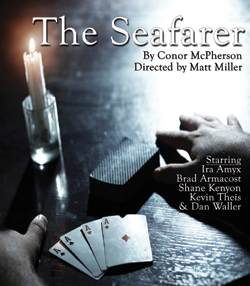 The Seafarer is a Christmas play by an Irish playwright. Given that, you know that there may not be a happy ending or a lot of tra-la-la. And there most likely will be consumption of alcohol. I hate stereotypes, but there you are. The Seafarer, by Conor McPherson, is a terrific production by Seanachai Theatre Company at The Den Theatre on Milwaukee Avenue. My Gapers Block review gives all the details. The play is running until January 5. I gave it a “highly recommended” for theatreinchicago.com, as did all the other reviewers.
That website, theatreinchicago.com, is a great resource for theatergoers. It compiles reviews of all current plays on Chicago, along with their ratings. Go to the website and click on Review Roundup in the left-hand column.
An Inspector Calls at Remy Bumppo Theatre seems at first like a smart drawing-room comedy. But J.B. Priestley’s play, written in 1945 for an English audience, soon turns into a tale about the 99 percent vs. the 1 percent. The 1 percent is the Birling family, wealthy through their manufacturing business. The 99 percent is represented by a young working woman who comes to a sad ending through actions, ultimately, taken by all the family members. (That’s a bit of a spoiler, so forget I said it.)
The Remy Bumppo cast is excellent and the production very gripping. Nick Sandys, as the mysterious inspector, plays the role very coolly. Calmly and without bluster, he terrorizes the Birlings in their dining room. Priestley was raised in a socialist family and was a writer of social conscience. As David Darlow says in his director’s note, Priestley “calls out to us to be accountable and responsible for our behavior and actions.” The play runs through January 12 in the upstairs mainstage at the Greenhouse Theater Center on Lincoln Ave.
Linguistic whine. Why can’t theater/theatre companies settle on one spelling, preferably the standard American spelling of theater, rather than the pretentious Anglified theatre. When I’m writing reviews for Gapers Block, it makes me crazy, going back and forth between the spellings, depending on whether I’m naming a theater company that persists in using that spelling (see above) or using the word generically as part of a sentence. Grrrrr.
Art with a message

Small Change by Richard Laurent; image courtesy of the curator.
The Art of Influence: Breaking Criminal Traditions. There’s a very interesting exhibit of art with a message at the IIT Chicago-Kent College of law, 565 W Adams St. I know, that’s an unusual place for an art exhibit, but it works. The exhibit is made up of 38 works in various media by 13 local and regional artists and represents metaphorically — in ways both beautiful and horrifying — the crimes perpetrated on women and girls in countries where those actions are considered part of the culture, rather than crimes. The purpose of the exhibit is to make an impact on those who may be influential in the future to help change the legal processes in those countries. My review for Gapers Block gives all the details and shows four images that illustrate the range of the work.
Films, live and DVDd
Blue Is the Warmest Color, directed by Abdellatif Kechiche. This controversial film about a young woman and her older woman lover in Lille, France, is beautifully filmed and to my mind, too long at 3 hours plus. The much-discussed sex scenes are quite beautiful and almost painterly in their composition. Most importantly, the film raises issues of male viewpoint, social class and life choice between the two lovers and their friends and families; those issues are fruitful discussion topics. The film is currently on view at local theaters.
A Constant Forge: The Life and Art of John Cassavetes (DVD). This very thorough documentary of Cassavetes’ work is well worth your time as an illustration of the auteur approach to independent filmmaking. It’s almost 3.5 hours long and no, this film wasn’t too long, although I did watch it in two sittings. It was made in 2000, about 11 years after his death at 59. The doc includes interviews with many of the actors he worked with: his wife Gena Rowland, Peter Falk, Ben Gazzara, Jon Voight and Seymour Cassel. The actors and others talked about his creativity, his honesty, and his lack of concern about making money. Many long film clips and film of scenes during the shooting process really bring Cassavetes’ approach to life.
My favorite Cassavetes quote: A reporter asks him if he’ll ever make a musical. He says he really wants to make only one musical, Dostoyevsky’s Crime and Punishment. My kind of guy.
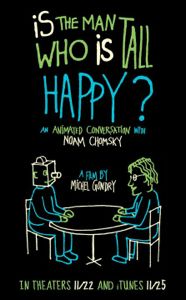 Is the Man Who Is Tall Happy? An Animated Conversation with Noam Chomsky. Yes, I said Noam Chomsky. But this is the avuncular linguistics professor, not the radical political activist (though just a hint of that Chomsky shows occasionally). French director Michel Gondry (Eternal Sunshine of the Spotless Mind) created this animated documentary from interviews with Chomsky. He animates and illustrates Chomsky’s ideas by scrawling clever cartoons and charts.
The film title is taken from a sentence that Chomsky diagrams near the end of the film to show how children learn to use language.
The film runs at the Gene Siskel Film Center through tomorrow. I’ll watch it again on DVD when it’s available. There are places where I wanted to say, “Wait, let me replay that last bit because I didn’t quite get it.”
My coming attractions for this week
Inside Llewyn Davis. This is the Coen brothers film about the early years of the folk movement in Greenwich Village in the 1950s. It opens here Friday and I’ll be there. In addition to the film, Showtime network has been running a concert with a setlist of some of the music from the film, performed by other musicians. There’s also a Showtime making-of film called Inside Inside Llewyn Davis. And there’s the soundtrack on CD or download. I’ll review this film here soon.
Blood on the Cat’s Neck by Rainer Werner Fassbinder at Trap Door Theatre on Cortland. The always provocative and entertaining Trap Door group has been getting mixed reviews for this play; it’s Jeff recommended, however.
Burning Bluebeard by Jay Torrence presented by The Ruffians at Theater Wit. The play is about the tragic 1903 Iroquois Theatre fire in Chicago. This is a theater company I have not seen before and I’m looking forward to it.
And finally, I’ve gone another whole week without writing about Bruce Springsteen. But he has a new album coming out in January. You can be sure I’ll make up for my apparent neglect.
After 32 years, it’s time: Oscar Libre!
Posted: December 13, 2013 Filed under: Politics | Tags: Free Oscar!, National Boricua Human Rights Network, Oscar Lopez Rivera, Pussy Riot 3 CommentsHuffington Post ran an article last weekend as a commentary on the death of Nelson Mandela. “But though Mandela, who died this week at the age of 95, eventually won his fight,” the article said, “many around the world today continue to fight their own battles, risking their lives and their freedom to speak up against injustice.”
HuffPost went on to highlight 10 political prisoners who deserved attention–and release. Prisoners listed were the Pussy Riot pair in Russia (of whom I have written several times), Liu Xiaobo in China, and eight more in other countries. The article ignored political prisoners held in the United States. (And by the way, Guantanamo is considered US property.)
Oscar Libre! Free Oscar!
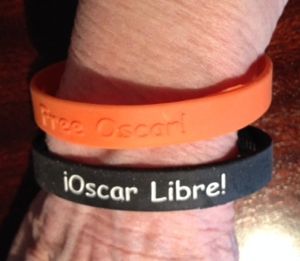
Free Oscar! bracelets. Photo by Nancy Bishop.
The important name not mentioned was Oscar Lopez Rivera. Several commenters to the article did mention his case and I wrote a correction message to the editor, but HuffPost has not responded. It happened that the day I read this I had just returned from the annual National Boricua Human Rights Network pancake breakfast, held every December at Casa Puertorriqueña to raise funds for Oscar Lopez Rivera and to generate support for his release. Each year, we write notes on Christmas cards for Oscar, hoping that next year he will celebrate the holiday at home with his family. And we sign petitions to President Obama, requesting that he consider Oscar’s case and release him.
Lopez Rivera, now 70, is in federal prison in Terre Haute, Indiana. He has been imprisoned for 32 years for sedition. He was never charged with causing harm to persons or property, just for planning and organizing in favor of Puerto Rican independence.
A longer serving US political prisoner is Native American activist Leonard Peltier, who is serving two life sentences for the 1975 execution-style deaths of two FBI agents. Peltier has maintained that he was framed by the FBI and has appealed his conviction several times but has been denied. The 68-year-old was last denied parole in 2009 and won’t be eligible again until 2024.
And then there’s Guantanamo, where we’ve held more than 150 political prisoners for 12 years. As Nicholas Kristof commented recently, “There is a whiff of hypocrisy about the adulation for Mandela even as we simultaneously sell weapons to repressive regimes around the world.” And hold political prisoners unjustly within our own borders.
Oscar Libre! Free Oscar!
Channeling Mr Hemingway
Posted: December 8, 2013 Filed under: Politics | Tags: Ernest Hemingway, Key West, six-toed cats, Spanish Civil War, Tennessee Williams 5 CommentsThere’s something eerie and exciting about walking through the home of a writer you admire. I recently returned from a family vacation cruise and our first port of call was Key West, where both Ernest Hemingway and Tennessee Williams created significant works in their oeuvre. Many other writers lived there at one time or another too.
Williams first visited Key West in 1941 and lived at the La Concha Hotel on Duval Street. He later bought a house that remained his home until his death in 1983, although he traveled and worked in many cities. In Key West, he wrote Streetcar Named Desire, Summer and Smoke, Night of the Iguana and The Rose Tattoo. The 1956 film of Tattoo was filmed in Key West with many residents acting as extras. It wasn’t possible to see the room where Williams wrote, so we passed the hotel on our trolley ride around the island.


Hemingway lived in the house in Key West from 1931 to 1940. (See my photos of the house exterior, coach house and his office.) A knowledgeable docent led us on a tour of the house, describing the art work Hemingway collected (including a painting of a cubist cat given to him by Pablo Picasso) and the heavily carved Spanish furniture that he had sent from Spain.
Yes, the six-toed cats are thriving at the Hemingway House. There are dozens of them, all descendants of Hemingway’s original polydactyl cat named Snowball. Cats named after famous authors prowl and lounge about on the patio and in the many little cat houses.
Hemingway turned the second floor of the coach house into his office. After touring the house itself, we were able to walk up the stairs of the coach house and peer into his office, which is restored to the way it was when he wrote there. Shivers down my spine. I felt just as I did walking through Carl Sandburg’s office on the second floor of his old farmhouse outside Asheville, NC.
During the Key West years, Hemingway spent time in Spain as a reporter covering the Spanish Civil War. That experience resulted in his novel For Whom the Bell Tolls, about an American fighting with the Republican forces in Spain.
If you’re not familiar with the Spanish Civil War, get thee to a bookstore or a website and read about it. To me, it was the last great war involving political passion. That’s why, without any support from their country, some 3000 Americans went to Spain to join the International Brigades and fight fascism. Because the US and other western powers refused to support the democratically elected Republican government, the fascists were able to take over, massacre thousands of Republican freedom fighters, and ensconce Generalissimo Francisco Franco is power for the next 30 years.
Hemingway also finished A Farewell to Arms in Key West and wrote To Have and Have Not, The Green Hills of Africa, Death in the Afternoon, and many short stories there. He moved to Cuba in 1940, where he spent almost 20 years. In 1959, he bought a house in Ketchum, Idaho, where he committed suicide in 1961.
Related posts
About me and the Spanish Civil War. Please check out my essay about how I came to be so interested (dare I say obsessed?) with this war. Also see the website for the Abraham Lincoln Brigade Archives, an organization dedicated to ensuring we remember the Spanish Civil War.
”¡No pasarán!” Two of the three Pussy Riot activists are still imprisoned in Russia for protesting the suppression of free speech. Here they are before their trial; Nadia (Nadezhda Tolokonnikova) is wearing a shirt commemorating the Spanish Civil War slogan, ”¡No pasarán!” They shall not pass!
Pussy Riot: A Punk Prayer. I wrote about this documentary on the Russian protestors a few months ago. They are activists who use art to communicate and bring about political action and they are among the many political prisoners around the world. (Of which more later, in my next post.)
Art-talk with Jaume Plensa, creator of that magical fountain
Posted: December 2, 2013 Filed under: Art & architecture | Tags: Crown Fountain, Gapers Block, Jaume Plensa, Millennium Park 2 Comments
Photo courtesy Chicago Architecture Foundation
“I have eyes in my fingers. I have to touch my art.”
That was just one of the comments made by Jaume Plensa, the Spanish artist who created the Crown Fountain at Millennium Park, in his appearance at the MCA recently. Plensa, who is a true creative spirit and a thoughtful artist, showed an 18-minute slide presentation of his sculptures in locations all over the world and was interviewed by Reed Kroloff, director of the Cranbrook Academy of Art.
I was only familiar with his fountain design here and it is considered his most important piece in the US. Why do I call it magical? Have you ever taken a child there or sat and watched kids play in the summer? Plensa has created the ultimate in interactive art. You can physically become part of his work of art. (But be sure to bring a towel.)
The MCA event was cosponsored with the Chicago Architecture Foundation and titled “Architecture Is Art…Is Architecture Art?” The question was never answered directly but Plensa did muse about the relationship between architecture and art. You can read more about him and his work in my Gapers Block article.
Related articles on public art and sculpture
Sculpture in Portage Park and Pioneer Court, plus new tours at a Frank Lloyd Wright landmark building. Read it here.
Public sculpture on the parklet on the State Street median and a global view of art under a viaduct. Art everywhere! You have to love it.
 nancy bishop's journal