My week in Cuba, part 2: The art and music scene
Posted: November 19, 2015 Filed under: Art & architecture, Music, People 3 CommentsLast week I wrote about my week in Cuba, with details on our itinerary, lodging, transportation and information briefings. If you missed My week in Cuba: Land of Hope and Dreams, you can catch it here. Cuba has a lively art and music scene although it’s not clear whether the artists and musicians can earn a living with their talents. (But then that’s a problem here too, isn’t it?)
We had a chance to visit artists’ studios, galleries, shops and street stalls to chat, view and shop for art and inexpensive artisan wares. We heard a lot of music, most of it played during our meals at paladars. Almost every paladar had a small group—trio or quartet—playing for diners. We enjoyed the music of a trio at lunch at Paladar Le Moneda Cubana in Old Havana one day and then found them playing for our breakfast the next morning at the hotel. Most of the music tends to be global pop, rather than the authentic Cuban music I would have liked to hear.
Raul Castro has loosened the restrictions on private enterprise to some extent. There are hundreds of paladars now and many private homes operating as bed and breakfasts. The main governmental control, according to locals, is inspection to be sure the full operation is being taxed. Artists are able to show and sell their work, but their income is heavily taxed, like other entrepreneurs. (In many of these places, we were not able to take photos.)
The art of Arian and Andrey
One evening a few of us visited two artists’ studios to meet the artists and see their work. Our guide was Jose Camilo Lopez, a cultural guide and friend of our tour manager. Along with his driver, Daniel, we zipped around Havana neighborhoods.
Irsula Studios is both gallery and workshop for artists. Arian Irsula, the owner, was able to use family money to lease and redo two floors of an old house. The space, still being renovated, features 15-foot ceilings and pillars with Corinthian capitals. It has now become a slick modern gallery and workspace. We saw collages and paintings by Arian and Andrey Quintana as well as other artists. An example from each of them is in the slide show. Arian has created some collages that I really liked. They’re black and white abstracts with bits of glass and mirror. I really would have loved to buy one (they were not cheap) but was unsure about (1) any bureaucratic restrictions about taking art out of Cuba, and (2) that the collage would be broken in travel. So I settled for buying a small print at a museum shop. (See below.)
Visiting Reynerio
We also visited the home, gallery and studio of Reynerio Tamayo, an established artist who works with cubarte.cult.cu, the government arts agency. His work makes use of many media and much of it is humorous or satirical or based on pop culture references. Reynerio is a delightful and charming guy and we spent quite a bit of time viewing his gallery of work and visiting with him and his family.
I should note that these artists usually don’t have websites; they may have Facebook pages, but they have very limited internet access. (See Cuba Part 1.) Typically, they’ll show you additional examples of their work on their smartphone galleries.
Dinner and a jazz concert
Later the same evening we went to the luxurious home of a Havana art dealer in the neighborhood called Nuevo Vedado. Odette Pandoja, a friend of the Smithsonian group, had invited us for dinner and a jazz concert. The home was large and beautiful, as I described in Cuba Part 1. I was particularly taken by a series of large black-and-white abstract photographs, which would be very happy in my apartment.
After dinner, a jazz trio made up of musicians on keyboards, percussion and clarinet played a fine concert for us. I bought the band’s CD/DVD combination as a gift for my musician son (after I play both of them myself, as he knows I will).
Art on the street and in museums
While we were in Cienfuegos, we had free time to walk around the square visiting artists’ studios and the street stalls where other artisans sold their work. I bought some bracelets and other jewelry, but my favorite find was these wooden cars (ostensibly for my grandsons) that look like the 1950s cars that are driven all over Havana. (I think I’m going to give them as gifts, but I’m growing fonder of them every day.) In Trinidad, a quartet of elders played in the park as we walked by on the cobblestone streets. We also visited an artist’s home and gallery there after a too-long and unmemorable lunch at Paladar El Dorado.
On our last morning before flying from Havana to Miami, we visited the Museum of Fine Arts in old Havana, where we saw work organized by decade. There was not much inspiring work there and we saw much work from the 1960s and ‘70s that was derivative of modernists such as Warhol and Picasso. In fact, we saw a 1965 painting that was almost a replica of Picasso’s Guernica. Cuban artists of that period created a lot of political art and pop art multiples. At this museum, like most others, we toured with a docent whose Spanish was translated into English by our guide.
One other museum stop I should mention was in Miami, the day before our departure for Havana. My friend Christa and I made a quick trip to PAMM, the Perez Museum of Art Miami, where we saw two exhibits and shopped in the excellent museum store. The museum is new and modern but there was a lot of construction going on around it so I wasn’t able to get a good photo of the exterior.
The most interesting exhibit was Bloodlines by the Dominican artist Firelei Báez, who now lives in New York. Her paintings of African-American and Cuban women are rich in detail and color; they often depict hair designs, textiles and body ornaments.
Music and dance
While in Cienfuegos, we had some interesting musical entertainment. After walking around the square, we climbed several flights of stairs to hear a special concert by the Choir of Cienfuegos, a chorus of about 24 local men and women, who performed a concert of Cuban and international songs and show tunes. One of them, incongruously, was the American folk song, “Shenandoah.”
The day we were traveling from Cienfuegos back to Havana, we stopped at the Museum of Guanabacoa (in the colonial township of Guanabacoa) for a folkloric performance of music and dance by Grupo Olurún. This ended up with many of us joining in the dancing, but for some reason, there are no photos to record this.
More Cuban music
The music we probably think of as real Cuban music is that of the Buena Vista Social Club, a Havana members club that closed in the 1940s and was reconstituted in the 1990s by guitarist Ry Cooder and then filmed by director Wim Wenders. Here’s some footage from the Wenders 1999 documentary, Buena Vista Social Club.
Another song playing in my mind last week has a famous Havana reference. It’s “Lawyers, Guns and Money” by the late great rocker Warren Zevon. It’s from his 1979 album, Excitable Boy, which is better known for the title track and the iconic song Werewolves of London (one of the ringtones on my phone). Zevon sings:
I was gambling in Havana
I took a little risk
Send lawyers, guns and money
Dad, get me out of this.
Technology disruption: The revolution happened while we weren’t looking
Posted: October 6, 2015 Filed under: Books, Digital life, Music, Writers & writing 2 CommentsDid you ever stop to think how the internet and the world-wide web changed our lives without our noticing it? If you’re a Millennial, you didn’t notice it because it was always there. Smartphones, texts, snapchat, all that. For older generations, an earthquake of technology happened in the late 1990s and 2000s. We love it and most of us wouldn’t give it up for anything. And that’s because as consumers, we love everything new and shiny.
But for businesses—of all kinds—the internet/web revolution came as some kind of surprise and upset many business models. Look at what happened to newspapers, book publishing, telecommunications, music, movies, television, retailing, real estate and other industries that weren’t paying attention until their business models imploded.
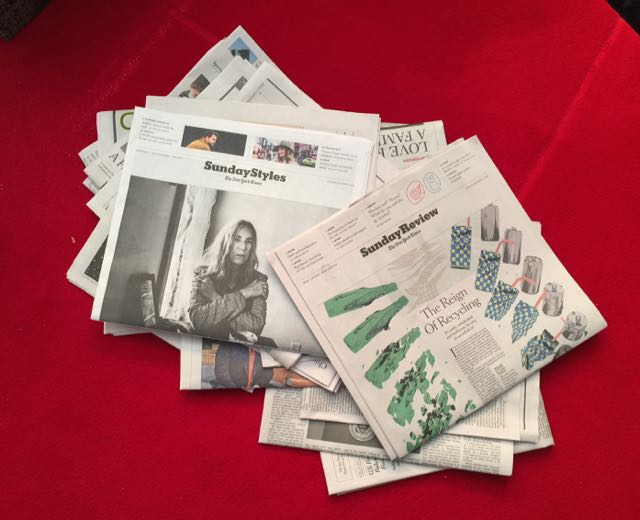
Sunday detritus.
Newspapers still haven’t recovered from the revolution in their business model. Most of them ignored the web for the first few years, hoping it would be a novelty and go away. It’s really only in this decade that newspapers have figured out that they have to change the way they do business. Some newspapers and magazines are relatively successful, using a pay wall and retaining digital subscribers. Many are floundering, laying off staff, cutting back publishing frequency. Only the older generations read newspapers at all, so newspapers will die eventually.
The news revolution has affected TV and radio too, although not so drastically yet.
News outlets now are being advised on how to make money in other ways, through memberships, events and beating ad blockers.

Soon to be considered “vintage.”
Book publishing also is still floundering, figuring out how to manage and make money from e-books. Amazon, the giant that started this revolution, eventually will get so big that it will fail too and be replaced by something that a 10-year-old kid in Schenectady is dreaming up now. (I think I owe an HT to someone for that kid-in-Schenectady idea, but I don’t remember who.)
The music industry (and TV and films to a lesser extent) also are suffering from the internet notion that all content should be free and available on our terms. CDs aren’t selling much, even though vinyl is making a retro comeback. We want to listen to music on something we carry around, even if the sound quality is poor. And we want to watch TV and movies on our terms, not when the network or theater happens to schedule them.
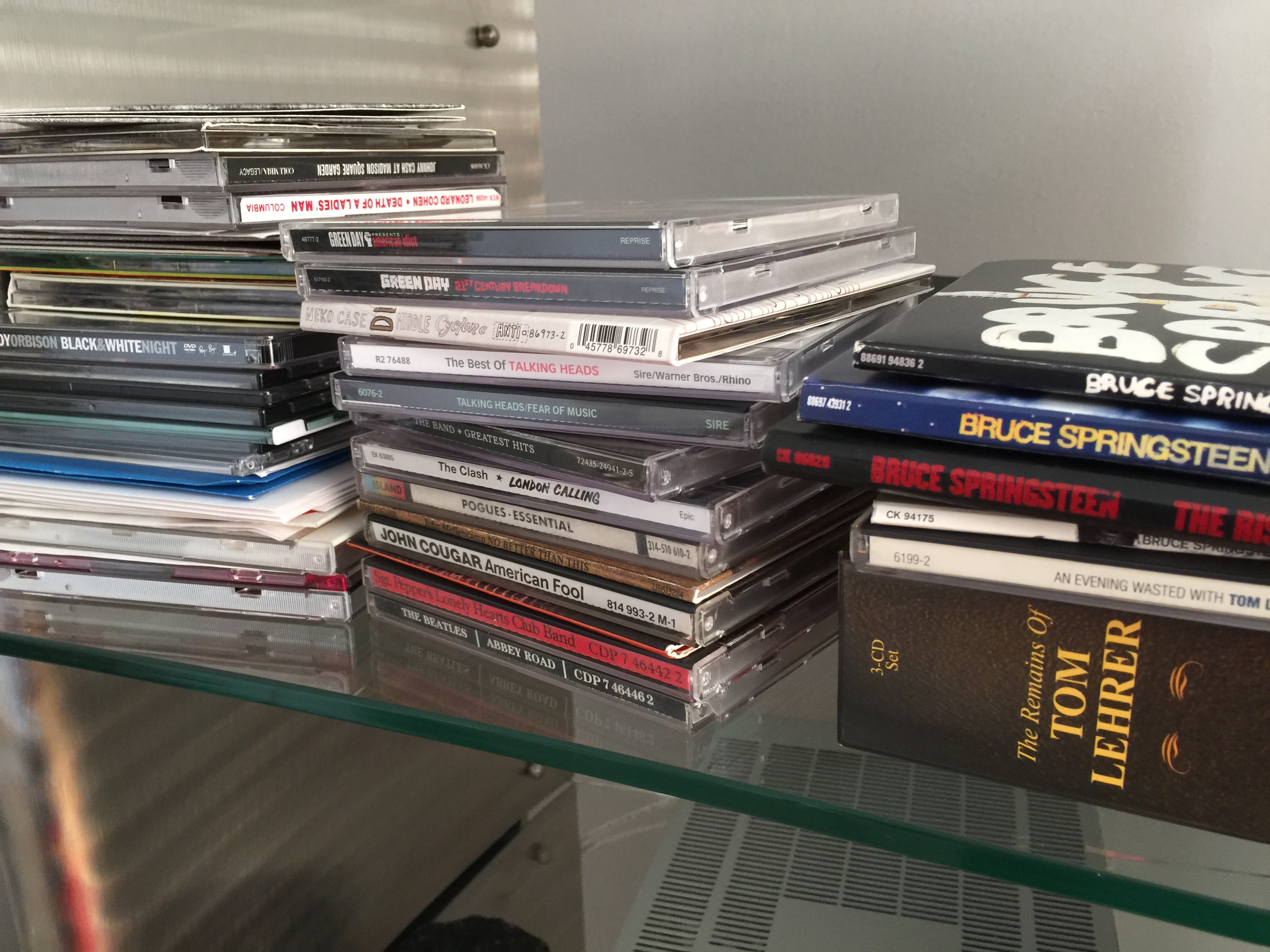
Some of my retro music.
Artists, writers and photographers are impacted by this content-should-be-free phenomenon. If no one wants to pay for content, then the publishers of content don’t want to pay for content creation. So, goodbye freelance businesses.
This internet/web revolution didn’t just happen overnight. Decades of technological development went into this phenomenon, but businesses were caught off guard. Even though most of them had some kind of computer or IT departments, the message of the coming revolution wasn’t acknowledged, or passed on. (Another factor in the revolution was the microchip, which enabled the miniaturization of our devices. It was introduced in 1959 but no one was paying attention to that either.)
The revolution happened while everyone was looking the other way.
- The modem was invented in 1958 at Bell Labs and the router (an Interface Message Processor) in 1967.
- In 1972, a guy named Ray Tomlinson invented email—a way to send messages across a network. It was his idea to use the “@” sign as the email standard address: user@host.
- In 1974, Elizabeth “Jake” Feinler led the team at SRI International’s Network Information Center. Among other things, they created the Host Naming Registry and the primary domain names we use today: .com, .gov, .edu, .org, .net, .mil.
- In 1974, Vint Cerf and Robert Kahn coined the term “internet.”
- Most importantly, In 1977, Lawrence Landweber created the Computer Science Network, a network for US university and industrial computer research groups. By 1984, more than 180 university, industry and government computer science departments were participating in CSNET.
In the middle 1980s, I was working on my first Mac at home but it wasn’t connected to anything. At work, no computer because the Wang word-processing machines were only for secretaries. My son was a graduate student finishing his PhD in economics and talked about getting “email” from his advisers. “Email,” I said. “What’s that?”
Then in 1989, when AOL started its first online service, I got email too. It was that pitifully slow telephone dialup access, but it was still a thrill to hear “You’ve got mail!”
- Finally (and skipping over many key technological advances), in 1989, Tim Berners-Lee created the World Wide Web and Robert Cailliau developed the first web browser for the Macintosh operating system. This is when business should have started paying attention and figuring out how their companies could take advantage of this new web thing.
- And all this happened years after the US Defense Department invented ARPA in 1958 and ASCii in 1963 so that machines from different makers could talk to each other. ARPAnet, the actual network, was initiated in 1966.
I owe my superficial surf of technology history to the Internet Hall of Fame’s internet timeline. Check it out here. http://www.internethalloffame.org/internet-history/timeline There’s also this http://www.pewinternet.org/2014/03/11/world-wide-web-timeline/ and this http://www.livescience.com/20727-internet-history.html
I decided to write this essay because I felt like venting. How could all these revolutions have happened to industries so important to me (newspapers, books, music, movies) without the industries being aware and preparing for the revolution? Big companies all have prestigious “strategy” officers and departments. What were they thinking about in the 1980s and 1990s? Not much, apparently. Or they were listening to big-name management consultants who probably were talking gobbledygook about customer intelligence, global advantage and supply chain management. I know whereof I speak on that one, because I used to work with those guys.
The theater review I’m working on now is about a fascinating play titled The (curious case of the) Watson Intelligence. It’s a time-tripping play full of ideas and technology. At one point, a character says, “we’re at this critical moment in our society when technology is developing more rapidly than our social and political infrastructures can keep up with.”
That is one of the problems.
All the photos above taken by Nancy Bishop in her own home, site of prerevolutionary media and all the other kind too.
The Freedom Principle: The art of jazz on display at the MCA
Posted: July 23, 2015 Filed under: Art & architecture, Music | Tags: AACM, Museum of Contemporary Art, Nick Cave Leave a commentThe Freedom Principle: Experiments in Art and Music, 1965 to Now. That’s the title of the new exhibit at the Museum of Contemporary Art. It’s a euphonious blend of the visual and the aural. It celebrates 50 years of the Association for the Advancement of Creative Musicians, a group always dedicated to progressive sounds.
I’m glad to see the MCA continuing their exploration of the confluence of art and music, as they did with the exciting David Bowie Is exhibit last fall. This exhibit is a little more low-key but it displays paintings and photographs that represent the visualization of jazz and depictions of AACM from its beginnings to now.
In addition to two-dimensional art, there are exciting sculptural exhibits, such as the stage set showing the huge range of instruments, especially percussion, that the AACM played. Two of the original AACM members collaborated with a sound designer to create “Rio Negro II,” a roomful of bamboo and rain sticks, chimes and robotic instruments. It’s a sight and sound to behold and enjoy.
You’ll also see archival materials such as record jackets, posters and brochures. I especially liked the display, “Speak Louder,” Sound Suits created by Nick Cave (no, not the Australian rocker–this one is the artist and fashion designer). They’re beautiful and functional.
The title of the exhibit is drawn from a book by Chicago music writer John Litweiler. My reviews are here and here. The exhibit price is included with the cost of admission. Musical performances are scheduled for some dates during the exhibit, which runs until Nov. 22. It’s an intriguing and well-curated exhibit, so support your local art museum!
Date with a diva: Interview with E Faye Butler & other theater news
Posted: July 15, 2015 Filed under: Music, Theater | Tags: Brilliant Adventures, E. Faye Butler, Goodman Theatre, Johnny Cash, Mercury Theater, Ring of Fire: The Music of Johnny Cash, Steep Theatre, Vanya and Sonia and Masha and Spike Leave a commentRecently I reviewed the new Goodman Theatre production of Christopher Durang’s Vanya and Sonia and Masha and Spike, a play with many Chekhovian and other theatrical references. I thought it was very good but regretted the fact that Goodman has been promoting it as a slaphappy summer comedy. That means the audience members think they have to be entertained and therefore find every line absolutely hilarious. As I said in my review:
“Durang’s treatment certainly contains much wit and draws the fine line between comedy and tragedy, but the opening night audience’s raucous laughter throughout both acts weakened the poignancy of the characters’ stories. Really, this isn’t the Marx Brothers.”

The Goodman publicity team was offering actor interviews and I was asked if I would like to interview one of the lead actors. After seeing the play, I said, “No, I want to interview the actor who played Cassandra. I want to hear her story about how she created her character.” And so one morning last week, I went back to the Goodman Theatre with my tape recorder (my iPhone actually) and a set of questions to ask E. Faye Butler.
I don’t do interviews often, because they’re time consuming and can end up being bland if the subject is afraid of sounding undignified. But E Faye was fabulous. She’s a classically trained actor who also sings and has a powerful voice and a magnetic persona. She is smart, articulate and funny and was absolutely the best interview I’ve done. Turning her recorded interview into an interesting story was easy. At least I think it’s interesting and I hope you do.
Here’s my date with the diva. My reviews of VSMS also appeared here and here.
Review: Brilliant Adventures at Steep Theatre
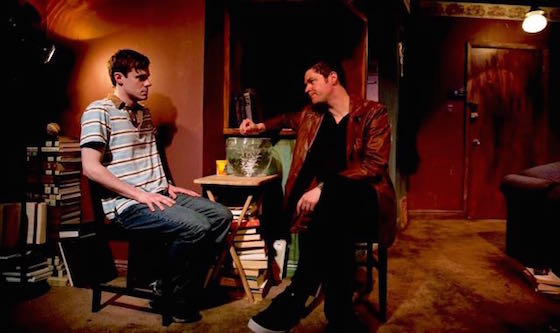 Last week I reviewed the new gritty British drama at Steep Theatre. It’s a US premiere of a play by Alistair McDowall, a new English playwright. Excellent play, directed by Robin Witt, with a group of six fine actors. The fascinating thing about Brilliant Adventures is that it starts out like one of those 1970s British working class films, but then devolves into sci-fi and fantasy. Really, it’s fascinating and it works.
As I said in my review, “It is a deeply classist play that explores the lives of those who live in Middlesbrough, a failed industrial city on the River Tees in northeast England.” The Steep playbill and the lobby exhibits do a good job of acquainting you with the environment and language of Middlesbrough.
Brilliant Adventures is an outstanding two hours of theater and I recommend it. You can see it through August 15. Steep is located on Berwyn, just east of the Berwyn Red Line station. You can also see my review here.
Review: Ring of Fire at the Mercury Theatre
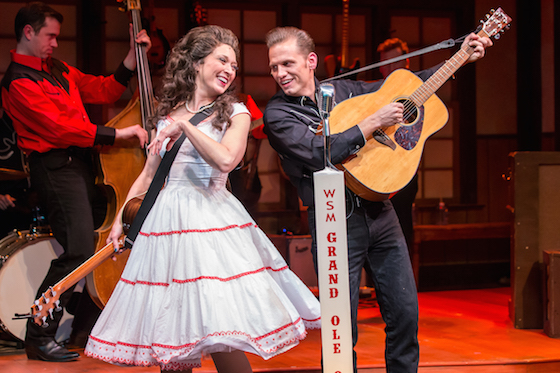 I also had a chance to review the Johnny Cash musical tribute in its extension through the end of August. (I missed it when it first opened this spring.) I went with friends who are music lovers like me and fans of rock, blues, bluegrass and country). June Sawyers has written dozens of books about music and musicians. It was a treat to see the show with two music fans and discuss the music at intermission and afterwards.
We all agreed it’s a great piece of entertainment but we thought it lacked the depth that the tortured story of Johnny Cash’s life would have added. But no, it’s strictly a jukebox musical with about 30 songs by Cash and other songwriters performed by a talented group of seven musicians.
Here’s a song from the show that was often performed by Johnny Cash but it was written by Geoff Mack (an Australian) and Hank Snow (who wrote the North American lyrics). I describe the lyrics as a tongue-twister travel itinerary. This is a Hank Snow version from 1965.
The Mercury Theatre is a comfortable venue with an excellent sound system. Ring of Fire is a pleasant evening of entertainment in the same way that Million Dollar Quartet is. But even that play is built around some narrative elements.
My Gapers Block review is posted now. You can read it here.
My July Fourth week: Fireworks, art and movies, silent and not
Posted: July 9, 2015 Filed under: Movies, Music | Tags: GSOHoppers, Love & Mercy 4 CommentsFourth of July may be my favorite holiday. Parades and fireworks! What could be better. And there’s nothing like a small town Fourth of July. I loved the Fourth when we lived in small college towns and this year I spent the holiday in a medium-sized city in North Carolina. Greensboro is something over a quarter million people but they still have a July Fourth parade down main street. Greene Street, actually—named for Nathanael Greene, the Revolutionary War general who forced the British troops to leave the Carolinas. The decisive battle was the Battle of Guilford Courthouse in 1781, near what is now Greensboro.
Since July 3 was a First Friday, the galleries and artisan shops on Elm Street were open and we walked around and looked at many creative endeavors. One of the places we visited was Elsewhere, an experimental venue of art, music and salvaged art (or junk, if you wish).
The Saturday parade featured a few bands, motorcycles and classic cars, fire engines, Uncle Sam on stilts and lots of politicians. Costumed paraders walked along the route tossing candy to the crowd and handing out small flags. My grandsons loved the candy and the fire engines. There was a block party and street festival downtown on both July 3 and 4.
Saturday night the Fourth we were invited to a skybox at the stadium to watch the Greensboro Grasshoppers play the Hickory Crawdads. (The Hoppers are a Class A team in the South Atlantic League, and a farm team of the Miami Marlins.) I won’t report the score to avoid embarrassing the Hoppers. The kids were delighted when the team mascot, Guilford Grasshopper, visited our skybox. He took pictures with everyone and gave me a hug. The evening ended with an excellent fireworks display, one of many around town that night.
Silent movies: Chaplin and Keaton
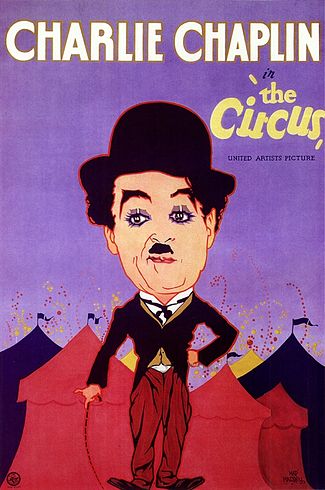 One quiet afternoon the 7-year-old and I went to a screening of Charlie Chaplin’s 1928 film, The Circus, at the aptly named Geeksboro Coffee Cinema. The coffee house caters to gaming geeks and the downstairs cinema shows weekly films. They also have Lawn Chair Movie Nights outside on weekends.
Meyer and I and about 20 other film geeks saw Chaplin’s silent film, in which the owner of a traveling circus hires the Little Tramp because he’s accidentally funny. There are all kinds of wonderful sight gags, like a pickpocket sequence, the Tramp locked in a cage with a lion and performing a high wire act beset by five monkeys.
The film ends as the circus pulls up stakes and leaves town. The Little Tramp walks off across the field in a tracking shot framed by an iris lens.
Meyer, who just finished first grade and is a great reader, could read all the title cards. He sat on the edge of his seat through most of the 71-minute film. What fun to take a child to such an entertaining old classic and discover it with him!
Here’s the lion cage clip from The Circus.
My film group discussed two Buster Keaton films last night, so I had a chance to watch two more silent films, both of them available for streaming. It was a chance to compare the talents of Chaplin and Keaton and I was surprised to discover that I found Keaton more subtle and interesting. The two Keaton films (both of which are often on best-film lists) are The General (1926) and Sherlock Jr. (1924), in which Keaton is a film projectionist who also cleans up the cinema after the show. He’s in love with a pretty girl and longs to be a detective. He carries around a pocketsize manual, How to Be a Detective. In one scene, Keaton appears to walk onto the screen and become part of the film. (The film runs 45 minutes.)
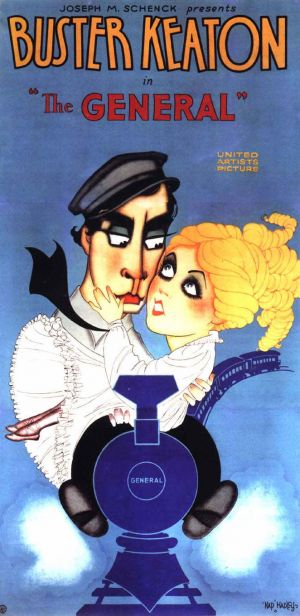 I think The General (78 minutes) is the better of the two films. The film (adapted from a book titled The Great Locomotive Chase by William Pittenger) is set in the South during the Civil War and Keaton is Johnnie Gray, a railroad engineer in love with Annabelle Lee. He wants to enlist, but is rejected, and ends up being a daring hero as the engineer of the Confederate train (titled General) that helps prevent the Northern Army’s supply trains from advancing into the South. The film has lots of amazing footage that was carried out in real time, including the train chase and a scene where a bridge collapses and one train falls into the gorge below. It was a very expensive film to produce and Keaton’s career suffered as a result.
Keaton is always calm, serious and practical about the situation he’s in, even while he’s performing amazing physical feats as he keeps the General running, finding wood, chopping it and tossing it into the firebox. He doesn’t mug for the camera or overact as most silent film stars (including Chaplin) did. Keaton’s deadpan expression earned him the nickname The Great Stone Face.
In the last 15 minutes of the film, however, it was pretty horrifying to realize that I was cheering for Johnnie Gray and the South, especially when the Southern troops appeared carrying the Confederate battle flag.
You can watch The General in full online, probably because Keaton let the copyright expire and it became public domain.
Here’s a classic Keaton scene from his 1920 short film, The Scarecrow, in which dining is an efficiency exercise.
One more movie: Love & Mercy
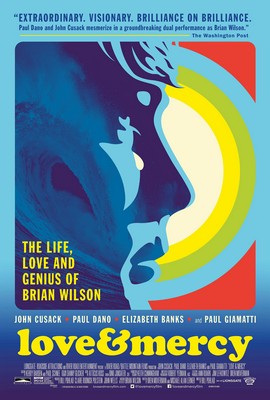 This Brian Wilson biopic is an excellent film that shows Wilson at two different times of his life, played by two different actors. Paul Dano is Wilson as a young man, frontman for the Beach Boys and orchestrator of Pet Sounds. The older Wilson, ~30 years later and suffering from serious emotional problems, is played by John Cusack. The two times of his life are shown seamlessly, with the early scenes paving the way for his later decline. The older Wilson was in such bad shape (“Lonely. Scared. Frightened,” he writes on a card he hands to a young woman he has just met) that he allows himself to be totally controlled by the venal Dr. Eugene Landy, vigorously played by Paul Giamatti.
The best scenes, to my mind, are those where Dano as Wilson is directing the development of Pet Sounds with the studio musicians known as the Wrecking Crew. He walks around the studio, perfecting the sound of each instrument, and adding sound effects. (The fact that the Beach Boys themselves were not the backing musicians caused a serious rift in the band.)
Love & Mercy runs two hours and is showing now at theaters in Chicago and Evanston.
Movie reviews: Two great rock docs (+ two more films)
Posted: April 29, 2015 Filed under: Movies, Music, Rock and roll | Tags: A Girl Walks Home Alone at Night, Goodbye to Language, Muscle Shoals, The Wrecking Crew Leave a commentFirst of all, two music documentaries, The Wrecking Crew and Muscle Shoals, both about the stories behind the music you see on stage or hear on a recording. And both great movies. (But then, you know I love rock docs.)
The Wrecking Crew, 2015, 100 minutes
The Wrecking Crew, directed by Denny Tedesco, is the glorious story of the session musicians who backed up many of the hits you love from the 1960s, ‘70s and ‘80s (even though you might have come to love that music only recently). The group of 20 or so musicians played in varying combinations behind the hits recorded by the Beach Boys, Herb Alpert, Sam Cooke, the Mamas and the Papas, the Crystals, the Ronettes, the Monkees and many more. They made Phil Spector’s famous Wall of Sound sound like a wall of sound.
The group dubbed The Wrecking Crew played on all these hits: “Be My Baby,” “California Girls,” “Strangers in the Night,” “Mrs. Robinson;” “You’ve Lost that Lovin’ Feelin,’“ “Up, Up and Away;” “Viva Las Vegas” and “Mr. Tambourine Man.” Six years in a row in the late 1960s and early ‘70s, the Grammy for Record of the Year went to Wrecking Crew member recordings.
Some of the musicians, like Glen Campbell, went on to perform in their own names and become famous. But most were talented musicians you never heard of, such as drummer Hall Blaine, tenor player Plas Johnson (you hear his saxophone on the theme song from The Pink Panther); guitarist Barney Kessel; pianist Don Randi; and electric bass player Carol Kaye.
And the late guitarist Tommy Tedesco, father of the director and the inspiration for the film. Tedesco senior was a fabulous musician and the film shows him in many stages of his life, playing many different kinds of music. Seeing how he earned his living (a very good living) as an almost-anonymous but essential musician, inspired his son to record the story of the Wrecking Crew, the name they gave themselves after people said they were wrecking the music business.
It was great to see Carol Kaye, known as one of the greatest bass players in the world at the time, in interviews and performance, both then and now. She said a lot of women were playing in jazz and music clubs in the late ‘50s and ‘60s. Sometimes she would play many gigs in one day. And she proves she still rocks in the solos she plays in the film.
 Many of the musicians came out of jazz and learned to play rock and roll on the job. Rock and roll was a dirty word then, but there was little money to be made playing jazz.
The Wrecking Crew was a Los Angeles-based group. Up until then, the music business was considered to be based in New York in the iconic Brill Building. But the Wrecking Crew pulled the business west.
The film is made up of music clips from the time and interviews with musicians then and now, plus interviews with figures such as the late Dick Clark, Frank Zappa, Cher, Nancy Sinatra and Leon Russell.
The Wrecking Crew was actually finished in 2008 and shown on festival circuits. But it couldn’t be shown commercially until Tedesco raised a pile of money to pay for licensing 100 hit songs used in the film. He finally succeeded with a Kickstarter campaign in which 4,245 backers pledged $313,157.
The film is running at least through next week at Landmark Century Centre. If you’re a music lover get to the theater now because it may not run much longer. There were a lot of musicians in the theater the day I saw it. I could tell by the jokes they laughed at.
Muscle Shoals, 2013, 110 minutes
What is Muscle Shoals? It’s just a little village on the Alabama border. But so much great music came out of it. No one can exactly explain why. Jimmy Cliff said, “At certain points in time on this planet, the are places where there’s a field of energy. At this time, there was Muscle Shoals.” Muscle Shoals is a 2013 documentary about FAME Studios and Muscle Shoals Sound Studio.
There was a certain Muscle Shoals sound. It was its own kind of R&B, different than Detroit, different than Memphis. U2’s Bono gives the river the credit. There’s the Mersey sound in Liverpool, then there’s the Mississippi and the Delta blues. Here it’s the Tennessee River. Bono thinks it must be that the sound comes out of the mud. But there was also something about the sound of the room that made it magical. (Dave Grohl says the same thing about the room they recorded in at Sound City, in his documentary of the same name.)
Director Greg ‘Freddy’ Camalier describes the sound as a “funky, soulful, propulsive kind of groove.” Some of the musicians who recorded there were Bob Dylan, Rod Stewart, Joe Cocker, Simon and Garfunkel, Aretha Franklin, the Rolling Stones, Wilson Pickett, Percy Sledge, Gregg Allman, Alicia Keys and Steve Winwood.
Rick Hall was the founder of FAME Studios who overcame the poverty of the area in the 1970s to establish the recording studio with a house band known as the Swampers. It was the Muscle Shoals rhythm section—guitar, bass guitar, keyboard and drums. In the heart of Alabama during the Jim Crow era, Hall established Muscle Shoals as an integrated musical operation with no color distinctions between black and white musicians.
It’s an inspiring musical story and like The Wrecking Crew, features interviews with musicians as well as a chance to hear the music they made.
The film Muscle Shoals is available on DVD and it’s streaming on Netflix.
And two other films of interest
A Girl Walks Home Alone at Night (99 minutes) is a film that has gotten some buzz as “an Iranian vampire western.” Well, okay, it is about a vampire but she only attacks men who mistreat women. It’s really a very fine film, directed by Ana Lily Amirpour, and set in a fictional Iranian ghost town known as Bad City. (It’s shot in Bakersfield, Calif.) The cast is Iranian-American actors speaking Farsi. There’s a sweet love story about two lonely people, one of whom happens to be the hijab-wearing vampire, beautifully played by Sheila Vand. Her boyfriend is played by Arash Marandi, on whom I developed a crush by the end of the film. The cinematography is high-contrast black-and-white, mostly shot at night in industrial-type settings. The story is engrossing and I will probably watch it again. If I was giving stars, I’d give it 4 out of 5.
Jean-Luc Godard’s Goodbye to Language (70 minutes) is a 3D film that should be seen in 3D. It’s currently streaming on Netflix and I strongly recommend you don’t watch it that way. I missed it when it was showing in 3D at the Gene Siskel Center and I’m sorry I did. I watched it last night on my lovely big TV screen. Don’t repeat my mistake. The film is experimental and kind of nonlinear and just looks strange in 2D. But at least it’s short.
The Power of Music: John Hammond, Robert Johnson and Bruce Springsteen
Posted: March 22, 2015 Filed under: Movies, Music, Rock and roll | Tags: Blood Brothers, Bruce Springsteen, John Hammond II, Radiolab, Robert Johnson Leave a commentYou may never have heard of John Hammond. But if you’re a music fan or a civil rights supporter, you know he’s a major figure of the 20th century. Radiolab, the WNYC program, did a show this week titled “The Power of Music” and almost half of it was devoted to the work of Hammond, the civil rights activist and A&R executive (artists and repertoire or talent scout) for Columbia Records. During the course of his long career, Hammond, who came from a wealthy family (he had a Vanderbilt in his past), discovered and launched the careers of musicians like Count Basie, Benny Goodman, Aretha Franklin, Bob Dylan and Bruce Springsteen. And dozens more.
Hammond was instrumental in bringing the music of African-American performers out of the “race music” ghetto they languished in for decades. Early in his career, he organized the first Carnegie Hall concert to feature black musicians—in December 1938. One of the musicians he wanted to feature was Robert Johnson, the legendary backwoods Mississippi blues master. When he learned that Johnson had died recently, he played some of his music by hooking up a turntable to the Carnegie Hall sound system. The Radiolab segment titled “Letting the Devil Tune Your Guitar” explores the legend about Hammond and Robert Johnson and the story that Johnson sold his soul to the devil to become a great guitarist. Radiolab comes to the spooky conclusion that there might have been more than one Robert Johnson. It’s a compelling piece of radio.
Robert Johnson died at 27 in about 1938 (or 1939 or 1941). His music inspired musicians like Eric Clapton, Keith Richards, Robert Plant, Jimi Hendrix and Bob Dylan. Johnson was inducted into the Rock and Roll Hall of Fame as an influencer at its first induction in 1986. He’s often credited as the songwriter of “Sweet Home Chicago.”
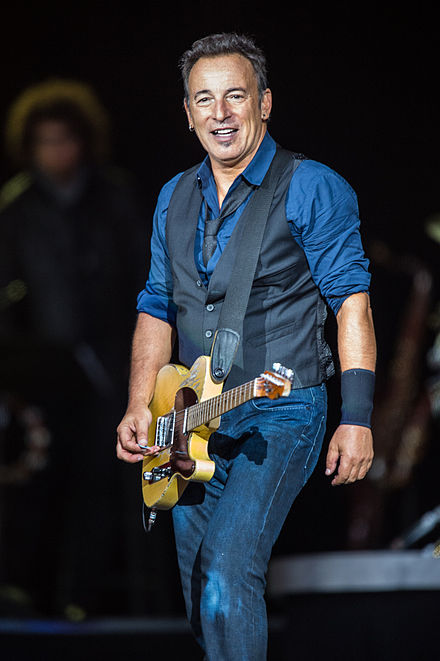 This weekend I watched an old documentary about that New Jersey musician who Hammond signed to Columbia in 1972. Blood Brothers: Bruce Springsteen and the E Street Band was made in 1995 when the band got together in a studio in New York to record a Greatest Hits album. Seeing the band 20 years younger was a visual shock. Their current personas are indelibly imprinted on my brain because I saw them so many times during recent tours. Today, yes, they’re older, grayer, balder, but they seem to be more fit and energized. Many of the band members in ’95 look a little pudgy and scruffy. Even Bruce, who today looks trim, even skinny, in tight black jeans, was a bit fleshy. And the beards make a huge difference. At first I didn’t recognize some of the band members under their hirsuteness. Garry Tallent, the bass player, and Roy Bittan, the pianist, looked very different. And so did Bruce.
The reunion was the first time the band had played together in 11 years and you could see how happy and excited they were to be together again. The power of music took them to great heights in recording the 18 songs for the album. The film shows the effort and creativity involved in getting the album made. Producer Chuck Plotkin and manager Jon Landau work closely together. Bruce is rewriting lyrics on a yellow pad and taking votes for the photo on the CD cover. Nils Lofgren and Max Weinberg are writing lyrics or notations or arrangements, as they’re getting ready to record.
The songs “Blood Brothers,” “Secret Garden,” “Murder Incorporated” and “This Hard Land” are some of the new tracks on that album. The film shows each of them being worked out with instrumentation changing until Bruce, the perfectionist, is satisfied. The final section shows the music video of “Murder” (directed by Jonathan Demme) being filmed in front of an audience of fans at Tramps in New York.
If you’re interested in learning more about John Hammond, there are several biographies. This book by Dunstan Prial looks like a good choice and I’m going to read it soon. For more info on Robert Johnson, I recommend Elijah Wald’s Escaping the Delta: Robert Johnson and the Invention of the Blues.
February reviews: Everything has a music theme
Posted: February 24, 2015 Filed under: Music, Rock and roll, Theater | Tags: Orchard Theatre, Red Orchid Theatre, Redtwist Theatre, Steppenwolf Theatre, Tuta Theatre, Warren Zevon 1 CommentVisions of music: Steve Schapiro and Richard Powers
Posted: January 20, 2015 Filed under: Books, Music | Tags: Ed Paschke Art Center, Orfeo, Richard Powers, Steve Schapiro 1 CommentMusic is a subject I love to burrow into, visually as well as aurally. Two recent cultural experiences enhanced my appreciation for the medium and its messages.
Steve Schapiro: Warhol, Reed and Bowie
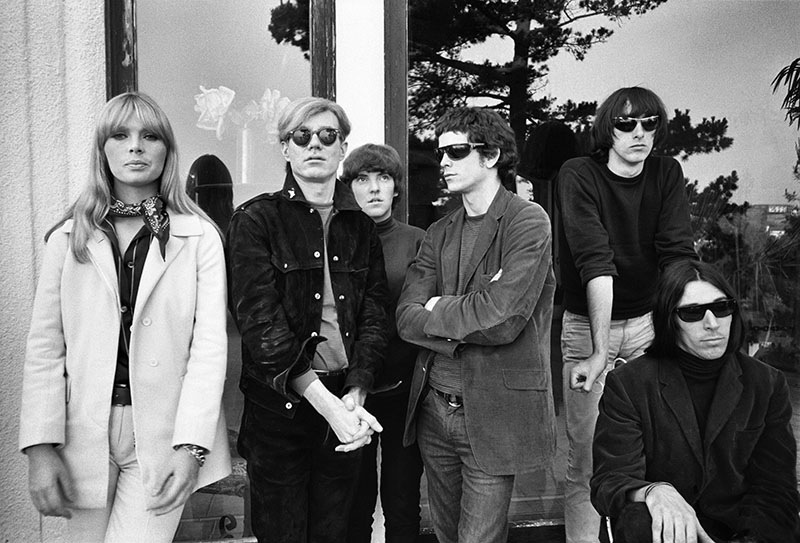
Andy Warhol, the Velvet Underground and Nico. Photo by Steve Schapiro.
Steve Schapiro is a photographer whose masterful work over almost five decades has spanned punk rock and movie masterpieces. His exhibit of photos of Andy Warhol, Lou Reed and the Velvet Underground, and David Bowie closed last weekend at the Ed Paschke Art Center. The exhibit featured a couple of dozen iconic black and white photos of these music legends.
The art center also showed a 30-minute video about Schapiro with many examples of his earlier work, shooting movie set photos during films such as Midnight Cowboy, The Godfather, Taxi Driver and Chinatown. There also are scenes from a recent conversation between Schapiro and Dustin Hoffman as the actor reminisced about photos Schapiro took during those movie set years.
Schapiro, now 80, lives and works in Chicago. He began taking photos when he was 9 and discovered the magic of the darkroom at summer camp. He’s currently shooting photos for several books and other projects, which you can read about in this interview.
Richard Powers: Orfeo, and a dog named Fidelio
I’ve written about Richard Powers before, most notably in my review of the 2013 Spike Jonze film, Her, which I compared to Powers’ 1995 novel, Galatea 2.2. (It drew about 200 readers to my blog last year, more than any other post; it still continues to draw).
Powers can be an acquired taste. I’ve read all his work and I acknowledge this fondness is something like my affinity for the late Portuguese writer, Jose Saramago. Powers is cerebral, mixes science and technology subjects with the arts, and his characters do not always come across as living, breathing humans.
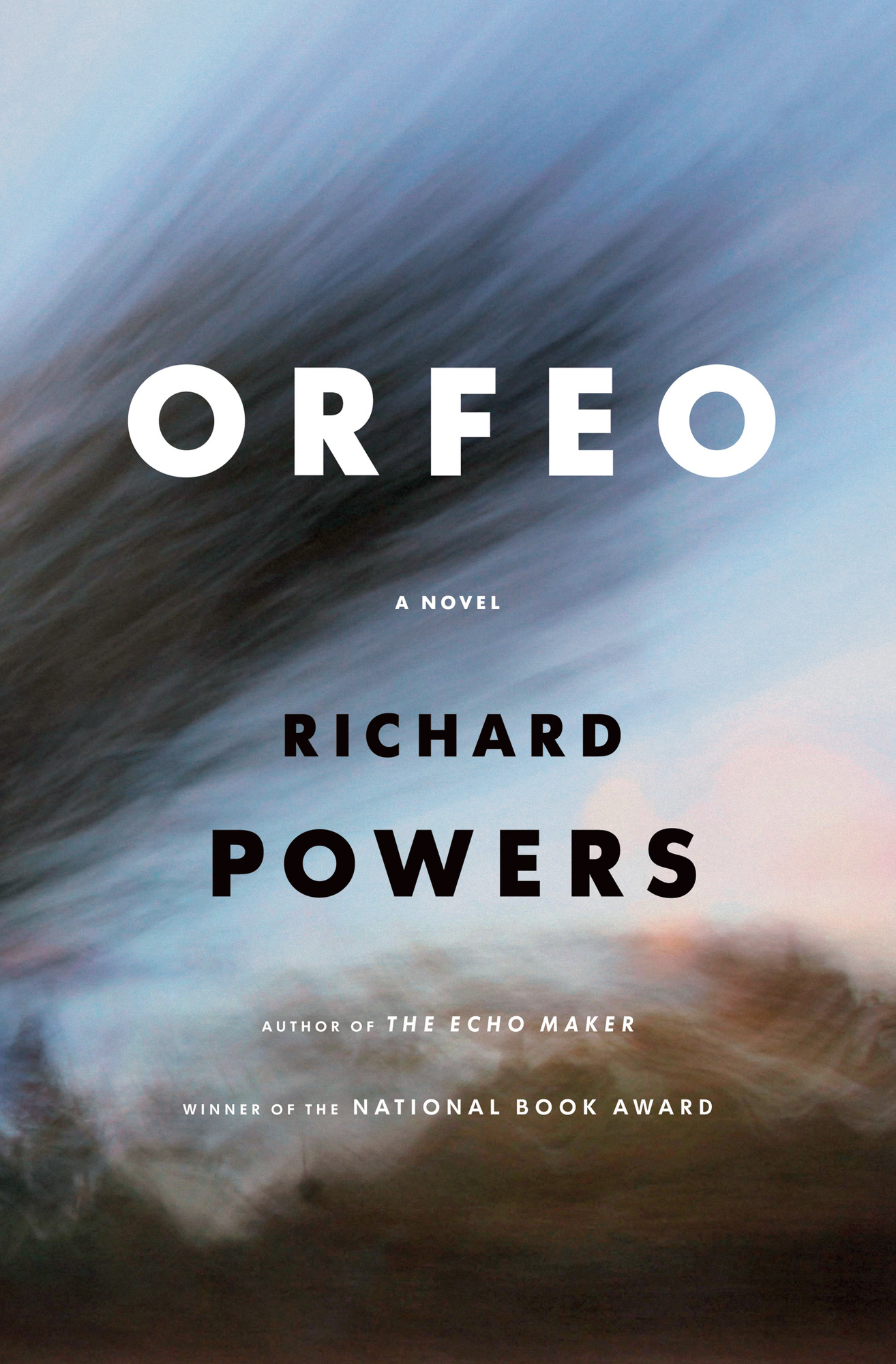 Orfeo is his latest novel and I think his best. You grow to care about his leading character and his quests in music and science. Powers displays breathtaking knowledge of ancient music, experimental music and composition. One long section of the book is about the composition of Quartet for the End of Time, composed in 1941 in a German prison camp by French composer Olivier Messiaen.
Yesterday I had the luxury of a really immersive reading experience. About four hours of sitting around the Greensboro airport and the plane ride home. I realized that too often my reading is episodic—an hour in the afternoon when I finish work or a short session of reading in bed. I don’t know if it was the immersive reading or the nature of Powers’ book, but I found myself really caring about the people in Orfeo.
Peter Els, the leading character, is a 70-year-old retired professor, whose passions are avant-garde music and home genetic experiments. The novel opens with the death of his dog Fidelio, a 14-year-old golden retriever who loved music. “Music launched her into ecstasies. She loved long, held intervals, preferably seconds, major or minor. When any human sustained a pitch for more than a heartbeat, she couldn’t help joining in.”
The novel is about Els’ long history as an avant-garde composer and the lovers and friends he connects with in that passion. In retirement, he offers classes in music at a retirement center and is working with a bacterial human pathogen in his tricked-out home laboratory, where he’s trying to record his own compositions in bacterial DNA.
This unfortunately attracts the attention of the Department of Homeland Security and people in hazmat suits arrive. Els flees and the story threads back and forth through his musical and romantic life to his current period of flight.
A good portion of Orfeo is set in Champaign/Urbana, where Powers was an undergraduate and now is professor of English. (Powers went to DeKalb High School and one of his early books is set in DeKalb.)
Els is inspired by John Cage and participates in “Musicircus,” an exuberant 1968 extravaganza in Champaign, where Cage was in residence from 1967 to 1969.
Powers’ Wikipedia page lists and describes his novels. I recommend dipping a toe into the Powers oeuvre. You might start with The Time of Our Singing (2003), which combines music and physics. And then move on to Orfeo and its musical magic.
Follow this blog, please
You can sign up to follow Nancy Bishop’s Journal and get an email whenever I post a new article, usually about once a week. Just type in your email address at the top of the righthand column and you’ll get an email asking you to verify your address. That’s it. No spam, no password.
2014: My pop culture memories
Posted: January 2, 2015 Filed under: Art & architecture, Books, Movies, Music, Theater Leave a commentIt’s the beginning of a new year and time to reflect on the pop culture year just ended. Critics did their top 10 lists of everything, but I’m going to do my list of 2014 favorites. Some of these are clearly eccentric choices–not necessarily “the best.” I’ve written about most of them during the year – either here or at Gapers Block or Culture Vulture.
Professionally….
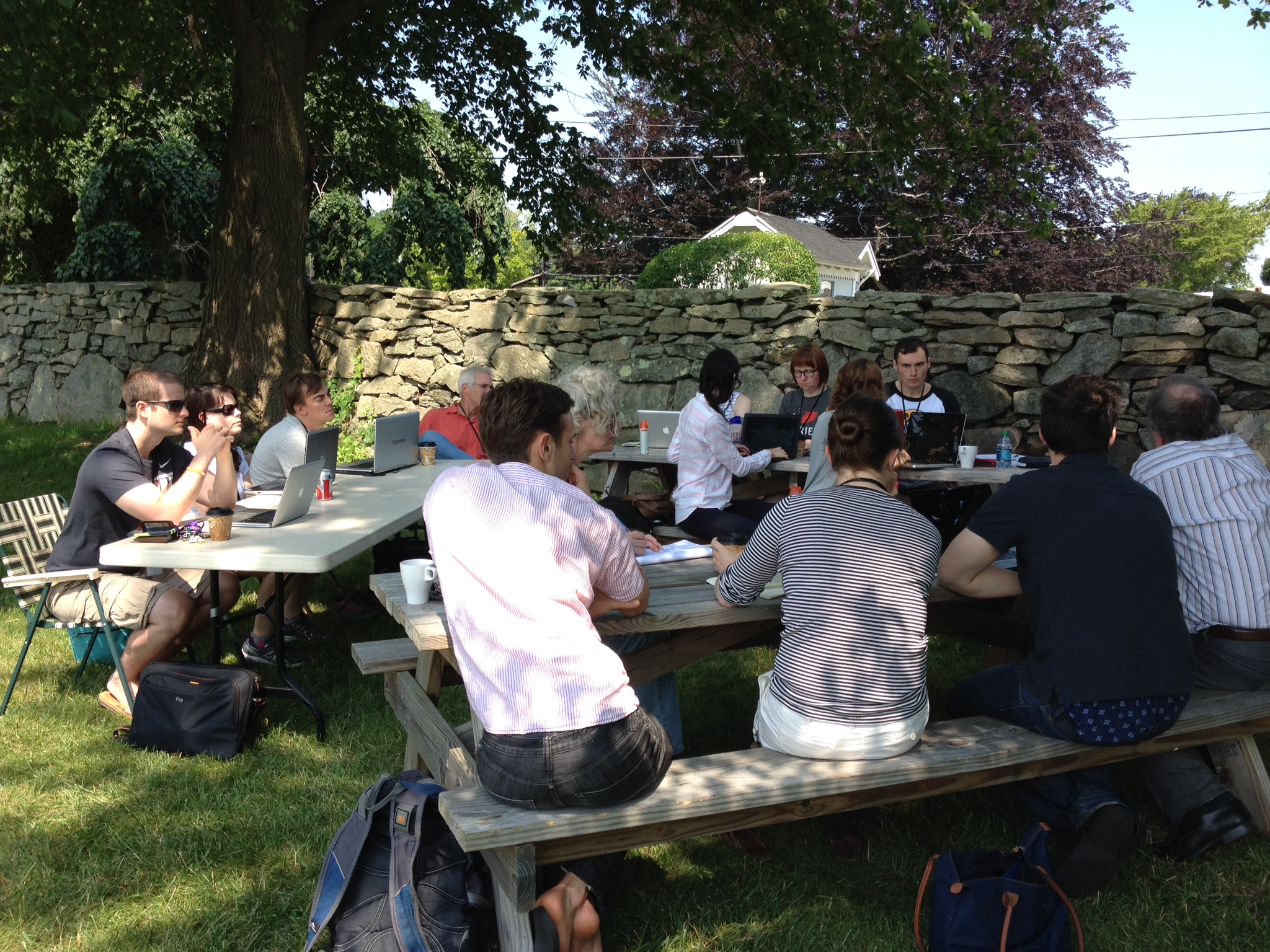
Critics at work in the Sunken Garden
My favorite professional experience – my two weeks at the National Critics Institute at the Eugene O’Neill Theater Center. It was a fabulous and enriching two weeks, complete with inspiration from colleagues and visiting experts, lots of plays to review, and sleep deprivation.
The institute strengthened my ability to write theater criticism and I did a lot of it this year. I wrote about 60 reviews—mostly theater but also reviews of art exhibits—for gapersblock.com and about 20 for culturevulture.net, a national arts website.
For Nancy Bishop’s Journal, I wrote 46 essays, which drew 4500 visitors from 86 countries—mostly the US, UK and Brazil. The two essays that drew the most visitors were:
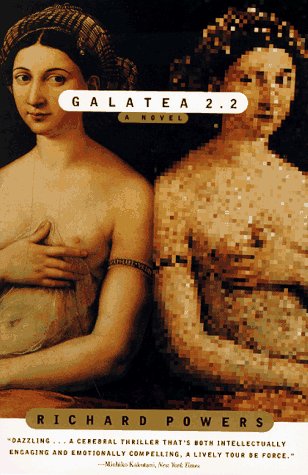 — My review of Spike Jonze’s film Her, which I compared to Richard Powers’ novel Galatea 2.2.
— An article demanding freedom for Oscar Lopez Rivera, a political prisoner in the US for 33 years.
Theater
My favorite experiences as a theater critic and theatergoer aren’t necessarily the plays on other top 10 lists, but they are shows that I found thrilling.
The Hypocrites’ All Our Tragic. This play was a masterful combination of all 32 extant Greek plays by Aeschylus, Euripides and Sophocles, written by Sean Graney. The 12 hours flew by, with plenty of breaks for food and conversation.
Oracle’s The jungle was a searing theater experience; a big story in the smallest space imaginable. My review commented, “Your Chicago ancestors may have greeted the Pilgrims, arrived on the Mayflower or a slave ship, or come in through Ellis Island. Whatever their origin, they’re part of our history. You can relive it in this stirring drama.”
A fabulous visiting production of Arguendo, a dramatization of a Supreme Court First Amendment case, directly from the transcript, by the Elevator Repair Service, the inventive New York theater company. Scroll down in this long post to see my review of Arguendo. The choreography of the justices on office chairs was priceless. Here’s the trailer:
Elevator Repair Service presented Gatz, a word-for-word reading of The Great Gatsby, at the MCA theater in 2006. Here’s a video sample of Gatz.
Also among my 2014 favorites: Seven Homeless Mammoths Wander New England at Theater Wit; a fine production of Martin McDonagh’s The Lieutenant of Inishmore at Aston Rep; and Chicago Shakes’ King Lear highlighted by Larry Yando’s moving performance in the title role. My reviews of The Lieutenant and Lear.
Films
Picking my favorite films of 2014 was really difficult, but here’s my try:
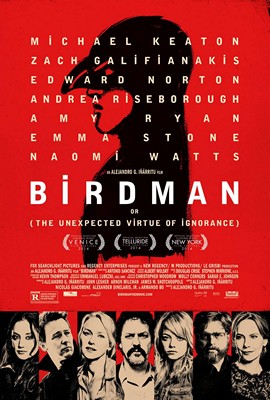 — Birdman, because it’s wildly inventive, sadly realistic, and beautiful to behold—especially if you love the backstage areas of old New York theaters. I’ve seen it twice and loved it both times.
— Boyhood, because Richard Linklater, who is obviously fascinated with the concept of time (re his “Before” film trilogy), took the time to see a boy and his family grow and change over 12 years.
— The Imitation Game. I could nitpick at plot points but the story is fascinating and Benedict Cumberbatch’s performance is award-worthy.
— The Grand Budapest Hotel. Yes, I know this is kind of sweet and quirky or “twee” as Greg Mitchell tweeted. I just saw it for the second time and still enjoyed Wes Anderson’s visual fun and games.
Favorite movie viewing experience: The Cabinet of Dr Caligari with a live organ performance at the Symphony Center on Halloween night.
Plus two exceptional art documentaries:
— National Gallery, a Frederick Wiseman documentary profile of London’s National Gallery, done in his fly-on-the-wall style with no narration or background music.
— The Hairy Who and the Chicago Imagists, about which I wrote two different pieces—first when it was shown here briefly in June and then when the Gene Siskel Film Center showed it in the fall.
Television
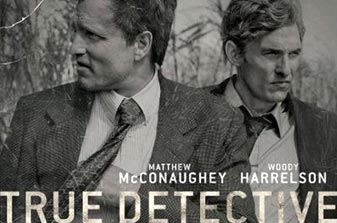 — True Detective, the weird, creepy, gothic HBO series starring Woody Harrelson and Matthew McConnaughey. True Detective will come again this year with a different cast and story line, but I doubt it will compare to year 1.
— The 2013 MusiCares Tribute to Bruce Springsteen, which was finally televised by PBS this fall. Many great performers cover his songs, finding new ways to interpret them, while Springsteen sat in the audience and watched. But he finally got to the stage to give his acceptance speech and play a few of his own songs.
— Sonic Highways, Dave Grohl’s tribute to American music, illustrated with the music and musicians of eight cities on HBO. The Chicago segment was episode 1. You can still view it on demand, if you subscribe to HBO.
Music
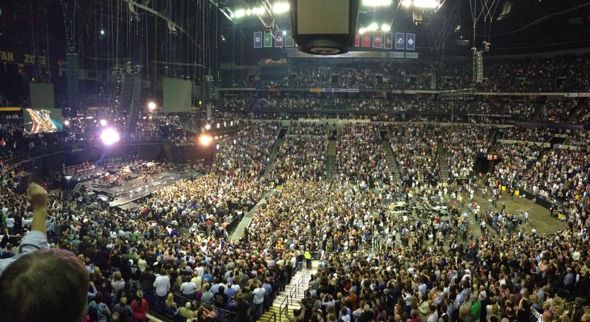
Bridgestone Arena, waiting for The Boss. Brad Paulsen photo.
— Bruce Springsteen and the E Street Band in Nashville. No, he didn’t come to Chicago, so we took a road trip.
— The Bruce Springsteen 65th birthday bash at Fitzgerald’s in Berwyn, organized by my friend, June Sawyers. In addition to the music, June and I read literary and not-so-literary commentary on Mr Springsteen.
Biggest musical disappointment: The October concert at the Symphony Center by Chris Thile and Edgar Meyer. The music and the performances were quiet, indistinguishable and without passion. I knew they weren’t going to rock out, but I did expect some enthusiasm.
Favorite album release: Leonard Cohen’s Popular Problems. The opening track, “Almost Like the Blues,” is especially fine. As the Pitchfork reviewer said, his music “sounds slick, but slightly off-kilter.” Springsteen’s High Hopes was also released in 2014, and of course I’ve listened to it many times.
Visual art
My favorite art and museum exhibits:
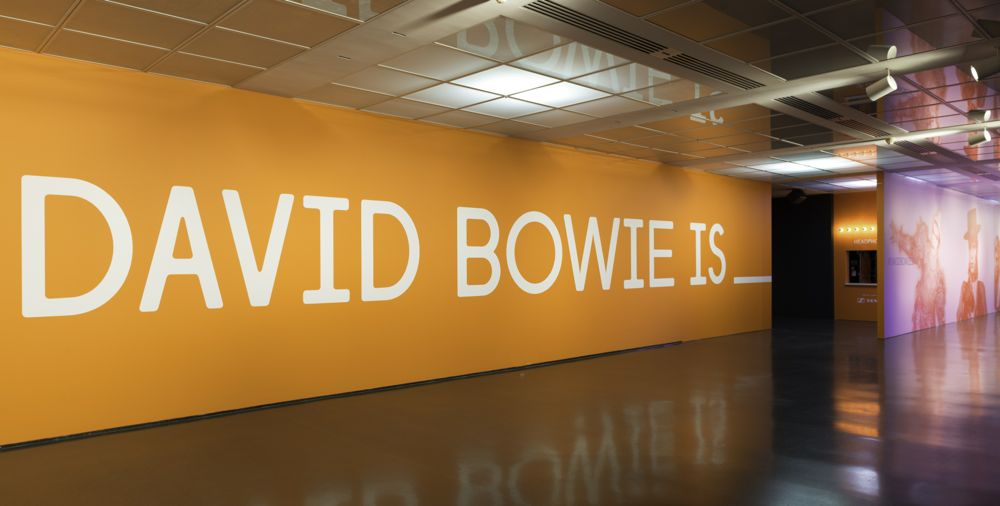 — David Bowie Is, which closes this weekend at the MCA. It’s an excellent exhibit and illuminates the genius of a musician who is ever conscious of his identity. My review.
— Magritte: The Mystery of the Ordinary, 1926-1938, at the Art Institute. My comments.
— The new Ed Paschke Art Center in Jefferson Park opened this summer and I was there.
Mecca Flat Blues, an amazing exhibit of one of the many places where Chicago’s architecture and civic life collide, at the Chicago Cultural Center. This was my personal favorite article of the year. Chicago Magazine named it one of the must-reads of the week in April. I reprised it on my blog with added memories of Mies.
Books and authors
— Hilary Mantel’s short stories, The Assassination of Margaret Thatcher. I had only read Mantel’s first book about Thomas Cromwell, Wolf Hall, which won the Man Booker Award. Her short stories are wildly different.
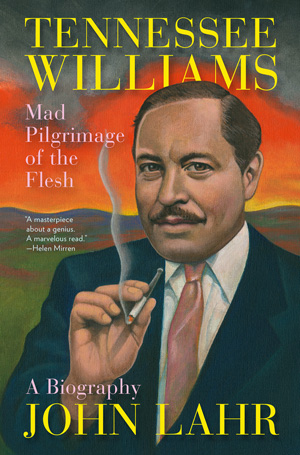 — John Lahr’s biography, Tennessee Williams: Mad Pilgrimage of the Flesh, is one of the best biographies I’ve ever read. I reviewed it and his appearance onstage at Steppenwolf.
— Stoner, the 1965 novel by John Edward Williams that was recently rediscovered. Julian Barnes declared it the must-read novel of 2013. Stoner was a farm boy who went to college to study agriculture and discovered the world of literature. One reason I loved its quiet prose about a life of disappointments is that it’s mostly set on the campus of the University of Missouri; it was lovely to read Williams’ descriptions of the place where I spent two years.
 nancy bishop's journal