Art in the gallery and out in the street
Posted: November 26, 2014 Filed under: Art & architecture, Movies | Tags: Banksy Does New York, Smart Museum of Art 1 CommentSculpture: Carved, Cast, Crumpled at the Smart Museum
The Smart Museum of Art in Hyde Park has dedicated its entire space to a sculpture exhibit that spans the eras from ancient to contemporary. Carved, Cast, Crumpled: Sculpture All Ways is well displayed and organized by historical era. There are works by modern masters like August Rodin, Jacques Lipschitz and Henry Moore, Asian religious figures, classic European bronzes, and neon, metal and fabric sculptures from the modern era. My slideshow will give you a quick overview of the diversity of the exhibit, which is open through December 21.
The Smart Museum is small and a two-hour visit will give you plenty of time to appreciate the entire exhibit plus have a snack in the café, which serves coffee, pastries and light lunch items. It’s popular with students so tables are scarce during the lunch hour. The museum is nestled behind Court Theatre at 5550 S. Greenwood on the University of Chicago campus. (All photos by Nancy Bishop.)
Out in the street: Banksy Does New York
Why do I love street art? I’m particularly fond of it because it takes art out of the elite realm and puts it out for everyone to enjoy. No admission fee, no checking your bag, no waiting in line. I also like it because it is part of the cycle of people’s art that encompasses comic books and graphic novels, pop art, the Chicago Imagists and the Hairy Who, and today’s post-street art.
Banksy is the famous and elusive British street artist who produced the delightful 2010 documentary, Exit Through the Gift Shop. In October 2013, Banksy took up a “residency” in New York. Every day of the month, he installed a piece of street art somewhere in New York and started a frenzy of art lovers and hipsters seeking out each day’s work. Banksy would post a tease on his website each morning, suggesting something about the art, but not identifying the location.

Copyright Daily Mail Online.
HBO Documentaries has produced a 90-minute film, directed by Chris Moukarbel, about this month of street art adventures, titled Banksy Does New York. It’s been running on HBO channels and it’s available on HBO on demand as well.
The installations are varied in form, materials and message. They range from stenciled figures and balloons to a crumbling sphinx to a slaughterhouse truck filled with squealing animal puppets that parked in front of various meat markets throughout the day.
Art on screen: National Gallery
National Gallery is a Frederick Wiseman documentary profile of London’s National Gallery. It’s running through December 4 at the Gene Siskel Film Center and although it’s almost three hours long, I highly recommend it. It’s a magnificent look at this immense art museum and its visitors, staff members and, most of all, its collection. There’s no narrative voiceover, no background music, just the museum and its denizens—and sometimes silence. The trailer will give you an idea of its charm.
As I said in my Gapers Block review, my favorite aspect of the film is the faces. Faces looking at faces. All manner of expression in the visitors and all manner of people portrayed on the walls.
Related posts:
More on street art. https://nancybishopsjournal.com/2014/02/12/out-in-the-street-street-art-and-post-street-art/
The Chicago Imagists and the Hairy Who as influencers. http://gapersblock.com/ac/2014/10/01/the-hairy-who-returns–to-the-siskel-film-center/
Ed Paschke et al. https://nancybishopsjournal.com/2014/08/02/art-that-mystifies-and-moves-magritte-koudelka-and-paschke/
Wisconsin road trip: Art, architecture and, of course, food
Posted: October 31, 2014 Filed under: Art & architecture, Food | Tags: Frank Lloyd Wright, Racine Art Museum, S C Johnson 5 CommentsIt was a crisp, sunny October Friday. Three of us (all former architectural docents) gathered at a hotel parking lot in Deerfield and headed north for Racine, an epicenter for devotees of Frank Lloyd Wright architecture (in case you thought Oak Park was the only place to see his work). We had an afternoon reservation to tour the S C Johnson world headquarters, most of which was designed by Wright. We had all seen the best-known Administration Building (1939) before, but now the Research Tower (1950) and Fortaleza Hall (2010) also were open for public tours. (All photos by Nancy Bishop, except the Great Workroom photo, which is a WikiCommons image.)
Starting from Deerfield, it was only about an hour until we reached Racine. Our friend Donna had already zeroed in on a lunch spot, the Kewpee Sandwich Shop. Their specialty was plain but delicious burgers and cheeseburgers (or double versions of each) plus French fries—and best of all—real old-fashioned malteds and milkshakes. The Kewpee Sandwich Shop is a throwback, with an art-deco exterior and wall tile bannered with kewpees. Its history can be traced back to a Kewpee Hamburger chain founded in 1923. It was a great lunch.
We were a little early for our tour so we drove around Racine hunting for a famous FLW house. We found the Thomas P Hardy house at 1319 S Main St. Wright designed it in 1905. A renovation was completed in 2013.
The tour begins at the S C Johnson tour center in the Golden Rondelle Theater, originally built as the S C Johnson pavilion at the New York World’s Fair of 1965-65. After the fair, the Rondelle was dismantled and shipped back to Racine, where it was redesigned by Taliesin Associates, the firm formed by Wright’s apprentices after his death.
Our tour group had a brief orientation and then walked to the Administration Building, setting of Wright’s Great Workroom, an high-ceilinged open office space furnished with Wright-designed office furniture. Our tour guide, Edsel, was well-informed and answered even our most docent-ish arcane questions. (I hate it when a tour guide makes mistakes and I have to decide whether to correct them or not.)
We then walked over to the Research Tower, designed by Wright for the Johnson R&D department to develop products like Pledge furniture polish and Off insect repellent. The building is built in floor stacks with a central utility core but hasn’t been used in many years, since changes in fire safety codes make its use impossible. The 15-storey building has only one tiny elevator so workers and visitors climb 29-inch-wide winding stairs to get to the lab floors that are open—and frozen in time, as if the Johnson chemists were on a lunch break. The office and lab supplies and papers on the desks and lab tables are as interesting as the architecture.
The final stop on the tour is Fortaleza Hall, designed by Foster & Partners (the photos on the firm’s website are spectacular). This 2010 building includes expansive space for historical exhibits about the company plus an area known as the Commons for employee amenities. In the building’s main hall is a replica of the twin-engine Sikorsky amphibian plane that Sam Johnson flew to Fortaleza, Brazil, in 1998, to find Carnauba palms for Johnson wax products.
If you go to Racine, you should also visit Wingspread, a magnificent 14,000 square-foot home that Wright designed in 1936 for H F Johnson Jr. You can book a tour at the website. We toured Wingspread on an earlier visit.
Leaving the S C Johnson area, we took a drive along the beautiful lakefront, with park and recreation areas. It’s close to the Racine Art Museum on Main Street in downtown Racine. RAM is a small museum in a modern building with well-designed exhibits and a gift shop stocked with a fine array of art and design products.
On the second level of RAM, we toured two excellent exhibits. Wayne Higby’s ceramics have a strong southwestern feel in palette and form. I particularly liked the landscape pieces that reminded me of the mesas in southwest Colorado. Wendy Wallen Malinow’s glass sculptures have a vivid playful look.
The gift shop yielded small purchases for all of us. I’m especially fond of the clever windup toys that I know my small grandsons will enjoy. Patience, kids, I’ll be there at Thanksgiving.
It wasn’t quite time to go home yet. We had more food stops to make. We decided to head for everyone’s favorite Danish bakery, O&H Bakery, to check out the kringle. As a former Wisconsinite, I’ve had them before. (You can buy them in Chicago; Treasure Island usually carries them.) We thought buying them at the source might be great, but in fact, they were disappointing. My cream-cheese kringle was just too sweet and the pastry wasn’t flaky. The croissants were fine, however.
Last stop was the famous Brat Stop in Kenosha, to have a quick supper before heading south. And to buy some fresh bratwurst to cook at home. I did that next day, along with a small batch of the family Bohemian sauerkraut. Excellent combination.
A trip to Racine is a great day trip or an overnight stay. You can visit the S C Johnson headquarters and Wingspread as well as RAM. S C Johnson tours (limited to 20 people) are free but reservations are required. See tour information here. Note that you can take photos of the building exteriors but interior photography is not allowed.
“David Bowie Is” is fabulous:
Posted: October 1, 2014 Filed under: Art & architecture, Chicago, Music | Tags: David Bowie Is, MCA Chicago Leave a comment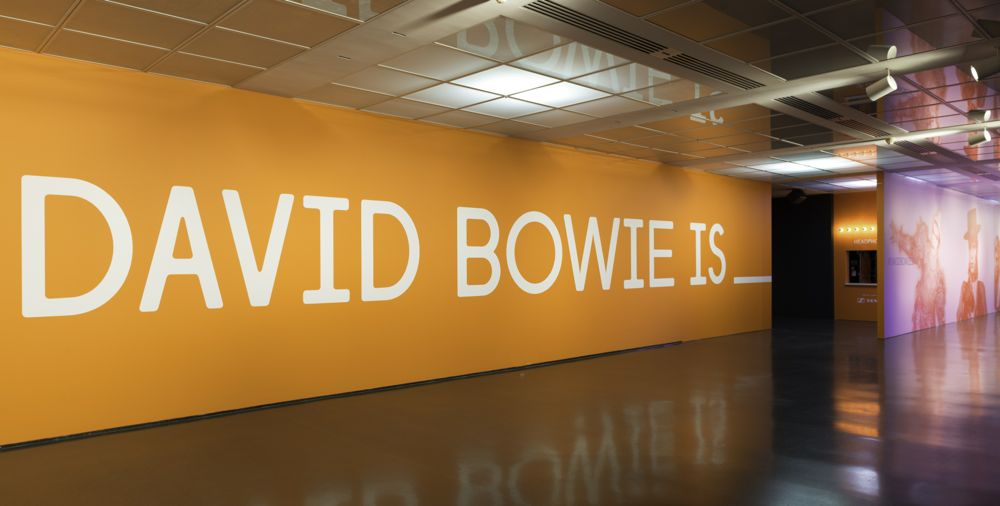
Signage at the MCA gallery entrance. Photo courtesy MCA.
The new David Bowie Is exhibit at the Museum of Contemporary Art deserves its hype. It’s a comprehensive, expansive look at the career of a man who was a singer/songwriter, musician–and far more. David Bowie is a painter, actor, writer, designer, composer–and most important, a man who knows how to develop and maintain a brand.
I reviewed the exhibit last week for Gapers Block, so take a look. My review also appears here on culturevulture.net.
Among the fascinating displays of Bowie’s art, designs, music and costumes is a large video display of his 1972 appearance on the BBC performing “Starman” wearing makeup and a colorful quilted fitted suit. His fans loved it and others were outraged–by his appearance as well as by what was seen as inappropriate behavior with his guitarist Mick Ronson. Here’s the same video. Don’t get excited. It’s not R rated, by any means. Great song, though.
Bowie hasn’t played a full concert since 2004 when he underwent emergency angioplasty after a concert in Germany. He often performed in Chicago during his touring years. One outstanding series of Bowie Chicago performances was the full month of August 1980 when he played the lead in the play, The Elephant Man, at the Blackstone Theatre. You can see a scene from that play in one exhibit area at the MCA.
Patrick Sisson’s article in the Reader tells about that month that Bowie called Chicago home…and describes some of the places he visited and people he spent time with while he was here.
Finally, here’s a video about the Bowie exhibit that’s a good visual intro. It’s an exhibit you should not miss.
Art that mystifies and moves: Magritte, Koudelka and Paschke
Posted: August 2, 2014 Filed under: Art & architecture 1 CommentChicagoans are fortunate to have two major art museums and many medium and small galleries, where you can see a vast array of classic and contemporary art. I took advantage of that this week, seeing Rene Magritte’s “elective affinities” and Josef Koudelka’s photographs at the Art Institute, and Ed Paschke’s vivid character studies at the new Ed Paschke Art Center.
Magritte: The Mystery of the Ordinary, 1926-1938
Magritte is the current major exhibit at the Art Institute of Chicago. You’ll find it in Regenstein Hall, on the second level near the rear of the building. One of the benefits is that you get to walk thru the beautiful hall of Asian sculpture, which is displayed in a setting of rich golds and oranges. Then, when you turn right and walk up a short flight of stairs, you’re greeted with the hallway of Ellsworth Kelly color-field paintings, one of my favorite exhibits.
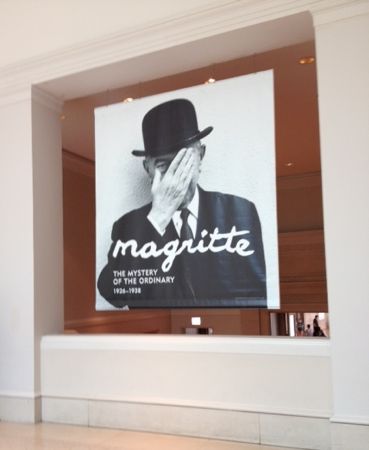 The Magritte exhibit runs until October 13 and it is well worth seeing, both for the art itself and for the creative way the work is exhibited. Magritte’s art was influenced by his work in advertising and theatrical design as well as by his connections with Andre Breton and Tristan Tsara, the founders of surrealism and of the Dada movement, respectively, as well as Salvador Dali and Joan Miro.
Magritte’s work is bizarre, quirky, and deliberately deceptive and shows his keen and intelligent sense of humor. One of his best-known works is the word-image painting, “The Treachery of Images,” a smoker’s pipe with the legend, “Ceci n’est pas une pipe.” Another work titled “The Interpretation of Dreams,” shows a two-by-two grid; each square includes an image and a label. But three of the four are labeled whimsically. Only the valise is in fact labeled as a valise. Most of his paintings are subtle and sometimes mystifying, like “Entr’acte,” a 1927 painting showing disembodied leg-arm parts on a stage-set background.
In “Not to be Reproduced,” we see the back of a man looking in a mirror at the back of his own image. In a painting titled “La Clairvoyance,” a painter (Magritte himself?) paints a large bird while looking intently at his model, a pristine egg.
Here’s a video teaser about the exhibit.
Curator Stephanie D’Alessandro is to be commended for bringing in Canadian opera director Robert Carsen to design the imaginative setting for Magritte’s work. No large white galleries here. Instead, the walls are dark gray and the only illumination is on the paintings themselves. The space swerves and snakes thru the display area so you only see one or a few works at a time. Near the end, there’s a series of very small galleries, like the tiny side chapels in a cathedral, each with one work hanging alone for your bemusement.
I heard two people talking as they walked out of the exhibit. One said, “Well, what did you think?” And her friend said, “I don’t know, I thought it was odd.” The first person said, “Well, I thought it was depressing. All those dark walls….”
Trust me, it isn’t depressing. Magritte puzzles and amuses. You’ll find yourself laughing aloud at some of his “mysteries.” Go on a day when you need a mood enhancer.
Josef Koudelka: Nationality Doubtful
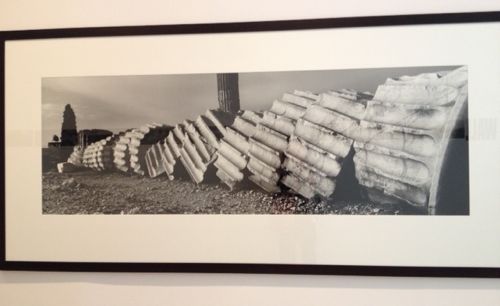
Koudelka: “Greece 1994 (Athens)” from the series Archaelogy
The Art Institute also is showing a large exhibit of dramatic photographs by the Czech-born Magnum photographer, Josef Koudelka. They’re displayed on the main level of the Modern Wing. In one gallery are his panoramic landscape photographs, some large and framed, and smaller ones, displayed in horizontal bands across the gallery walls. His landscapes are not green and pastoral. He photographs old industrial and mining sites, destroyed monuments and the detritus of modern life.
Across the hall in a second gallery are two very moving exhibits of human scale. “Gypsies” is composed of 22 photos, portraits of musicians, individuals, groups and interiors showing the lives of the Roma people, photographed in Rumania, Slovakia and the “Czech lands.” They’re grainy, black and white, and very human. Most stunning is a funeral image of a family standing on both sides of a body wrapped in white; the scene is naturally lighted from the window in a Caravaggesque manner.
The second exhibit is titled “Invasion” and was photographed in August 1968 as Russian troops and tanks invaded Prague. Koudelka loaded his camera with East German movie film and shot for six days. He then managed to process the film and Magnum smuggled the negatives to the US. The exhibit includes a video of a CBS newscast about the invasion, showing dozens of Koudelka’s images.
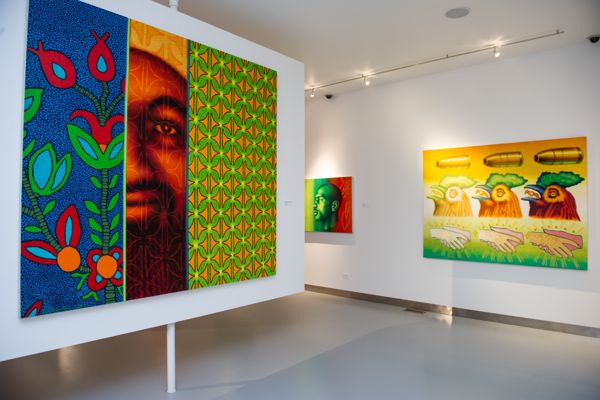
View of the Ed Paschke gallery. Photo courtesy Ed Paschke Art Center.
Ed Paschke in Jefferson Park
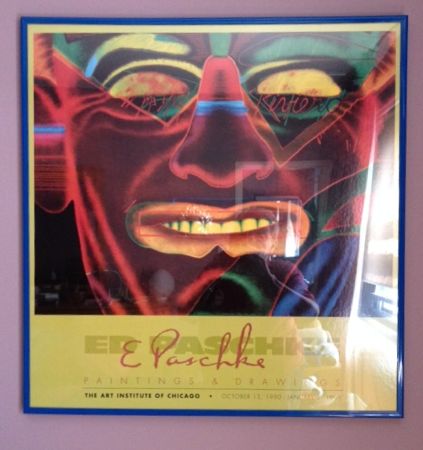 The Ed Paschke Art Center, a museum dedicated to the work of Ed Paschke of the Chicago Imagists, opened last month in Jefferson Park. I have always been a fan of Paschke’s work, which is brilliantly vivid and gorgeously grotesque. I visited the new center this week and wrote an article about it for Gapers Block. You can read it here and see a few images from the center. The 30-minute video is particularly interesting because Paschke is so articulate about how he works. There are interview segments from the 1970s and the early 2000s.
This poster is from the 1990-91 retrospective of Paschke’s work at the Art Institute. This poster has been hanging in my bedroom ever since and has lulled me to sleep every night.
Theater to feed my obsessions: Bombs, dystopia and technology
Posted: June 20, 2014 Filed under: Art & architecture, Movies, Theater 2 CommentsI have a few obsessions and they’re probably baffling or inscrutable to most of my friends and relatives. If you’re a rock music fan, you’ll understand my Bruce Springsteen obsession. But my obsessions with the Spanish Civil War, technology and dystopian societies, and the genius physicists who created that engine of doom, the first atomic bomb, are a little weird, I admit. I’m not going to try to explain them here. But I don’t miss a chance to read about, or see dramatizations of, those topics. And that explains why I really liked a few of the plays I’ve reviewed and seen lately.
The Half Life of Memory by Cold Basement Dramatics
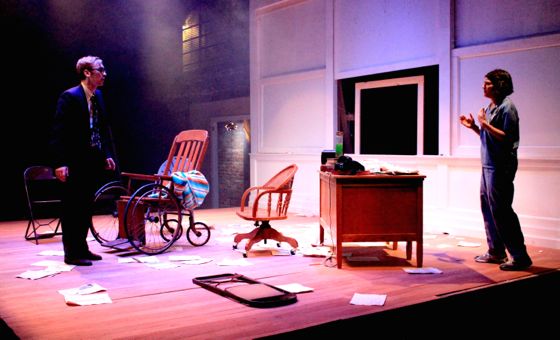 Those genius physicists—Oppenheimer, Fermi, Einstein and Teller—do a song and dance number in this memory play now being performed by a small theater company at the city’s Storefront Theater on Randolph Street. The protagonist is a retired physicist suffering from dementia, who dreams that his memory is radioactive and will allow him to create the next huge weapon of mass destruction. Edward Teller eggs him on, while the other physicists are less sanguine about the idea.
Cold Basement Dramatics does a good job with this difficult topic. Mark Maxwell plays the protagonist in an intelligent and graceful style and the rest of the cast is very good too.
Here’s the opening of my Gapers Block review:
“Our memories can beguile us, deceive us, even betray us. On the other hand, we also create those deceptions by repressing memories and even creating memories that never existed. The Half Life of Memory, Jason Lindner’s fascinating new work produced by Cold Basement Dramatics, is a memory play… with a bang.”
Playwright Lindner created the character based on a relative who was one of the Manhattan Project physicists. The play has some rough edges but is definitely worth your time and interest.
The Half Life of Memory runs thru June 29 at the Storefront Theatre, 66 E Randolph St. Tickets are cheap too!
Tyrant by Sideshow Theatre Company
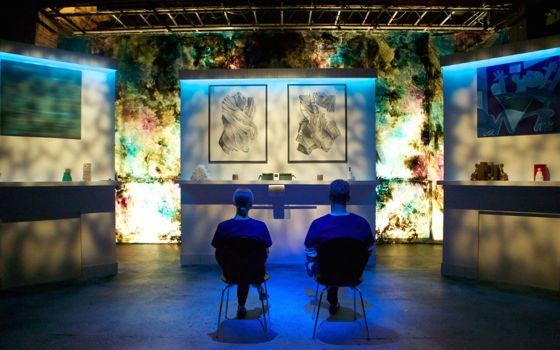 Tyrant shows us how a future society has solved the problem of homelessness and unemployment. Sideshow presents a dystopian future in this world premiere play by Kathleen Akerley and they do a decent job with it. The topic and treatment are interesting, and this kind of risk-taking deserves an audience. (My rating was “somewhat recommended.”)
This is how my Gapers Block review starts:
“Here’s a solution for the problem of homelessness. Gather up the homeless and give them the choice of joining the military, leaving the country, or moving to a center for special training. The latter group is assigned to wealthy people to perform household and personal chores. In Sideshow Theatre Company’s Tyrant, Congress does that one year from now with the US Rectification Act, which allows “rectifees” to be “actualized” by the presumably well-intentioned 1 percent (or perhaps 10 percent).”
Tyrant runs through June 29 at Theater Wit, 1229 W Belmont.
Ask Aunt Susan at Goodman Theatre

Alex Stage and Marc Grapey at the Hole in the Wall Bar.
The play in Goodman’s smaller theater space is a modernized version of Nathanael West’s novella, Miss Lonelyhearts. Rather than being a 1930s newspaper advice columnist, our protagonist is a young man who creates content and code for an internet company. His boss, the funny, fiendish Steve, asks him to start giving advice online to readers who write in with their problems. This becomes a huge success almost immediately, but Aunt Susan doesn’t know how to handle his fame. Nor does his girlfriend Betty. But Steve and his partner/wife Lydia do and they move Aunt Susan to version 2.0.
Ask Aunt Susan has gotten a few negative reviews but most are in the “recommended” category, as mine was. The 90-minute play has some flaws and needs some work, but it’s great fun and asks us to question how we maintain our lives today. Plus Marc Grapey’s performance as Steve is not to be missed. Grapey is a terrific comic actor and does a four-star job in this play.
My Gapers Block review wonders:
“Ask Aunt Susan… is a smart, funny 90-minute tear through today’s era of digital connections and a cri de coeur for a slower pace and a little more humanity in our personal relationships. Or is it?”
Ask Aunt Susan runs through June 22 at the Goodman Theatre, 170 N Dearborn St.
I also interviewed playwright Seth Bockley about his thinking on internet obsessions, generational differences, and how he visualizes a play while writing it. Read it here.
Vieux Carré at Raven Theatre
 This haunting Tennessee Williams play presents many of the themes of his other works. Loneliness. Failed dreams. Artistic awakening. Poverty. Homosexuality. This is one of Williams’ late plays, written in 1977, and it addresses those themes as he did in better-known works such as The Glass Menagerie and Streetcar Named Desire. This play deserves to be better known. Vieux Carré deals with The Writer (Ty Olwin) as a young man newly arrived in New Orleans and trying to sort out his creative and romantic life, while living in a rooming house in the French Quarter. The denizens of the rooming house suffer poverty, hunger and lost love.
Raven Theatre does reliably high quality work and this play is no exception. The two-act, two-hour play directed by Cody Estle is beautifully handled. Mrs Wire (Joanne Montemurro) owns the boarding house and handles her turn from mean-spirited landlady to grieving her own loss beautifully. She tells The Writer, “There’s so much loneliness in this house that you can hear it.”
Veteran Chicago actor Will Casey plays Nightingale, a gay artist who is dying of tuberculosis and mourning his unsuccessful career. He tries to introduce the younger man to a new love and life style, which The Writer seems to resist. The relationship between the two actors ebbs and flows until its tragic end.
Vieux Carré runs at Raven Theatre Company, 6157 N Clark St, thru June 28.
And a few favorite movies
Hairy Who & the Chicago Imagists
 Do you remember the artists known as the Hairy Who from the ‘60s and ‘70s? They were outrageous and confrontational and their work was vividly colored and luridly graphic. You can relive your past art memories in this outstanding documentary, which I just reviewed. It’s having limited showings but you’ll be able to see it in late September at the Gene Siskel Film Center. I’m going to see it again.
Obvious Child
I saw this excellent indie film last month at the Music Box during the Chicago Critics Film Festival. And now it’s back and showing at several local theaters. It’s directed by Gillian Robespierre and stars Jenny Slate as a young woman standup comic who gets pregnant in a drunken one-night stand (that turns into a tender romance). The performances are excellent, the script is raunchy and fun. Most interesting, the concept of abortion gets rational consideration; it’s not treated as an idea that dare not be mentioned. This is the first film I’ve seen that takes this approach and it’s refreshingly natural and naturalistic. I highly recommend seeing Obvious Child.
NOTE: All photos courtesy of the theater or production companies.
May mashup: My pop culture diary
Posted: May 31, 2014 Filed under: Art & architecture, Movies, Music, Theater | Tags: Court Theatre, E Street Band, Profiles Theatre, theandygram.com 3 CommentsBusy end-of-May at Nancy’s house. House guests, including two perfectly darling grandsons, and a family wedding at a grand venue. So I haven’t seen much theater since the last time we chatted. Still, there were a few great movies, one so-so play, and news about a new website that I’m writing for. You’ll find some TV recs too.
First, some architecture notes
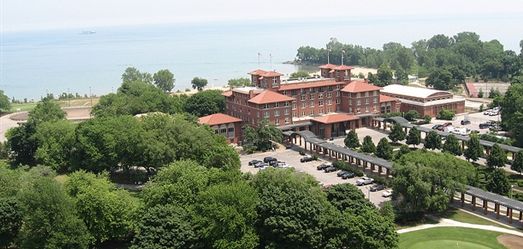
South Shore Cultural Center. Photo courtesy Chicago Park District
A lakefront wedding. The wedding was at the beautiful South Shore Cultural Center, right on the lakefront at 71st Street. It was originally a private country club and it’s now part of the Chicago Park District. If you haven’t been there, it is simply lovely and worth a visit. If you’re planning an event, it should be on your list of venues.
The country club, built in 1906, was designed by Marshall and Fox, who designed the Drake and Blackstone Hotels. It was expanded in 1916, also by Marshall and Fox. (Benjamin Marshall also designed the elegant Beaux Arts apartment building at 1550 N State Parkway.) The wedding ceremony was held in the beautiful solarium, looking out at the lake, and then we moved to a reception hall for champagne and greetings, and finally to the dining room. You can see some CPD photos here.
An architecture scavenger hunt. If you’re a fan of Chicago’s Loop architecture, you should sign up for the Chicago Architecture Foundation’s scavenger hunt next Saturday afternoon, June 7. The game starts and ends at the Railway Exchange Building at 224 S Michigan; there’ll be an awards reception in the grand atrium. You’ll find the details in my story on Gapers Block.
Theater notes
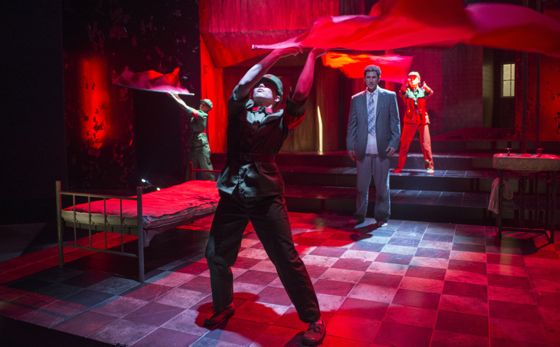
Photo by Michael Brosilow.
M Butterfly at Court Theatre. The script by David Henry Hwang is marvelous, very smart and well-written. I thought the Court production left a little to be desired—it was a bit flat. The reviews were definitely mixed from “not recommended” to “highly recommended.” I imagine director Charles Newell might have taken some notes and spiffed up his production since then. The play tells the amazing story of the French diplomat who was deceived for 20 years by a male opera star posing as a female diva. Despite my review, I do recommend a trip to Hyde Park.
Here’s my review; my rating was “somewhat recommended.”
TheAndyGram.com. This is a New York-based theater website that covers Broadway, off-Broadway, Washington, Connecticut and, now, Chicago. My first review (of Cock at Profiles Theatre) is now up on theandygram.com. See it here. It’s a terrific show and I highly recommend it. It runs until June 29; details are at the end of my review.
My headline is “… A Riveting Play That Explores All the Meanings of Its Title.” Here’s how my review begins:
Cock is a play title you very rarely find in a theater review headline. I’m hoping that’s because of fear of internet anti-obscenity filters, rather than puritanism on the part of copy editors. The play by Mike Bartlett is a comedy about sexual identity, a love triangle and a power play among three characters: John, a bisexual who is fighting to discover his identity; M and W, his lovers, who battle each other and John himself to determine the course of their lives.
Movies I loved…or at least liked
The Normal Heart. HBO’s production of Larry Kramer’s play about the early years of the AIDS epidemic is excellent. I wasn’t sure what to expect but I had read enough about the production, and the playwright’s involvement, to be optimistic that its edges wouldn’t be softened. And they weren’t. We needed to be reminded about the terror of the disease first known as “gay cancer.” And to be reminded that the war is not over. The tagline, “To win a war, you have to start one,” is an ideal descriptor.
The acting is excellent. Mark Ruffalo plays a very believable Ned Weeks (Larry Kramer) and there are terrific performances by Julia Roberts, Jim Parsons and Matt Bomer. I originally saw the play off-Broadway in about 1985 and Timeline Theatre did an excellent production last year. I highly recommend the HBO film. Here’s the trailer.
Stoker and Blue Velvet. My film group discussed Stoker last week and we’re discussing Blue Velvet soon. They are both excellent films and each is weird, creepy and outrageous in its own way.
Stoker (2013, 99 minutes) is the first English-language film by the Korean director, Chan-Wook Park. (He directed the so-called vengeance trilogy, which includes Oldboy.) His title is surely meant to remind us of Bram Stoker, who created Dracula, but Stoker is just a family name. A family whose father is killed in a mysterious auto accident, whose daughter ( Mia Wasikowska) is obsessed with hunting and saddle shoes, and whose mother (Nicole Kidman) can’t get her daughter to love her. But at the funeral, an uncle (Matthew Goode) appears out of nowhere and befriends mother and daughter. The story is a bit of a takeoff on an Alfred Hitchcock film, Shadow of a Doubt, about a young girl’s relationship with her serial-killer uncle. Stoker has lots of strange and beautiful cinematography and features a psychologically steamy piano duet of Philip Glass music.
If you stay up late or get up early or set your DVR, HBO is showing Stoker June 1 at 3:20am CT.
Blue Velvet (1986, 120 minutes) is an early David Lynch film, before Twin Peaks. The weirdness is set off when an earnest young man (Kyle MacLachlan) finds a severed human ear in a field as he’s walking home. The plot revolves around his boy detective attempts to solve a mystery with a very young Laura Dern as his co-star. Isabelle Rossellini is a nightclub singer who performs “Blue Velvet” and Dennis Hopper is her crazed tormentor, who uses a mask to breathe in gas to energize his crimes.
Roger Ebert hated this film so much that he gave it one star in 1986. He and Gene Siskel disagreed on it, however. (When it was revived 20 years later, one reviewer said it was still “a hilarious, red-hot poker to the brain.”) Here’s a clip of the “At the Movies” review from 1986. Go to 2:35 to see Roger and Gene debate the film.
Rock and Roll Hall of Fame Induction
Yes, tonight is the night that we can see the E Street Band inducted into the Rock and Roll Hall of Fame. Their frontman, Bruce Springsteen, was inducted in 1999. The induction ceremony took place in April but tonight is the three-hour-plus event, with all the honorees, along with a bunch of special guests performing. The band is being inducted in a category that used to be known as sidemen and now is called the Award for Musical Excellence.
Other inductees are Peter Gabriel, Nirvana, Hall and Oates, KISS, Linda Ronstadt and Cat Stevens. Artists are eligible for the Rock Hall 25 years after their first recording. Rock Hall members (including me) voted for a list of eligible musicians and then the panel of judges picks the inductees. My DVR is already set.
The Mecca: Where modernism began (and memories of Mies)
Posted: April 16, 2014 Filed under: Art & architecture | Tags: Chicago Cultural Center, IIT Crown Hall, Mecca Flat Blues, Mies van der Rohe, the Bauhaus, Thomas Dyja 1 CommentThe first time I heard of the Mecca, the grand old apartment building in Bronzeville, was when I read Thomas Dyja’s colorful cultural history, The Third Coast: When Chicago Built the American Dream. (The book won the 2013 Heartland Prize for nonfiction.) The current exhibit at the Chicago Cultural Center—Mecca Flat Blues—tells the story of the Mecca and how that very site became the location of the campus of Illinois Institute of Technology and of Ludwig Mies van der Rohe’s masterpiece, S R Crown Hall. I just reviewed the exhibit for Gapers Block. You can read my article here.
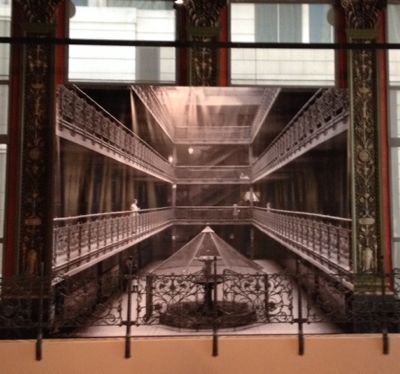
Photo by Nancy Bishop.
The Mecca was located on 34th and State streets. Amazing stories swirled around the Mecca itself from its opening in 1892 until its demolition in 1952. Dyja gave a lecture last week on “The Battle for the Mecca” and described how that one square block on 34th Street between State and Dearborn streets inspired so much. Gwendolyn Brooks’ great poem “In the Mecca,” was about the time she spent working there. A blues song from the 1920s, “Mecca Flat Blues,” commemorated the building, which was part of an entertainment district where jazz and blues flourished. When you check out my review, be sure to play the video of the blues song with audio from the original vinyl recording, played on a very old turntable. The Mecca was demolished and the site scraped clean to provide the site for the new IIT building. Dyja called it a palimpsest: a writing surface scraped clean for new writing on which traces of past writing remain.
The exhibit continues in the Sidney Yates Gallery at the Cultural Center until May 25. See details at the end of my review.
A note about my Gapers Block article: Chicago Magazine named it one of the “must-read articles of the week.” I was kinda pleased.
Memories of Mies
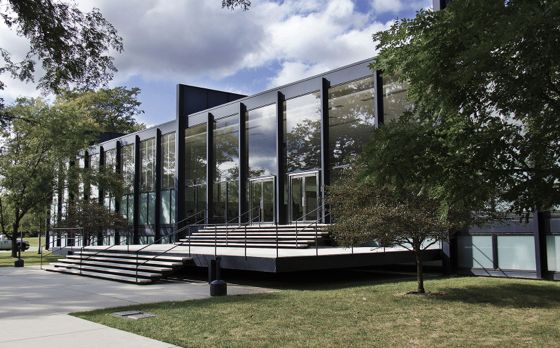
S R Crown Hall. Photo courtesy Wikimedia Commons
My first visit to Crown Hall was an unforgettable experience for a longtime devotee of architecture and design. It was September 1969 and a major retrospective celebrating 50 years of Bauhaus art and design was on display at Crown Hall. Mies van der Rohe, its architect, was one of the many alumni of the Bauhaus who came to Chicago in the 1930s. Mies had died just the month before—in August 1969. I was living in DeKalb at the time and had never been to the IIT campus, even though I had grown up in Chicago—on the far northwest side. But I was a lover of Bauhaus design and the exhibit was something I could not miss. I started early, so I could spend a whole long day at the exhibit. I had seen small photos of Crown Hall so I knew the building I was looking for on the unfamiliar campus. But as I walked toward it, it took my breath away. The expanse of glass gleaming in the sun and the precision of the steel i-beams were simply stunning. Even though other Mies high-rise buildings are also considered masterpieces, this four-story academic building is much more elegant, because its entirety can be appreciated in one view.
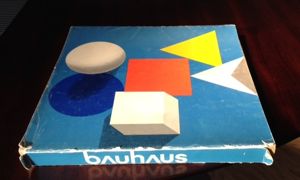
Original catalog from 1969. Photo by Nancy Bishop.
The Bauhaus exhibit was very comprehensive and thrilling to see. Paintings, photography, architectural renderings and photographs, furniture, sculpture, pottery, typography by dozens of famous artists and designers. I was on sensory overload by the end of the day. I still have the square 365-page catalog, which I count among my treasures.
See the Farnsworth House
Another beautiful example of Mies’ low-rise designs is his Farnsworth House in Plano, Illinois—a museum house that’s open for tours April through November.
Related posts
Walking the Mies staircase at the Arts Club. Scroll down in my October post.
Chicago’s Bauhaus legacy. See my comments on the great 2013 exhibit at the Ukrainian Institute of Modern Art.
Speaking of art: The work is what it is
Posted: April 11, 2014 Filed under: Art & architecture | Tags: Art Institute of Chicago, Chicago Cultural Center, Christopher Wool, Finding Vivian Maier 3 CommentsSome musings on the nature of art and the artist…and letting the artist’s work stand on its own.
Finding Vivian Maier—and viewing her work
Yesterday I saw the new documentary about photographer Vivian Maier: Finding Vivian Maier, directed by John Maloof and Charlie Siskel. Maloof is one of the three major owners of Maier’s work and probably holds the greatest number of images (negatives and undeveloped film) and her ephemera. I’ve written about Maier before and her work has had lots of attention in the last two years.
The new film was interesting and well done (although Maloof, who is not a film director, inserted way too much of himself in the film). In deciphering the mystery of Vivian Maier, the filmmakers did some good research, including going to Europe, where she had traveled. They also sought out the now-adult children for whom she cared as a nanny in the Chicago suburbs 50 or 60 years ago. Some of them discussed “Vivian” at length and told stories of her cruelty; others talked about her strange habits and her hoarding.
You know what? I didn’t want to know those things about Vivian Maier because I want to appreciate her work for what it is. Brilliant, engaging images of humanity. The fact that her work was never shown when she was alive is a sad story and in fact, she might not even approve of the current Maier-mania.
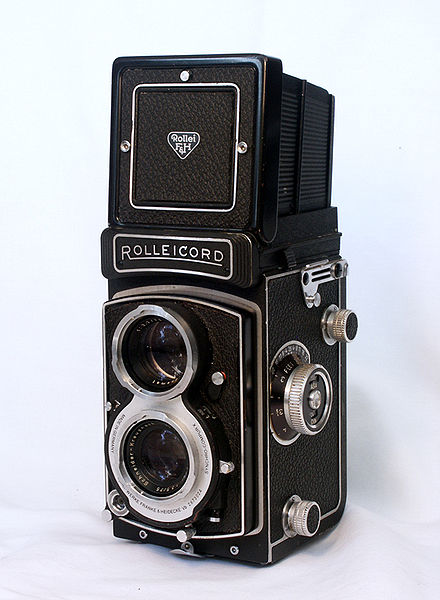
A Rolleicord: My first real camera
But the work is there and it’s magnificent. If you haven’t seen it, get to the Chicago History Museum or check it out online. The work stands on its own.
A technology aside
Maier shot with a Rolleiflex, a twin-lens reflex camera (my first camera, a college graduation present from my parents, was a Rolleicord, the amateur-photographer model) and that meant she could be more discreet in photographing subjects. With a twin-lens, you hold the camera at chest-level and frame the image by looking down into the viewfinder; you don’t hold the camera up to your face, which may seem more intrusive to the subject.
The art is what it is
Today I went to the Art Institute because I didn’t want to miss the retrospective of Christopher Wool’s work. (More below.) It is fascinating, beautiful and interesting as it has changed over time. I don’t want to know if the artist was going through a bad divorce or drinking too much or living in exile. The work is the work. It stands on its own.
You may be thinking of Woody Allen about now. Some of you may believe that he is a perverted, child-abusing horrible person. And he may be. The evidence about that is confusing and contradictory.
But even if he is all those things, his work is still outstanding. He’s one of the finest American film creators of our time. His work deserves to be viewed on its own merits. His art is what it is.
The abstract expressionism of Christopher Wool
The retrospective of Christopher Wool’s work is on display at the Art Institute of Chicago until May 11. It’s in Regenstein Hall in the American modern art wing (not in the new Modern Wing). His early work is probably best known. He used letterforms to create word paintings, using language as image. (All photos by Nancy Bishop.)
One of the best-known works of this period is Apocalypse Now, which Christie’s sold at auction in November for many millions. See an interesting discussion of this sale here. My favorite wall in the current exhibit is Untitled (Black Book Drawings), a series of 22 pieces in which negative character types of eight or nine letters are primly stacked.
In the 21st century, his paintings take on a new expressionistic look in abstract forms of tangles of black lines, shadows, dots and swashes of paint and ink.
His gray paintings in the last rooms of the exhibit are large-scale works in enamel on linen.
Finally or firstly, the bronze Wool sculpture at the entry to the exhibit transforms his two-dimensional creativity into three dimensions. My photo shows the sculpture with the works of Ellsworth Kelly peeping out behind the tangle of metal.
On the horizon
The exhibit titled Mecca Flat Blues at the Cultural Center is not to be missed. I’m writing a feature about it for Gapers Block and will post a link here soon.
Also at the Cultural Center, the exhibit 35 Years of Public Art is just one of many reasons to stop by the building that used to be the Chicago Public Library. It’s a city treasure for many reasons.
Out in the Street—Street art and post-street art
Posted: February 12, 2014 Filed under: Art & architecture | Tags: Chicago street art, Maxwell Colette Gallery, Post-street art 1 CommentWhen I’m out in the street
I walk the way I wanna walk
When I’m out in the street
I talk the way I wanna talk
When I’m out in the street
When I’m out in the street
Baby, out in the street I don’t feel sad or blue
Baby, out in the street I’ll be waiting for you
–Bruce Springsteen, “Out in the Street” from The River, 1980
How could I resist an opportunity to start an essay with a piece of Springsteen art? It fits because I’ve recently seen two fascinating exhibits of street art and post-street art. What is post-street art? I’ll get to that in a minute.
Chicago Street Art
The street art exhibit was Paint Paste Sticker: Chicago Street Art, shown at the Chicago Cultural Center from November thru January. I stopped in to spend some time there one day and I was struck by the creativity and vibrant use of materials. There was plenty of tagging, of course, and lots of image-based art created in many media. The fact that the exhibit was housed in a city building was interesting because not too long ago, the mayor had graffiti blasters out cleaning up such creativity all over the city.


The exhibit legend noted that graffiti writing proliferated in the ‘70s with improvements in spray-can technology and moved into image-based art in the ‘80s and ‘90s. The exhibit is a “multi-ethnic, intergenerational gathering of Chicago artists, many of whom were first connected by the ‘L,’ and whose disciplines are Graffiti and Street Art.” Some of the artists whose work I noted were Zore, Traz, Thor, Risk, G.P., The Champ, Capser, Nick Adam and Flex. We may not have heard of them but they’re well known in the street art community.
Post-Street Art
Not long after that, I spent time at an exhibit of “post-street art” at the Maxwell Colette Gallery on Ashland Avenue in the Noble Square neighborhood.
Gallery director Oliver Hind defined post-street art as art that has come off the street into galleries and collections; it has almost become mainstream. I interviewed him for my Gapers Block review and we had a fascinating conversation about the art and some of the events that brought about the acceptance of street art by the gallery community. I mention these in my review: The 2008 use of a street artist’s portrait of Barack Obama as the official campaign portrait, and the 2010 documentary Exit Through the Gift Shop about the work of street artists.


The current exhibit at Maxwell Colette is the work of two post-street artists: Peeta, an internationally known painter whose beautiful crystalline work is based on letterforms; and Alecks Cruz, a Chicago artist who creates tag-like sculptures out of corrugated boxes.
The art in the two exhibits is for sale and Hild has more interesting street art for sale in his gallery and online. My heart beat faster for several of them.
You can view The Maxwell Colette exhibit through March 1. Hours are 12-6pm Wednesday through Saturday. More information in my review.
Out in the Street
The Springsteen song I quoted above has been adapted into a street ballet but so far I can’t find it online. I haven’t given up, however. I was transfixed by it at a Springsteen symposium in 2009. In place of that, as today’s treat, here’s a video of a young Bruce Springsteen singing “Out in the Street” in Paris in 1985. This is the period when he was touring on his album Born in the USA. The video includes his red-haired future wife, Patti Scialfa (they were married in 1991), and the late great Clarence Clemons in white.
The Best Things About 2013
Posted: January 2, 2014 Filed under: Art & architecture, Movies, Music, Theater, TV, radio | Tags: Bruce Springsteen, Chicago Dramatists, Gapers Block, Interrobang Theatre Project 2 CommentsYes, there were some horrible things about 2013, mostly political, Congressional, in fact. But there were some great things about the year. Here’s are some of the things I want to remember about the last 12 months.

I’ve written about most of these things here, but I decided not to provide links because then the whole post would be links. If you want to follow up on a topic, check the Categories selections on the right. (Image courtesy PSD Graphics.)
Personally….
- Retirement means I’m finally able to be a writer. Writing about the things I love. I was a business writer for 35 years, but it was never this much fun.
- Being “hired” to write for Gapers Block has been terrific. Thank you, Andrew and LaShawn. In just seven months, I’ve posted 71 articles, mostly theater and art reviews. All Gapers Block writers work as volunteers, but I do get free theater tickets and personal previews of art exhibits.
- Nancy Bishop’s Journal has been in business for 18 months and this year I wrote 65 new posts, as my WordPress Annual Report announced yesterday.
Theater bests
- An Iliad at Court Theatre was absolutely the best play of my year.
- The Seafarer at Seanachai Theatre, performed at The Den Theatre, was a close second. It’s been extended, so you can still see it until February 1.
- Homeland 1972 at Chicago Dramatists. How could I not love a play based on a Bruce Springsteen song? (“Highway Patrolman” from the 1982 album Nebraska.)
- Terminus performed by Interrobang Theatre Project at the Athenaeum.
- The Half-Brothers Mendelssohn by Strange Tree Theatre at Signal Ensemble Theatre. The time machine was worth the ticket price but the whole show was smart and funny.
- Remy Bumppo seems to do no wrong, at least this year. Both Northanger Abbey and An Inspector Calls were outstanding productions.
- Hypocrites is another company that does great work. Their production of the Chicago story titled Ivywild was wondrous.
- Trap Door Theatre’s production of The Balcony was outstanding, and so is most of this group’s work.
- There were many more excellent shows, many that I reviewed for Gapers Block. But I’ll stop at nine.
Music
- Leonard Cohen at the Chicago Theatre. Leonard was his usual charming, sprightly self and left me cheering for a performer who knows how to present a great show. Both Leonard and I are approaching the age at which we might be called “super-agers” and I look forward to seeing how both of us do in our 80s.
- The farewell to Lou Reed, who died in October at 71, was a musical tribute played outside in a grove of trees near Lincoln Center. Watch this video to see friends and fans rocking out to his “Walk on the Wild Side.”
- The soundtrack from the film Inside Llewyn Davis, taking us back 50 years to relive the ‘60s in Greenwich Village, in the pre-Dylan era. The songs are all new arrangements of traditional folk songs, except for “Please Mr. Kennedy,” done in a hilarious performance by Oscar Isaac, Justin Timberlake and Adam Driver (providing the bass notes).
- “Dream Baby Dream,” the Springsteen song I couldn’t stop listening to
- Anticipation: A new Springsteen record, High Hopes, will be released January 14. We’re hoping that Bruce will finally come home to tour but so far the 2014 dates are only in South Africa and Australia.
Films (a few of my favorites, in random order)
- Inside Llewyn Davis, which I’ve seen twice and reviewed here last week.
- Russian Ark, a 2002 film by Aleksandr Sokurov, a technological and artistic masterpiece, despite being plotless. It’s a tour thru the Hermitage with a cast of thousands.
- Sound City, a documentary made by Dave Grohl about one of the last analog music production studios in Los Angeles.
- Anna Karenina, a gorgeous film innovatively staged—literally on a theater stage—with beautiful costumes, settings, cinematography and acting.
- Holy Motors, a bizarre masterwork directed by Leos Carax, starring Denis Lavant.
- Springsteen and I, in which his fans talk about how they came to be Springsteen fans and what his music means to them.
- 20 Feet from Stardom, a film about the background singers, mostly black and female, who make rock sound like the music we love.
- I didn’t see Spike Jonze’s Her until January 3, but it’s one of the top films of 2013. My review is coming up.
- The Story of Film: An Odyssey, written and produced by Mark Cousins, an Irish film critic. The fascinating 15-part series starts with the first barely moving pictures in the 19th century and ends with today’s filmmakers. TCM ran it on 15 consecutive Monday nights this fall and Netflix is streaming it.
- As always, a bow to the Gene Siskel Film Center and its dedication to excellent, rarely seen films
Television
- House of Cards, the Netflix political drama available for binge-watching
- Treme, a somewhat flawed HBO series, centered on the eponymous New Orleans neighborhood, with great music; it ended this week after four seasons.
- Breaking Bad on AMC; it’s all over for Walter White. Looking forward to the final season of Mad Men, also to be shown in two parts. Will Don Draper finally become Dick Whitman?
- Stand Up for Heroes, the annual benefit concert for wounded warriors, on which Mr. Springsteen did a 20-minute set and told bad jokes.
- Palladia, the 24/7 rock music channel. What would I do without it?
Art and art venues
- The Art of Fashion X 3. The most underrated of the three exhibits–Inspiring Beauty: 50 Years of the Ebony Fashion Fair—is at the Chicago History Museum until May 11. It’s a fabulous show; don’t miss it. The other two were Punk: Chaos to Couture at the Metropolitan Museum of Art in New York; and the Art Institute of Chicago’s Impressionism, Fashion and Modernity exhibit.
- Shutter to Think: The Rock & Roll Lens of Paul Natkin. This exhibit of the Chicago rock and roll photographer’s work for magazines, album covers and posters is excellent. It’s at the Chicago Cultural Center thru January 4, so you still have a minute to see it.
- Chicago’s Bauhaus Legacy, a superb exhibit at the Ukrainian Institute of Modern Art on West Grand Avenue. I wrote a feature about this excellent small museum for Gapers Block.
- The Work at Play exhibit of graphic design at the Chicago Design Museum in the Block 37 building, part of the Pop-Up Art Loop project. The exhibit honored the work of John Massey, a famous Chicago designer, and other important graphic designers
Books and book events
- I’ve written about short stories, my book group, ebooks on the CTA, and musical author book events: Richard Hell at the BookCellar and Peter Hook at the MCA
- Emile Zola, whose novels I binged on this year. Nana, The Ladies’ Paradise, The Joy of Life and Germinal are just the beginning.
- The 50th anniversary of the release of Betty Friedan’s The Feminine Mystique.
Miscellaneous but important
- The death of Roger Ebert left a huge gap in film criticism and the movie biz.
- Edward Snowden and the NSA. Snowden’s release of NSA files, whether legal or not, made us aware of how much the government is invading our privacy. My view is that Snowden is a patriot and should be given amnesty so he can come home. He should not be imprisoned and tortured as Bradley/Chelsea Manning was for similar acts. Today the New York Times published a powerful editorial agreeing with me.
- Oscar Libre. After 32 years, it’s time to release Oscar Lopez Rivera, the Puerto Rican independence activist. I wrote about him a few weeks ago.
- And now, it’s time for ….

 nancy bishop's journal