Reading, short and spicy
Posted: April 17, 2013 Filed under: Uncategorized | Tags: George Saunders, Jennifer Egan, Junot Diaz, Stuart Dybek, TC Boyle 2 CommentsShort stories have always been the stepchildren of the fiction family. Why is that? To me, the short story is the perfect form of reading for today’s digital, short-attention-span culture. So it should get more respect.
But that’s not the best reason to appreciate short stories. A good short story is gripping and insightful about a character, a place or a moment in time. A short story collection is perfect for commuter reading, before-you-go-to-sleep reading, or lazy Sunday afternoon reading.
Now the digital age may be changing the short story’s relationship to the fiction family. A recent issue of The New York Times Book Review (March 24, 2013) was devoted to “Fresh Voices.” Of the eight fiction works discussed, four were short-story collections. And a February article in the Times pointed out that short fiction is a “good fit for today’s little screens.” http://nyti.ms/YR01ac
My book group gave up on Henry James’ The Ambassadors (400 pages on my Kindle). We revolted en masse about finishing it. But most of us finished and enjoyed Hilary Mantel’s Wolf Hall (~650 pages). So I don’t think that means we are 21st century Philistines. The Mantel book is fascinating, if dense, historical fiction; with a lot of events transpiring and a lot of people named Thomas. The Ambassadors, on the other hand, is a drawing room drama that languishes.
However, among the last few books we’ve read and liked are several in the short fiction genre. I’m going to talk about those and a few of my other favorite short story writers. None of these authors are really traditional fiction writers. But I recommend any or all of them if you want to dip into contemporary short fiction.
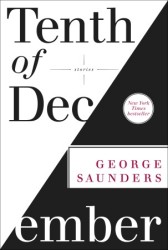 George Saunders’ Tenth of December (2013). Saunders has been getting movie-star publicity lately. The release of this book earlier this year was treated like the arrival of the latest Batman movie. His stories are rooted in pop culture, technology and current affairs and written in various styles. One story is in the form of a corporate memo involving personal confession; another is a series of shorthand diary entries by a man who tries to bring his family’s life up to the level of affluent neighbors. In fact, most of the stories are about downwardly mobile people trying to survive. Class and status distinctions abound. Most of the stories are sad, some are jarringly violent; and most have ambiguous endings. Here’s a link to a half-hour Saunders interview, where Saunders talks about his writing. I liked his description of how he edits until he gets “jangly sentences.” http://www.charlierose.com/view/interview/12757
Junot Diaz’ This Is How You Lose Her (2012). Diaz also has celebrity status as a writer; he’s a 2012 MacArthur Fellow and his 2008 novel The Brief Wondrous Life of Oscar Wao won the Pulitzer Prize for Fiction. His new book is a series of loosely linked stories about love and trying to make it work, involving the immigrant experiences of Dominican-Americans. His writing is a blend of Spanglish and streetwise slang and becomes more formal in the stories about his older characters. The stories have a strong autobiographical feel, although Diaz does not describe them that way. My favorite is “Invierno,” the story of a Dominican family’s arrival in their new New Jersey home in the middle of a snowstorm. The two brothers Rafa and Yunior yearn to be outside and play with the gringo kids, but their father does his best to keep them inside.
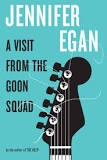 Jennifer Egan’s A Visit From the Goon Squad (2010). This book of short fiction is a series of interlocking stories that stand alone or read novelistically. The leading characters are Bennie, a former punk rocker turned record executive, and Sasha, the young woman he employs, who goes through several incarnations and ends up living with husband and two children in the California desert. One story, by the way, is a PowerPoint presentation on “Great Rock and Roll Pauses” by Sasha’s daughter. The stories play out over a period of 50 years or more, with characters evolving and linking back and forth. The last story ends in a mass musical event on the site known as the Footprint, where the World Trade Centers once stood. This is a really creative work of short fiction.
Stuart Dybek’s The Coast of Chicago (1990), I Sailed With Magellan (2003), and Childhood and Other Neighborhoods (1980). Dybek is my favorite short story writer and one of my favorite writers. The Coast of Chicago was the 2004 selection for One Book, One Chicago. His writing, his characters, his geography are so quintessentially Chicago that his books would make me homesick if I didn’t live here. He also has two wonderful books of Chicago poems: Streets in Their Own Ink (2004) and Brass Knuckles (1979). I’m going to devote a whole essay to Dybek in the near future, so I will save my commentary for that.
 T. Coraghessan Boyle’s Greasy Lake & Other Stories (1985), and Wild Child and Other Stories (2010). T.C. Boyle is a witty and imaginative writer. His stories are rarely realistic but always fascinating. I guess I should confess that I picked up Greasy Lake in a bookstore because of the title — it’s the name of a fictional place in a Bruce Springsteen song, “Spirit in the Night,” from his first album Greetings from Asbury Park (1972). Boyle’s characters include an Elvis impersonator, a presidential staffer who facilitates Ike’s steamy affair with Nina Khrushchev (I said this was fiction, didn’t I?), and a blues musician who may be Robert Johnson. And that’s just in Greasy Lake & Other Stories. Wild Child includes many stories published in literary magazines and “Best of” compilations. His writing is colorful and often poetic. Boyle’s stories are so delicious that looking them over for this post made me want to read them all over again.
Here’s a random sample of Boyle’s prose: “Robert’s dream is thick with the thighs of women, the liquid image of songs sung and songs to come, bright wire wheels and sloping fenders, swamps, trees, power lines, and the road, the road spinning out like string from a spool, like veins, blood and heart, distance without end, without horizon.”
The Best in Rock Fiction (2005), edited by June Skinner Sawyers, introduction by Anthony DeCurtis. This is a book of short stories and excerpts from longer works by writers who have a rock and roll sensibility, as Sawyers says in her preface. “I want to capture the way rock sounds on the page, its unpredictability, the possibility that anything could happen,” she says. Some of the writers whose work is included are Nick Hornby, Don DeLillo, T.C. Boyle, Stephen King and Jonathan Lethem. Some of my favorites from this book are “White Noise” by DeLillo, an excerpt from “Eddie and the Cruisers” by P.F. Kluge, and an excerpt from Hornby’s book High Fidelity. “The Girl Who Sang With the Beatles” by Robert Hemenway is a wistful 1960s story about Cynthia, who is mesmerized by the Beatles’ music, and her husband, Larry, who prefers foreign movies and chamber music. For a while, they each listen to their own music on separate stereo headphones but at the end, Larry enters into her Beatles world.
I should acknowledge that June is a Chicago writer and a personal friend. See more about her work here http://www.illinoisauthors.org/authors/June_Sawyers.
Finally, here are some comments about short stories by an English journalist in Metro, a London version of Chicago’s Red Eye. The news peg is that the Costa Awards decided to add the short story to its traditional literary prize genres. http://nyti.ms/YR01ac
“The commercial reality is that short stories simply don’t shift as well as novels. People can argue – as many do – that the espresso-style adrenalin shot the genre offers is perfectly suited to today’s on-the-move culture and that new digital technology can support the form in the way traditional magazines used to. But the evidence remains that you are more likely to buy the new, unevenly reviewed JK Rowling for a friend for Christmas than Junot Díaz’s new, excellently received collection of short stories.”
Do you agree? Join me in becoming a short story fan.
Yes for “No” + Holy Motors + Goodbye Solo
Posted: April 9, 2013 Filed under: Movies, Politics | Tags: Chile, Gael Garcia Bernal, Goodbye Solo, Holy Motors, No, the film 1 CommentIn my continuing quest to tell you about pop culture that the mainstream media generally ignores, here are three terrific films. One is still in theaters and the other two are available on DVD.
No. 2012. Directed by Pablo Larraín. Spanish with subtitles. Nominee for best foreign film Oscar. Run time 1 hour, 45 minutes. This film will certainly be on a lot of best-of-2013 lists and it’s still in theaters.
September 11 was a day of infamy for Chile long before it was for the US. On that date in 1973, the democratically elected socialist government of Salvador Allende was overthrown in a military coup led by General Augusto Pinochet, who led Chile’s government for the next 15 years. (Allende was either assassinated or committed suicide, depending on whose side you believe.) This historical background is introduced briefly at the beginning of the film, which is fact-based.*
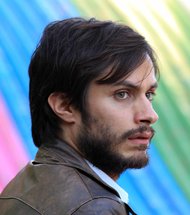 In 1988, Pinochet agrees to international pressure for Chile to have a plebiscite on whether he should govern for another eight years and a Yes/No election is planned. Both sides are to have 15 minutes of national television time each night. (What a brilliant way to solve the campaign finance problem.) The leftists on the No side want to make TV commercials showing the torture, murder and disappearances of the Pinochet regime. But René Saavedra, a clever advertising executive, played by Gael Garcia Bernal, reluctantly agrees to help the left with its No campaign. People either don’t remember or don’t want to remember those days, he tells them. They want to believe they will be happy in the future. So the No campaign mounts a “Happiness Is No” campaign, complete with rainbow logos, theme songs, banners, parades and t-shirts. (Photo by Tomás Dittburn/Sony Pictures Classics)
You could argue this is a putdown of commercial advertising invading political discourse. Or you could just sit back and enjoy this clever satire on politics. The No side wins the plebiscite and the film ends in celebration. In fact, Pinochet had a behind-the-scenes role for years afterward.
The film is shot in smudgy color that feels like you’re watching an old videotape. There are other well-known Latin American actors besides the oh-so-darling Garcia Bernal, whose character is a mix of naïve and radical. You’ve seen him in Y Tu Mamá También, The Motorcycle Diaries, Bad Education, The Crime of Padre Amaro, and many other Pedro Almodovar films.
* The film has generated some controversy in Chile, of course. Described here. http://nyti.ms/12G358m
Holy Motors. 2012. Fantasy drama film written and directed by Leos Carax, starring Denis Lavant. French with subtitles. Get the DVD. Run time just under 2 hours. (July update: Holy Motors is now available streaming on Netflix.)
I hardly know where to start describing this. Lavant is M. Oscar, who lives 10 or 12 parallel lives or stories throughout the day and night of this film. He rides from gig to gig throughout Paris in a white stretch limo, which serves as dressing room, wardrobe and prop closet. His chauffeur Celine, a lovely woman with silver hair, apprises him of his appointments and keeps him on schedule.
He emerges from the limousine once as an old beggar woman, and again as a madman (M. Merde) who eats flowers stolen from a street market, then runs through the famous Paris cemetery, Pere Lachaise, where instead of names of famous people on tombstones, you see “visit my website at xxxxxx.com.” Other incarnations involve murder, simulated lovemaking in spandex, and a father-daughter interlude. You see why I said there’s no way to describe this film. Suffice to say, it’s a mesmerizing and beautiful film and you’ll be rewarded if you have patience. And … the title Holy Motors will make sense at the end. Kinda.
Roger Ebert gave it 3.5 stars in November and ended his review this way. “Here is a film that is exasperating, frustrating, anarchic and in a constant state of renewal. It’s not tame. Some audience members are going to grow very restless. My notion is, few will be bored.”
Goodbye Solo. 2008. Written and directed by Ramin Bahrani. On DVD. 90 minutes.
I’ve spent a lot of time in the Piedmont-Triad area of central North Carolina. So I was interested in this film set in Winston-Salem and Blowing Rock, a beautiful state park where I’ve hiked with my son. Solo is a Senegalese immigrant taxi driver who befriends William, a depressed old man, who hires Solo for a one-way trip to Blowing Rock.
Solo arranges to drive William whenever he calls the taxi company and tries to involve him in life in Winston, including meeting his pregnant wife and her daughter Alex. Solo worries about William’s plan for the trip to Blowing Rock, where it’s so windy “that if you throw a stick, it will fly back to you.” But he and Alex drive William to the park, and the last half hour involves the beautiful drive on the Blue Ridge Parkway and the visit to the park.
This is a small film, a sweet film (despite the ending). In a way, it represents how the area is changing with new immigrants like Solo making a home and a life. It’s not set in a taxi; you get acquainted with a lot of Winston-Salem and the region. This is Bahrani’s third film and I will be interested in seeing his other work.
Oh, Roger. The balcony is closed
Posted: April 5, 2013 Filed under: Digital life, Movies | Tags: Movies, Roger Ebert 2 CommentsI’m a cancer survivor. Twice. 16 years and counting. So I had particular empathy for Roger Ebert’s decade-plus battle with cancer. Despite his pain, many surgeries, and finally his inability to eat, drink or speak, he never flagged in his writing, film reviewing and outrage at political insanity. In 2012, he reviewed 306 films, his record. When he died yesterday, his tweet count was over 31,000.
He didn’t invent it, but he thrived on the internet, tweeting and blogging madly. He was one of the first people I followed on Twitter (just after Bruce Springsteen, who actually doesn’t tweet) and found him endlessly provocative. He didn’t just review and write about films. He also commented upon and provided links to items on important social issues and political controversies. He was an unreconstructed liberal and I valued his comments.
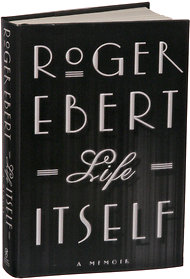 Something Roger said in his memoir helped get me started on this blog. I quote this on my What I Believe page. He said his blog taught him how to organize the accumulation of a lifetime. ”It pushed me into first person confession, it insisted on the personal, it seemed to organize itself into manageable fragments.” For Ebert, his blog was the beginning of writing his memoir, Life Itself (2011, Grand Central Publishing).
I did meet Roger and his wife Chaz once years ago at LAX. I was waiting to get home from a business trip and I knew they had been doing something much more glamorous in Hollywood. I had the opportunity to speak to him and I said something silly about a review he had written about a film I liked. I wished we could have had a longer conversation.
I regret not taking any of his film classes but reading his reviews ultimately was like listening to a film scholar. He was a humanistic reviewer. He wrote thoughtfully about the characters in the films he reviewed and often expressed insights that made a film and its people more meaningful. Recently I wrote here about This Must Be the Place, which is admittedly a rather weird film (just my type). A lot of reviews were negative or neutral at best. But Roger made an effort to help us understand Cheyenne, the aging glam rock star, and his sadness, a part totally inhabited by Sean Penn. https://nancybishopsjournal.com/2013/03/21/whats-showing-not-for-the-faint-of-heart/
Roger introduced me to many types of films, and showed me how to appreciate the skills of directors as well as cinematographers and other production staff. He wrote about the work of Andrew Sarris, whose concept of the director as “auteur,” or the true author of the film, is important in contemporary film viewing and in encouraging us to follow the work of certain directors.
I always loved movies, from the time I was old enough to walk to the Montclare Theater on Grand and Harlem with my friends Carol and Dolores. When we were in high school, we went to the Mercury Theater on North Avenue and Harlem, where we could smoke in the bathroom and flirt with boys from other high schools. Movies were more than entertainment.
After I subscribed to Netflix and had access to its large film archive, I was able to visit or revisit many classic, foreign and indie films that I had either seen in decades past or missed entirely. I started catching up on the great directors I had missed, reading Roger’s reviews as I went along. It was fun to read his early reviews of great directors like Altman, Antonioni, Bergman, Bunuel, Fellini, Kieslowski, Lang, Scorcese and Welles and later reviews of some of my favorite contemporary madmen like Pedro Almodovar, Guy Maddin, Christopher Guest, Jim Jarmusch, Kevin Smith and Quentin Tarantino. (What would I do without imdb.com, the wayback machine for movie junkies?)
Of all the obits and encomiums about him, one of my favorites is the editorial on the back of the special Roger Ebert wraparound section in today’s Chicago Sun-Times. It’s titled “Do you love what you do?” and describes how Roger did. And we all should.
There are many fine film reviewers today, like Tony Scott. Peter Travers, David Edelstein, Dana Stevens and Mick LaSalle. But none of them will replace Roger. Because the balcony is closed.
———————————–
If you’d like behind-the-scenes insights about the Siskel and Ebert TV era, I recommend an ebook titled Enemies, A Love Story: The Oral History of Siskel and Ebert by Josh Schollmeyer. It’s a series of interview quotes about every aspect of their TV history from many of the people they worked with. The ebook is published by Now and Then Reader, which publishes original short-form nonfiction in digital formats. See their site at nowandthenreader.com.
Coriolanus on stage and screen
Posted: April 3, 2013 Filed under: Movies, Theater | Tags: Coriolanus, Ralph Fiennes, Shakespeare, The Hypocrites Theatre Leave a comment The Hypocrites is presenting an inventive version of a not-often-performed Shakespeare play, Coriolanus, at Chopin Theatre. The audience sits around the small performing space and feels very much involved in the verbal and physical confrontations that occur. (I’d call it theater in the round, but that suggests a stage with people separated from the actors. We were really on stage. I had to keep my feet tucked under my chair to keep them out of the action.)
You get a real sense of the combination of warmth and animosity from the verbal and physical byplay between the Roman warrior Caius Martius (later Coriolanus) and Aufidius, general of the Volscians, enemy of Rome. The cast is uniformly good and the fight choreography is well done, if occasionally threatening to the audience. One aspect of costuming looked strange to me. The Roman elites are wearing suits that made them look like carnival barkers or English skiffles musicians. Plaid trousers, big patterned lapels and even some cummerbunds. Very odd look. Or perhaps I was missing the meaning that the costume designer intended.
The play is trimmed from its Shakespearean length to a tight hour and 45 minutes, with no intermission. Coriolanus runs at The Hypocrites until April 23, so you have no excuse for missing it.
So I went home that day, after a Sunday afternoon performance, thinking of the film version of Coriolanus that I had seen recently. And I found it was streaming on Netflix. So I watched Coriolanus for a second time that day. The film is just over two hours and stars Ralph Fiennes* as Coriolanus, Gerard Butler as Aufidius and Vanessa Redgrave as Volumnia, Caius Martius’ ferocious mother.
The film is terrific and I recommend it highly, either with or without the stage version. The film is set in the current era, with soldiers in camouflage wear and characters viewing battlefield coverage and Roman protestors on Fidelis TV. It was filmed mostly in Serbia and has the film advantage of showing Caius Martius, banished from Rome (yes, I’ve skimped on the plot details here), trudging down highways and fields toward the Volscians.
Coriolanus is one of Shakespeare’s last plays but it is not usually ranked among his best, even though T.S. Eliot famously preferred it to Hamlet. But the film version is gripping and worth watching.
Caius Martius is not a reflective person. He is dominated by his mother, who treats him like a child warrior. Harold Bloom describes him as a “battering ram of a soldier” and does not include him in his description of Shakespearean characters who “invent the human.” Bloom describes Hamlet as the avatar of the man who reflects upon and celebrates his inner self. Caius Martius does none of that.
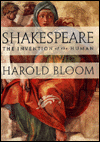 Book note for Shakespeare fans. I strongly recommend Harold Bloom’s insightful book Shakespeare: The Invention of the Human (Riverhead Books, 1998), in which he devotes a chapter to each of the Bard’s plays and explores leading characters. It’s a book you will always want to consult after viewing Shakespeare – on stage or screen.
———————————-
* I had seen Fiennes portray Coriolanus before. I quote from my post celebrating the magic of live performance, Live or Memorex, November 2012: “One of my cherished theater memories is seeing Ralph Fiennes play Coriolanus at the Almeida Theatre in London. It was a very warm June and I got a last-minute front-row seat. Fiennes was wearing a heavy wool uniform and dripping sweat. I was mesmerized by the sweat as well as by the performance.” https://nancybishopsjournal.com/2012/11/10/live-or-memorex/#more-236
 nancy bishop's journal